


Democratic Progressive Party (DPP) presidential candidate Tsai Ing-wen (蔡英文) yesterday canvassed the streets of Nantou, Changhua and Taichung to solicit support in difficult constituencies, calling on voters to concentrate all their votes for the party and its candidates.
On the first leg of her campaign tour yesterday in Nantou’s Jhong Sing New Village (中興新村) to stump for DPP legislative candidates Tsai Huang-liang (蔡煌瑯) and Chang Kuo-hsin (張國鑫), Tsai Ing-wen was greeted by a crowd of overseas Taiwanese and business leaders, who held placards showing where they came from and expressed support for Tsai Ing-wen and the DPP’s candidates.
“Nantou is Taiwan’s heartland, and the local constituencies are a decisive battlefield and a key election indicator. It bodes well for the election if Nantou shows good results,” Tsai Ing-wen said.
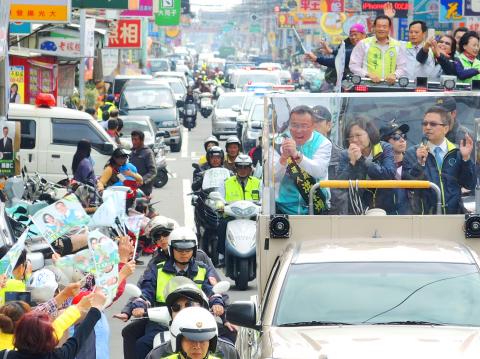
Photo: CNA
Dubbing a contingent of overseas supporters the “the Ing overseas clique,” she urged overseas Taiwanese to return to vote in the presidential and legislative elections on Saturday to be part of the nation’s progress.
Describing the DPP as “the No. 1 brand of reform,” she called on voters to cast their legislator-at-large votes for the party, saying the DPP’s lineup of candidates is a good representation of a progressive force that deserves a mandate.
She also asked DPP supporters not to split their votes with other parties, but instead concentrate their votes for the DPP and its candidates to achieve a DPP majority in the legislature.
In response to reporters’ questions about what difference it would make to Taiwan’s male-dominated political sphere if she is elected president, Tsai Ing-wen said, in English: “At least we get to prove this a place where we address and then achieve gender equality.”
On her relations with China and dealing with Chinese President Xi Jinping (習近平), she said: “It is a matter of communication, communication and communication.”
Her motorcade procession later toured the streets of downtown Nantou and Changhua’s Shim (溪湖) and Yanpu (鹽埔) townships, which were lined with supporters waving flags and setting off firecrackers.
The procession was later greeted by a colder crowd at the embattled Shalu District (沙鹿) in Taichung, where DPP legislative candidate Chen Shih-kai (陳世凱) is pitted against KMT Legislator Yen Kuan-hen (顏寬恆), who is seeking re-election, so the motorcade made a detour to the district to improve Chen’s chance of election en route to Changhau’s Yuanlin Township (員林), where a nighttime rally was held.
Thousands of DPP supporters braved the rain to attend the rally, the focus of which was seeking a sweeping majority to ensure the first power transition in the legislature and electing the first female president.
Tainan Mayor William Lai (賴清德) encouraged voters to cast their votes regardless of the weather to ensure that Tsai Ing-wen becomes the president elected with the highest number of votes in Taiwan’s history.
Saying she had some of her happiest moments when she saw the DPP overturn the KMT administration in Changhua in the nine-in-one elections in 2014, Tsai Ing-wen said the last mile to bring about the complete transition of power is a few days away, while reiterating that voters should concentrate their votes on the DPP.
She promised a DPP administration would treat cities and counties ruled by the KMT and by the DPP equally, including New Taipei City, where KMT presidential candidate Eric Chu (朱立倫) serves as mayor.

UPGRADE: The Kang Ding-class frigate is replacing its Chaparall missiles with Tien Chien II and Hua Yang VLS, which would provide it with long-range, 360° air defense Taiwan plans to produce 1,200 to 1,376 Hai Chien II missiles (海劍二, Sea Sword II) — also known as TC-2N — to serve as the standard air defense system of the navy’s surface combatant fleet, a source said yesterday. Last week, the Hai Chien II, the naval version of the Tien Kung II missile (天劍二, Sky Sword II), completed a live-fire test in waters off the National Chungshan Institute of Science and Technology’s Jiupeng facility (九鵬) in Pingtung County’s Manjhou Township (滿州). The MIM72 Chaparral and other dated air defense missiles that currently arm Taiwanese ships have inadequate range to combat Chinese

REASONS FOR TRAVEL: An assistant professor said that proposed amendments to penalize drivers if they used drugs overseas would not deter people from traveling People who operate a motor vehicle under the influence of marijuana would have their driver’s license revoked, even if they used the substance while overseas, the Ministry of Transportation and Communications said yesterday, citing proposed amendments to the Road Traffic Management and Penalty Act (道路交通管理處罰條例). The amendments would also authorize the government to revoke the licenses of people determined to have used Category 1 or Category 2 narcotics, even if they were not operating a vehicle while under the influence of drugs, as well as ban them from taking the license test for three years, the ministry said. People aged 18 or

HEAVY WEATHER: Typhoon Jangmi is due to crash straight into the Ryukyus as airlines look to shift flights to larger aircraft or cancel flights to Okinawa entirely Taiwan’s international air carriers announced flight adjustments over the weekend as Typhoon Jangmi is forecast to hit the Ryukyu Islands today and tomorrow. The Central Weather Administration (CWA) upgraded Jangmi from a tropical storm to a typhoon at 8am yesterday, with the eye located 580km south of Naha city. It was moving north at 19kph. Today, China Airlines’ CI-120, CI-121, CI-122 and CI-123 flights between Taoyuan and Naha, Okinawa, have been canceled as well as CI-132 and CI-133 between Kaohsiung and Naha. EVA Air’s BR-112, BR-113, BR-186 and BR-185 flights between Taoyuan and Naha are also canceled. Low-cost carrier Tigerair Taiwan canceled IT-230,
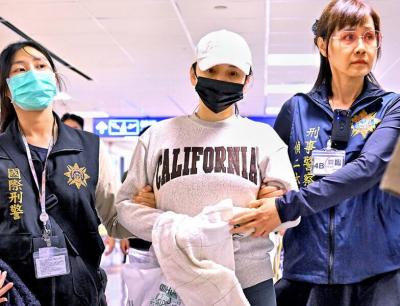
Johanne Liou (劉喬安), a Taiwanese woman who shot to unwanted fame during the Sunflower movement protests in 2014, returned to Taiwan last night after being deported from the US. She is to stand trial in Taiwan for charges involving embezzlement, fraud and drug crimes. The Criminal Investigation Bureau (CIB) said it took her into custody at Taiwan Taoyuan International Airport and would first question her before transferring her to the New Taipei District Prosecutors’ Office. She was arrested upon disembarking a flight from San Francisco that landed shortly before 7pm. Liou absconded to the US in 2019 after jumping bail


 RSS
RSS