


Liberty Times (LT): Taiwanese films won in 12 categories at the latest Golden Horse Awards, which is a majority of the categories. By all appearances, it was a successful performance, but directors Hou Hsiao-hsien (侯孝賢) and Ang Lee (李安) said Taiwanese films did not win enough awards. What is your take?
Wu Nien-jen (吳念真): What does it matter how many awards were or were not won? The Golden Horse has an ongoing struggle with an identity crisis, although it should be said that it is improving in that regard.
In the past, the Golden Horse consistently rewarded Mandarin-language films and it is tough for Hoklo-language [commonly known as Taiwanese] films to participate. For example, Dust in the Wind (戀戀風塵) had very few lines in Mandarin and was licensed as a Hoklo-language film; it was very nearly excluded from the Golden Horse Awards.
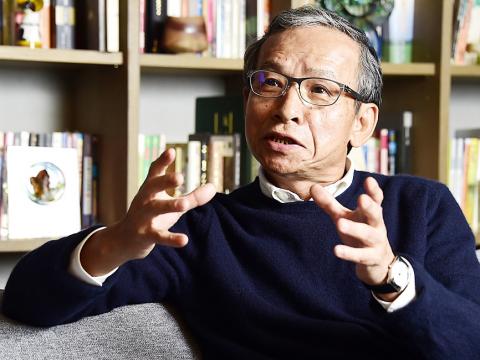
Photo: Pan Shao-tang, Taipei Times
In earlier times, the Golden Horse had a strong political flavor. Patriotic, anti-communist films were guaranteed to win an award. There was one year when they awarded the best film to a movie that was not even considered for best director or best screenplay. Now the Golden Horse is more fair and open.
I think Hou and Lee said Taiwan did not win enough awards as an exhortation, because we did not try hard enough and we were not productive enough. This is a warning: If you do not fight, you do not gain.
LT: What do you think the future holds for the Golden Horse Awards? What could be done better?
Wu: When a film festival grows a personality, roll with it. My suggestion would be making the deliberations of the judges more transparent and emphasize its fairness and objectivity, so that people would understand the reasoning behind decisions.
LT: If you are chosen as a judge for the next Golden Horse Awards, what would you do?
Wu: In its defense, the Golden Horse Awards has done well in recent years. They have good judges. The awards have a broader perspective and are more open-minded than in the past. Once we have made certain that the event’s reputation is established in Taiwan, Hong Kong and China, I would not be too concerned with the nationality of the event’s participating films.
LT: There is a huge market and a lot of capital in China. Many talented young people are going to China because they do not want to be constrained by Taiwan’s funding and business environment. What do you think is the way forward for the next generation of Taiwanese directors?
Wu: You have to accept reality. Filmmaking cannot be caged in Taiwan. How are you going to make Ang Lee films in Taiwan? Was his brain not drained?
Saying this might offend people, but filmmaking is nothing special. You chose something; you have to live with it. It is like founding a theater company; you should not crank them out left and right just to make the government subsidize you. You are not some big shot who is better than everybody else, you chose this.
We were the people who got the government to subsidize cinema in the first place. At the time, our thinking was, helping one good film to the international stage is better than sending 10 diplomats. Artistic films often have trouble convincing studios agents, because many of those agents do not know about film art. So we need the government to provide funding to directors with potential to shoot films for the international stage; but it eventually became a game for spoils.
I believe Taiwan’s dilemma is the small market, unlike Chinese cinema. Chinese cinema is a world to itself. With 1.3 billion people, a blockbuster can make a lot of money. Taiwan has 23 million people, which is too small. If filmmaking does not expand beyond the local market, it does not have a fighting chance.
LT: Access to the Chinese market is not that easy for Taiwanese films. Do you think the government has a role to play?
Wu: Negotiate with Beijing, go talk to them; if there is freedom on both sides, the markets can make exchanges across the divide.
But politics as always is a stumbling block. We have restrictions on imports from China and, of course, they have restrictions on our exports. They might also censor the content. Once there are restrictions like this, freedom is diminished.
If China can become a free market that Taiwan can participate in, then that is something we could sink our teeth into.
LT: After the Jan. 16 elections, what do you hope for film and cultural policy?
Wu: How the government could help the film industry is the same talk I have heard time and again for 40 years. My answer is the same: “The government? I am grateful if they do not mess me up!”
The government should help from a good vantage point, such as imports of equipment, taxation, a transparent system of tallying box office sales instead of taking the studio’s word for it and an expedited process for getting foreign technicians work permits in Taiwan.
LT: Film director Ko I-chen (柯一正) and metal band Chthonic’s Freddy Lim (林昶佐) are participating in the legislative elections. What are your thoughts on that?
Wu: Ko is correct in his thinking that the blue and green camps are from the same political networks and neither have the time of day for new challenges. Ko thinks that having fresh people in the legislature might give us a new voice, and that is not so bad. We should encourage them, but not individually. Votes should be distributed to maximize the New Power Party’s gains, to send more [of their candidates] to the legislature.
From another perspective, Taiwan has already started on a new direction. Fresh faces showed through last year’s Nov. 29 county commissioner and city mayor elections, and youthful vitality cannot be contained. If political parties do not respect that, they will die horribly. I have heard some young friends — and even a few stubborn old gentlemen — who said the elections are already over and voting is unnecessary.
LT: The government is promoting “cultural and creative” [industry] more than cinema. Hou said the cultural and creative industry is a sham. What do you think?
Wu: I agree. I am sick and tired of the phrase. How can you be “culturally creative” when you have no creativity? I think it is a bunch of maniacs blabbering nonsense. I do not know a single thing they “culturally created.” Drawings on T-shirts is called “culturally creative?” Idiots. There is no vision in what the government is supporting. It is idiocy.
LT: In comparison to the mass production of the cultural and creative industry, the documentary Fly, Kite Fly (老鷹想飛) took 23 years to make. Why did you volunteer to do voiceover work on it without pay?
Wu: They had their work cut out for them, so I helped any way I could. The central figure in the documentary, Mr Eagle, Shen Chen-chung (沈振中), was one of my subjects in [the book] Nien-jen on Taiwan (台灣念真情). The people left in Taiwan who are still willing to spend this kind of time to do something deserve encouragement. They know what they do might swallow their fortunes and they still give it all they have. That is why seeing politicians puts me in a mood fit for a rampage; they have no heart for work. They do everything for an angle, to advance their careers and self-interest.
Translated by Jonathan Chin, staff writer.

Considering that most countries issue more than five denominations of banknotes, the central bank has decided to redesign all five denominations, the bank said as it prepares for the first major overhaul of the banknotes in more than 24 years. Central bank Governor Yang Chin-lung (楊金龍) is expected to report to the Legislative Yuan today on the bank’s operations and the redesign’s progress. The bank in a report sent to the legislature ahead of today’s meeting said it had commissioned a survey on the public’s preferences. Survey results showed that NT$100 and NT$1,000 banknotes are the most commonly used, while NT$200 and NT$2,000

The Centers for Disease Control (CDC) yesterday reported the first case of a new COVID-19 subvariant — BA.3.2 — in a 10-year-old Singaporean girl who had a fever upon arrival in Taiwan and tested positive for the disease. The girl left Taiwan on March 20 and the case did not have a direct impact on the local community, it said. The WHO added the BA.3.2 strain to its list of Variants Under Monitoring in December last year, but this was the first imported case of the COVID-19 variant in Taiwan, CDC Deputy Director-General Lin Ming-cheng (林明誠) said. The girl arrived in Taiwan on

South Korea is planning to revise its controversial electronic arrival card, a step Taiwanese officials said prompted them to hold off on planned retaliatory measures, a South Korean media report said yesterday. A Yonhap News Agency report said that the South Korean Ministry of Foreign Affairs is planning to remove the “previous departure place” and “next destination” fields from its e-arrival card system. The plan, reached after interagency consultations, is under review and aims to simplify entry procedures and align the electronic form with the paper version, a South Korean ministry official said. The fields — which appeared only on the electronic form

The Ministry of Foreign Affairs (MOFA) is suspending retaliation measures against South Korea that were set to take effect tomorrow, after Seoul said it is updating its e-arrival system, MOFA said today. The measures were to be a new round of retaliation after Taiwan on March 1 changed South Korea's designation on government-issued alien resident certificates held by South Korean nationals to "South Korea” from the "Republic of Korea," the country’s official name. The move came after months of protests to Seoul over its listing of Taiwan as "China (Taiwan)" in dropdown menus on its new online immigration entry system. MOFA last week


 RSS
RSS