


The Democratic Progressive Party (DPP) Central Standing Committee yesterday passed a list of non-DPP legislative candidates to support, with an eye on uniting their efforts to defeat Chinese Nationalist Party (KMT) nominees.
“Considering the overall situation heading into the legislative elections, the Campaign Strategy Committee suggested that the DPP support legislative candidates in constituencies where it is expected to be difficult for the party to win,” Campaign Strategy Committee convener Su Jia-chyuan (蘇嘉全) said at a meeting in Taoyuan. “We seek to cooperate with them as allies, with victory in the elections our ultimate goal.”
The “allies” chosen by the Campaign Strategy Committee include New Power Party legislative nominees Huang Kuo-chang (黃國昌) in New Taipei City’s 12th electoral district, Freddy Lim (林昶佐) in Taipei’s fifth electoral district, Hung Tzu-yung (洪慈庸) in Taichung’s third electoral district, as well as People First Party candidate Vivian Huang (黃珊珊) in Taipei’s fourth electoral district, Green Party-Social Democratic Party candidate Fan Yun (范雲) in Taipei’s sixth electoral district and Taiwan Solidarity Union nominee Liu Kuo-lung (劉國隆) in Taichung’s fifth electoral district.
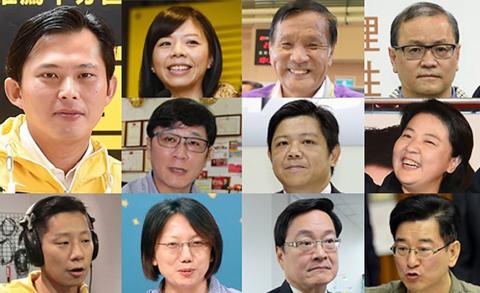
Photo: Taipei Times
Also among the allies are independent candidates Lee Hsing-chang (李幸長) in New Taipei City’s ninth electoral district, and in Taipei: Billy Pan (潘建志) in the third electoral district, Yang Shih-chiu (楊實秋) in the seventh, Lee Ching-yuan (李慶元) in the eighth, as well as Chao Cheng-yu (趙正宇) in Taoyuan’s sixth electoral district.
Su’s proposal received overwhelming support in the Central Standing Committee meeting, which adopted it immediately.
“The DPP supports candidates who would most threaten a KMT victory, without the precondition that the candidate must support the DPP’s presidential candidate in return,” DPP spokesperson Yang Chia-liang (楊家俍) said. “We would negotiate with them to see how we could cooperate in the election.”

Photo: CNA

POLAM KOPITIAM CASE: Of the two people still in hospital, one has undergone a liver transplant and is improving, while the other is being evaluated for a liver transplant A fourth person has died from bongkrek acid poisoning linked to the Polam Kopitiam (寶林茶室) restaurant in Taipei’s Far Eastern Sogo Xinyi A13 Department Store, the Ministry of Health and Welfare said yesterday, as two other people remain seriously ill in hospital. The first death was reported on March 24. The man had been 39 years old and had eaten at the restaurant on March 22. As more cases of suspected food poisoning involving people who had eaten at the restaurant were reported by hospitals on March 26, the ministry and the Taipei Department of Health launched an investigation. The Food and

A fourth person has died in a food poisoning outbreak linked to the Xinyi (信義) branch of Malaysian restaurant chain Polam Kopitiam (寶林茶室) in Taipei, Deputy Minister of Health and Welfare Victor Wang (王必勝) said on Monday. It was the second fatality in three days, after another was announced on Saturday. The 40-year-old woman experienced multiple organ failure in the early hours on Monday, and the family decided not to undergo emergency resuscitation, Wang said. She initially showed signs of improvement after seeking medical treatment for nausea, vomiting and diarrhea, but her condition worsened due to an infection, he said. Two others who
MEDICAL: The bills would also upgrade the status of the Ethical Guidelines Governing the Research of Human Embryos and Embryonic Stem Cell Research to law The Executive Yuan yesterday approved two bills to govern regenerative medicine that aim to boost development of the field. Taiwan would reach an important milestone in regenerative medicine development with passage of the regenerative medicine act and the regenerative medicine preparations ordinance, which would allow studies to proceed and treatments to be developed, Deputy Minister of Health and Welfare Victor Wang (王必勝) told reporters at a news conference after a Cabinet meeting. Regenerative treatments have been used for several conditions, including cancer — by regenerating blood cells — and restoring joint function in soft tissue, Wang said. The draft legislation requires regenerative treatments

Taiwanese should be mindful when visiting China, as Beijing in July is likely to tighten the implementation of policies on national security following the introduction of two regulations, a researcher said on Saturday. China on Friday unveiled the regulations governing the law enforcement and judicial activities of national security agencies. They would help crack down on “illegal” and “criminal” activities that Beijing considers to be endangering national security, according to reports by China’s state media. The definition of what constitutes a national security threat in China is vague, Taiwan Thinktank researcher Wu Se-chih (吳瑟致) said. The two procedural regulations are to provide Chinese


 RSS
RSS