


The government does not do enough to support talented classical musicians, award-winning violinist Tseng Yu-chien (曾宇謙) says.
Tseng, 21, won a silver medal in the violin category of the XV International Tchaikovsky Competition in Moscow in July. Tseng was in effect the top winner in the violin category as there was no candidate nominated for the gold medal.
He is scheduled to perform with the Munich Philharmonic Orchestra, led by Russian conductor Valery Gergiev, at the National Concert Hall in Taipei tonight and tomorrow night.
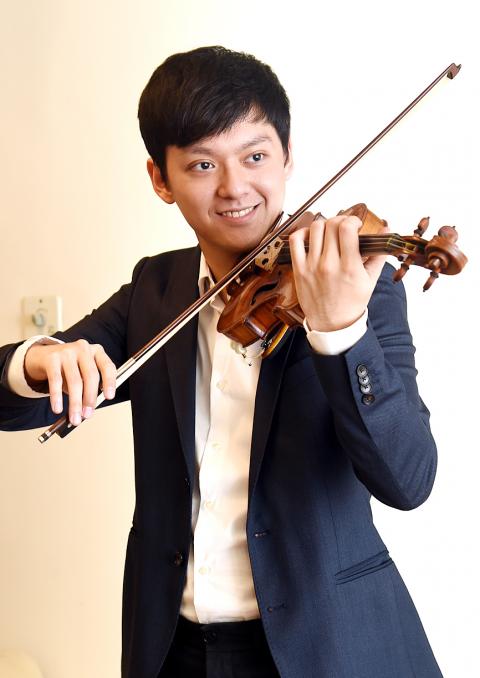
Photo: Sung Chih-hsiung, Taipei Times
Tseng praised the policies of former Council of Cultural Affairs director Tchen Yu-hsiu (陳郁秀), especially the establishment of the Music Talent Tank, a program which he said had been compromised by well-meaning reforms.
“Previously, the Music Talent Bank had an elitist strategy, and concentrated its resources on a small number of music students who had shown talent and potential. However, its selection process was later criticized for being unfair, and it was overhauled along egalitarian lines,” Tseng said.
The reforms did away with financial aid and travel subsidies that the government previously gave to young classical musicians to help them compete in international competitions, Tseng said.
“Now, even the most talented and successful musicians must fend for themselves... If the selection process was flawed, then reforms should have improved that instead of shutting down a program that was doing good work,” Tseng said.
In contrast, South Korea’s policies toward classical music contributed to the outstanding performance of their musicians, among them violinist Lim Ji-young, who this year won first prize at the Queen Elisabeth Music Competition in Belgium, and Cho Seong-jin who won this year’s International Chopin Piano Competition in Poland.
“South Korean musical academies are not as watered-down as ours; they concentrate their resources in the same place. Taiwan pays a lot of attention to creating a superficial impression of egalitarianism, but the reality is that not everybody is equipped to be superb, and the result of spreading the butter everywhere is that we are hard-pressed to cultivate internationally competitive musicians,” he said.
Tseng said that his own experiences led him to conclude that the government does not value high culture.
“A lot of folks said the Tchaikovsky competition is the classical music equivalent of the Olympics, but after having won it and returning home, the government did not recognize my efforts in any substantial way,” Tseng said, calling on the government to treat classical musicians and artists who win internationally renowned competitions in the same way it rewards athletes.
Tseng performed at this year’s International Tchaikovsky Competition using a violin loaned from the Chimei Museum which was crafted by Italian luthier Giuseppe Guarneri between 1730 and 1734.
The museum, located in Tainan, said it is honored that one of its violins helped Tseng win the medal in the prestigious competition, adding that it has 1,362 violins in its collection and has allowed more than 3,000 violinists to borrow more than 220 of them over the past decade.

Considering that most countries issue more than five denominations of banknotes, the central bank has decided to redesign all five denominations, the bank said as it prepares for the first major overhaul of the banknotes in more than 24 years. Central bank Governor Yang Chin-lung (楊金龍) is expected to report to the Legislative Yuan today on the bank’s operations and the redesign’s progress. The bank in a report sent to the legislature ahead of today’s meeting said it had commissioned a survey on the public’s preferences. Survey results showed that NT$100 and NT$1,000 banknotes are the most commonly used, while NT$200 and NT$2,000

The Centers for Disease Control (CDC) yesterday reported the first case of a new COVID-19 subvariant — BA.3.2 — in a 10-year-old Singaporean girl who had a fever upon arrival in Taiwan and tested positive for the disease. The girl left Taiwan on March 20 and the case did not have a direct impact on the local community, it said. The WHO added the BA.3.2 strain to its list of Variants Under Monitoring in December last year, but this was the first imported case of the COVID-19 variant in Taiwan, CDC Deputy Director-General Lin Ming-cheng (林明誠) said. The girl arrived in Taiwan on

South Korea is planning to revise its controversial electronic arrival card, a step Taiwanese officials said prompted them to hold off on planned retaliatory measures, a South Korean media report said yesterday. A Yonhap News Agency report said that the South Korean Ministry of Foreign Affairs is planning to remove the “previous departure place” and “next destination” fields from its e-arrival card system. The plan, reached after interagency consultations, is under review and aims to simplify entry procedures and align the electronic form with the paper version, a South Korean ministry official said. The fields — which appeared only on the electronic form

The Ministry of Foreign Affairs (MOFA) is suspending retaliation measures against South Korea that were set to take effect tomorrow, after Seoul said it is updating its e-arrival system, MOFA said today. The measures were to be a new round of retaliation after Taiwan on March 1 changed South Korea's designation on government-issued alien resident certificates held by South Korean nationals to "South Korea” from the "Republic of Korea," the country’s official name. The move came after months of protests to Seoul over its listing of Taiwan as "China (Taiwan)" in dropdown menus on its new online immigration entry system. MOFA last week


 RSS
RSS