


Chinese Nationalist Party (KMT) presidential candidate Eric Chu (朱立倫) yesterday was expected to attend several closed-door meetings in Washington with US government officials.
While for diplomatic and protocol reasons, there was no official confirmation of his schedule, administration sources said that Chu would be “warmly welcomed” and treated much the same as Democratic Progressive Party presidential candidate Tsai Ing-wen (蔡英文) during her visit earlier this year.
Chu’s week-long visit to the US — highlighted by three days in Washington, is aimed at winning US support for his candidacy in the Jan. 16 presidential elections and in assuring Washington that if elected he would maintain peaceful cross-strait relations.
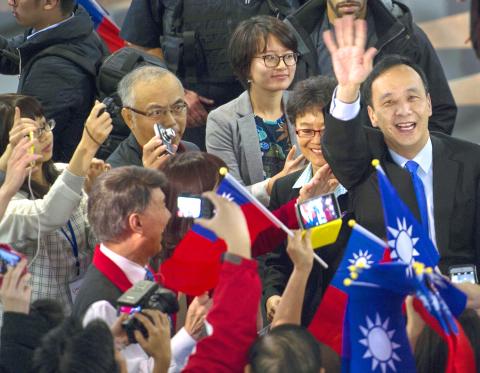
Photo: AFP
At a Wednesday night dinner given by Taiwanese-American supporters, Chu said that the so-called “1992 consensus” and its differing interpretations constituted the only way forward in relations with Beijing.
He said that the meeting between President Ma Ying-jeou (馬英九) and Chinese President Xi Jinping (習近平) on Saturday last week had established a foundation for peace in the future and that if elected he would work toward more cooperation with China.
He said that Taiwan should not be a “troublemaker.”
Chu’s delegation includes former representative to the US Jason Yuan (袁健生), former minister of foreign affairs Timothy Yang (楊進添) and former National Security Council deputy secretary-general Ho Szu-yin (何思因).
It was thought that Chu and members of his delegation would hold four separate meetings with officials from the US Department of State, the National Security Council (NSC), the Department of Defense.
Chu arrived in Los Angeles on Tuesday and flew to Washington on Wednesday.
At the State Department yesterday, Chu was expected to be seen by US Deputy Secretary of State Antony Blinken, US Assistant Secretary of State for East Asian Affairs Danny Russel and Deputy Assistant Secretary of State for East Asian and Pacific Affairs Susan Thornton.
They were likely to discuss the Ma-Xi meeting, cross-strait relations and the significance of the “1992 consensus,” which refers to a tacit understanding between the KMT and the Chinese government that both sides of the Taiwan Strait acknowledge there is “one China,” with each side having its own interpretation of what “China” means. Former Mainland Affairs Council chairman Su Chi (蘇起) admitted in 2006 to making up the term in 2000.
At the White House, Chu was expected to meet with NSC Senior Director for Asian Affairs Daniel Kritenbrink with future cross-strait relations at the top of the agenda.
Later, Chu was to visit the Pentagon for talks with US Assistant Secretary of Defense for East Asia Abraham Denmark.
It is speculated that the main topic of discussion would be Taiwan’s indigenous diesel electric submarine building program and possible US assistance.
Chu is also to visit Deputy US Trade Representative Robert Holleyman and conversation is likely to focus on Taiwan’s desire to join the Trans-Pacific Partnership trade deal.
Chu and his delegation were also to attend a reception hosted by Representative to the US Shen Lyu-shun (沈呂巡) at the Twin Oaks Estate.
Chu is scheduled today to meet privately with think tank experts at the Brookings Institution and talk with the editorial board of the Washington Post before flying to New York.
In New York he was planning to talk with the National Committee on American Foreign Policy, before heading to San Francisco and then returning to Taipei on Monday.
Washington-based analysts were surprised that Chu would not to make a public speech while in the US capital or answer questions from the press and academics at an open think tank conference.
Tsai gained wide-spread publicity during her visit by making a keynote address and answering questions at the Center for Strategic and International Studies.

Considering that most countries issue more than five denominations of banknotes, the central bank has decided to redesign all five denominations, the bank said as it prepares for the first major overhaul of the banknotes in more than 24 years. Central bank Governor Yang Chin-lung (楊金龍) is expected to report to the Legislative Yuan today on the bank’s operations and the redesign’s progress. The bank in a report sent to the legislature ahead of today’s meeting said it had commissioned a survey on the public’s preferences. Survey results showed that NT$100 and NT$1,000 banknotes are the most commonly used, while NT$200 and NT$2,000

The Centers for Disease Control (CDC) yesterday reported the first case of a new COVID-19 subvariant — BA.3.2 — in a 10-year-old Singaporean girl who had a fever upon arrival in Taiwan and tested positive for the disease. The girl left Taiwan on March 20 and the case did not have a direct impact on the local community, it said. The WHO added the BA.3.2 strain to its list of Variants Under Monitoring in December last year, but this was the first imported case of the COVID-19 variant in Taiwan, CDC Deputy Director-General Lin Ming-cheng (林明誠) said. The girl arrived in Taiwan on

South Korea is planning to revise its controversial electronic arrival card, a step Taiwanese officials said prompted them to hold off on planned retaliatory measures, a South Korean media report said yesterday. A Yonhap News Agency report said that the South Korean Ministry of Foreign Affairs is planning to remove the “previous departure place” and “next destination” fields from its e-arrival card system. The plan, reached after interagency consultations, is under review and aims to simplify entry procedures and align the electronic form with the paper version, a South Korean ministry official said. The fields — which appeared only on the electronic form

The Ministry of Foreign Affairs (MOFA) is suspending retaliation measures against South Korea that were set to take effect tomorrow, after Seoul said it is updating its e-arrival system, MOFA said today. The measures were to be a new round of retaliation after Taiwan on March 1 changed South Korea's designation on government-issued alien resident certificates held by South Korean nationals to "South Korea” from the "Republic of Korea," the country’s official name. The move came after months of protests to Seoul over its listing of Taiwan as "China (Taiwan)" in dropdown menus on its new online immigration entry system. MOFA last week


 RSS
RSS