


Pictures of a 262m-long and 15-story high bridge in the Sandimen (三地門) area and Majia (瑪家) and Neipu (內埔) townships in Pingtung County went viral on the Internet recently as it was hailed as the nation’s longest suspension bridge.
Called the glass bridge because of its glass surface, it was built 30m downriver from the site of an old bridge, and it spans the Ailiao River (隘寮溪).
The north side is close to an ancient trail near Sandimen and the south side is adjacent to the Aboriginal Cultural Park staff dormitory, officials said.
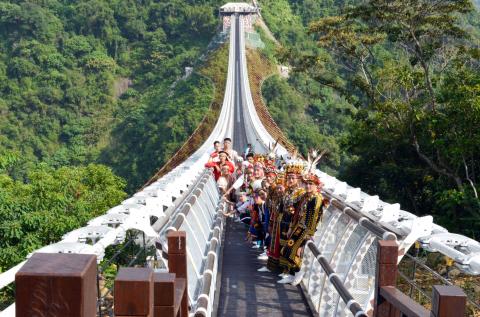
Photo provided by the Red Cross
Bridge designer Lee Chung-pin (李仲彬) said that the Sandimen suspension bridge is longer than the Fumei suspension bridge in Alishan (阿里山), which is 175m long.
The glass bridge was reportedly also the nation’s most expensive suspension bridge, with the maintenance catwalk alone costing NT$2 million (US$61,106).
The bridge has other unique aspects, such as anchoring below rocks on both sides and high-end construction materials, such as stainless steel that has been certified rust-resistant for about 150 years.
These features ensure the bridge is stable and does not move in the wind, Lee said.
Paiwan artist Sakuliu Pavavalung was invited by the county government to adorn the bridge with art that is representative of local Aborigines.
The bridge features a taro and a yam at both entrances, symbolic of the melding of Han and Aboriginal cultures.
The bridge itself features mosaics made by Beiyeh Elementary School and Timur Elementary School students, officials said.
The bridge has a maximum capacity of 100 people.
The county government has negotiated with the Aboriginal Cultural Park, the Neipu Agricultural-Industrial Vocational High School and the Water Resources Agency’s seventh river management office for about 700 parking spaces.
Pingtung County public transport is also to include the bridge on its routes.
With construction completed this month, the county government is set to open the bridge to the public next month, pending the results of safety inspections, the county government said, adding that to limit the flow of visitors on the bridge, a fee will be charged.
The Red Cross donated NT$53 million to help build the bridge, while the Executive Yuan’s Typhoon Morakot rebuilding association invested NT$9 million, primarily in the construction of roads and cultural adornments. The county government provided NT$3.5 million, and township offices also contributed to construction costs.
The county government said that it hoped the new bridge would serve the county as the old one did by attracting visitors to the region.
The old bridge had been a regional landmark since the Japanese colonial era and featured on postcards from the time, the county government said, adding that the new bridge could help connect tourist hotspots in northern Pingtung.
With a route that links Aboriginal communities to other regional sites in the area, such as St Mary’s Church in Wanjin Township (萬金), visitors can explore all that Pingtung has to offer, the county government said.

Considering that most countries issue more than five denominations of banknotes, the central bank has decided to redesign all five denominations, the bank said as it prepares for the first major overhaul of the banknotes in more than 24 years. Central bank Governor Yang Chin-lung (楊金龍) is expected to report to the Legislative Yuan today on the bank’s operations and the redesign’s progress. The bank in a report sent to the legislature ahead of today’s meeting said it had commissioned a survey on the public’s preferences. Survey results showed that NT$100 and NT$1,000 banknotes are the most commonly used, while NT$200 and NT$2,000

The Centers for Disease Control (CDC) yesterday reported the first case of a new COVID-19 subvariant — BA.3.2 — in a 10-year-old Singaporean girl who had a fever upon arrival in Taiwan and tested positive for the disease. The girl left Taiwan on March 20 and the case did not have a direct impact on the local community, it said. The WHO added the BA.3.2 strain to its list of Variants Under Monitoring in December last year, but this was the first imported case of the COVID-19 variant in Taiwan, CDC Deputy Director-General Lin Ming-cheng (林明誠) said. The girl arrived in Taiwan on

South Korea is planning to revise its controversial electronic arrival card, a step Taiwanese officials said prompted them to hold off on planned retaliatory measures, a South Korean media report said yesterday. A Yonhap News Agency report said that the South Korean Ministry of Foreign Affairs is planning to remove the “previous departure place” and “next destination” fields from its e-arrival card system. The plan, reached after interagency consultations, is under review and aims to simplify entry procedures and align the electronic form with the paper version, a South Korean ministry official said. The fields — which appeared only on the electronic form

The Ministry of Foreign Affairs (MOFA) is suspending retaliation measures against South Korea that were set to take effect tomorrow, after Seoul said it is updating its e-arrival system, MOFA said today. The measures were to be a new round of retaliation after Taiwan on March 1 changed South Korea's designation on government-issued alien resident certificates held by South Korean nationals to "South Korea” from the "Republic of Korea," the country’s official name. The move came after months of protests to Seoul over its listing of Taiwan as "China (Taiwan)" in dropdown menus on its new online immigration entry system. MOFA last week


 RSS
RSS