


Presidential Office Secretary-General Tseng Yung-chuan (曾永權) yesterday said that President Ma Ying-jeou (馬英九) is willing to report to the legislature after his meeting with Chinese President Xi Jinping (習近平) in Singapore on Saturday.
Legislative Speaker Wang Jin-pyng (王金平) said the legislature supports any conversation that is advantageous to cross-strait peace and regional stability.
The Presidential Office late on Tuesday said that Tseng and Premier Mao Chi-kuo (毛治國) would visit the Legislative Yuan yesterday to report on the meeting.
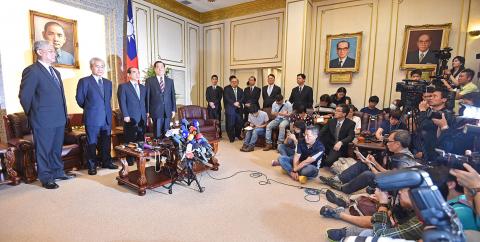
Photo: Liu Hsin-de, Taipei Times
The official announcement of the Singapore meeting came only after the Liberty Times (the Taipei Times’ sister newspaper) published an online exclusive at about 10:30pm on Tuesday that Ma was to meet Xi in Singapore during the Chinese leader’s visit to the city-state.
Presidential Office spokesperson Charles Chen (陳以信) released a statement after the Liberty Times published its scoop, saying the goal of the meeting is to “consolidate the cross-strait peace, maintain the ‘status quo’ of the Taiwan Strait” and that “no agreement would be signed or joint statement made.”
Tseng yesterday reiterated Chen’s statement at the legislature after he and Mao held a closed-door meeting with Wang, confirming that Ma is to hold talks with the Chinese president in Singapore, “exchanging views with [Xi] on matters concerning the consolidation of the cross-strait peace and maintaining the ‘status quo.’”
“The president would return the same day,” Tseng said.
“The president is to hold a press conference [today], and he has said that he is willing to come to the Legislative Yuan at its invitation after the Ma-Xi meeting,” Tseng said.
Mao said the meeting is a major political event, and “the Executive Yuan, under the principle of legislative supervision, has come to ask Legislative Speaker Wang to convene the legislative caucuses to be reported to on the matter by Mainland Affairs Council Minister Andrew Hsia (夏立言) and myself.”
Mao and Hsia met with the caucuses in the afternoon, although the Democratic Progressive Party did not attend because it was held behind closed doors.
The Taiwan Solidarity Union (TSU) lawmakers attended for a few minutes and then withdrew in protest.
Wang yesterday morning said it was a good thing that “the Presidential Office and the Executive Yuan are reporting to the legislature on their own initiatives,” adding that “their proactive attempt to communicate with both the ruling and the opposition parties to earn their support is a move demonstrating their respect for the public opinion.”
“The ruling and opposition parties should put aside their partisan biases and oversee [the Ma-Xi meeting] rationally, with the public’s greatest wellbeing in mind,” he said.
Wang said he had three points to make about the Singapore meeting: “First, the leaders should meet on an equal footing and with dignity; second, the legislature supports any conversation that is advantageous to cross-strait peace and regional stability; third, the meeting has the nation’s full attention and we would hope the conversation, which is tightly connected to the nation’s development, could respond to the public’s expectations and achieve its end successfully.”
Asked if it was true that he only learned of the Singapore meeting late on Tuesday night, Wang said yes.
“I did not know about it until close to 12pm,” he said, adding that he had learned about it through the media.
However, Wang said that Ma had telephoned him about 5pm on Tuesday to say that Tseng and Mao would visit him at the legislature [yesterday] to discuss “important matters,” but did not tell him say anything about a meeting with Xi.
When Tseng called him about an hour later to arrange a meeting time, he did not mention the Singapore get-together either, Wang said.
Before Wang held his closed-door meeting with Tseng and Mao, TSU Legislators Lai Cheng-chang (賴振昌) and Yeh Chin-ling (葉津鈴) tried to interrupt, shouting that the Presidential Office’s decision was a “black-box” process.
“It is okay if the Chinese Nationalist Party [KMT] does not want the Republic of China [ROC]. We do not want it either. Taiwan is Taiwan. The KMT could [leave] if it does not want the ROC,” Yeh said.

Considering that most countries issue more than five denominations of banknotes, the central bank has decided to redesign all five denominations, the bank said as it prepares for the first major overhaul of the banknotes in more than 24 years. Central bank Governor Yang Chin-lung (楊金龍) is expected to report to the Legislative Yuan today on the bank’s operations and the redesign’s progress. The bank in a report sent to the legislature ahead of today’s meeting said it had commissioned a survey on the public’s preferences. Survey results showed that NT$100 and NT$1,000 banknotes are the most commonly used, while NT$200 and NT$2,000

The Centers for Disease Control (CDC) yesterday reported the first case of a new COVID-19 subvariant — BA.3.2 — in a 10-year-old Singaporean girl who had a fever upon arrival in Taiwan and tested positive for the disease. The girl left Taiwan on March 20 and the case did not have a direct impact on the local community, it said. The WHO added the BA.3.2 strain to its list of Variants Under Monitoring in December last year, but this was the first imported case of the COVID-19 variant in Taiwan, CDC Deputy Director-General Lin Ming-cheng (林明誠) said. The girl arrived in Taiwan on

South Korea is planning to revise its controversial electronic arrival card, a step Taiwanese officials said prompted them to hold off on planned retaliatory measures, a South Korean media report said yesterday. A Yonhap News Agency report said that the South Korean Ministry of Foreign Affairs is planning to remove the “previous departure place” and “next destination” fields from its e-arrival card system. The plan, reached after interagency consultations, is under review and aims to simplify entry procedures and align the electronic form with the paper version, a South Korean ministry official said. The fields — which appeared only on the electronic form

The Ministry of Foreign Affairs (MOFA) is suspending retaliation measures against South Korea that were set to take effect tomorrow, after Seoul said it is updating its e-arrival system, MOFA said today. The measures were to be a new round of retaliation after Taiwan on March 1 changed South Korea's designation on government-issued alien resident certificates held by South Korean nationals to "South Korea” from the "Republic of Korea," the country’s official name. The move came after months of protests to Seoul over its listing of Taiwan as "China (Taiwan)" in dropdown menus on its new online immigration entry system. MOFA last week


 RSS
RSS