


Taiwan has to improve its fishing practices and eliminate illegal behavior or face trade sanctions from the EU, environmental group Greenpeace said.
Greenpeace reported last month that a Taiwanese fishing vessel, the Shuen De Ching No. 888, was illegally harvesting shark fins and throwing the bodies of the sharks into the sea near Papua New Guinea in the South Pacific.
The European Commission issued a yellow card to Taiwan on Oct. 1, warning that it risked being identified as an uncooperative country in the fight against “illegal, unreported and unregulated” fishing.
Greenpeace said the Fisheries Agency sent officials to check on the Shuen De Ching No. 888 following the ship’s return to Taiwan and found that it had falsely recorded its catch, cut fins off sharks and thrown their bodies into the sea, and violated the ban on fishing for black sharks.
However, the agency’s count of the ship’s catch was far short of Greenpeace’s, indicating that it is not capable of plugging management loopholes, Greenpeace said.
That raised doubts that the agency would be able to solve the yellow card problem within six months, Greenpeace said, and if Taiwan cannot make improvements within that time frame, the EU could impose trade sanctions on Taiwanese seafood.
Based on its annual fish exports to the EU, Taiwan stands to lose about NT$520 million (US$15.91 million) a year, it said.
Greenpeace oceans campaigner Yen Ning (顏寧) said the captain of the Taiwanese ship admitted that it transported a catch early last month, but an investigation by the Fisheries Agency had found nothing and it ended up saying only that the ship made an incorrect report.
The agency fined the ship NT$150,000 and its catch was confiscated, a punishment Yen said was too lenient.
Yen said that reform of Taiwan’s deep-sea fishing system is urgent. She cited as examples South Korea and the Philippines, which stepped up regulation after being issued yellow cards.
South Korea now imposes fines of up to NT$28 million for illegal fishing, while the Philippines raised its fines to NT$31.5 million. Taiwan’s fines are between NT$30,000 and NT$300,000.

LOUD AND PROUD Taiwan might have taken a drubbing against Australia and Japan, but you might not know it from the enthusiasm and numbers of the fans Taiwan might not be expected to win the World Baseball Classic (WBC) but their fans are making their presence felt in Tokyo, with tens of thousands decked out in the team’s blue, blowing horns and singing songs. Taiwanese fans have packed out the Tokyo Dome for all three of their games so far and even threatened to drown out home team supporters when their team played Japan on Friday. They blew trumpets, chanted for their favorite players and had their own cheerleading squad who dance on a stage during the game. The team struggled to match that exuberance on the field, with
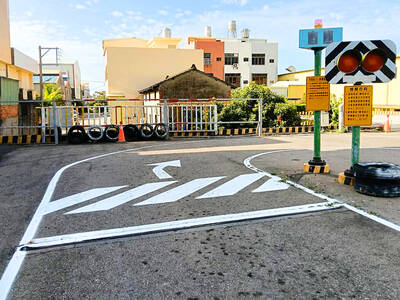
UPDATED TEST: The new rules aim to assess drivers’ awareness of risky behaviors and how they respond under certain circumstances, the Highway Bureau said Driver’s license applicants who fail to yield to pedestrians at intersections or to check blind spots, or omit pointing-and-calling procedures would fail the driving test, the Highway Bureau said yesterday. The change is set to be implemented at the end of the month, and is part of the bureau’s reform of the driving portion of the test, which has been criticized for failing to assess whether drivers can operate vehicles safely. Sedan drivers would be tested regarding yielding to pedestrians and turning their heads to check blind spots, while drivers of large vehicles would be tested on their familiarity with pointing-and-calling

Whether Japan would help defend Taiwan in case of a cross-strait conflict would depend on the US and the extent to which Japan would be allowed to act under the US-Japan Security Treaty, former Japanese minister of defense Satoshi Morimoto said. As China has not given up on the idea of invading Taiwan by force, to what extent Japan could support US military action would hinge on Washington’s intention and its negotiation with Tokyo, Morimoto said in an interview with the Liberty Times (sister paper of the Taipei Times) yesterday. There has to be sufficient mutual recognition of how Japan could provide

A Taiwanese man apologized on Friday after saying in a social media post that he worked with Australia to provide scouting reports on Taiwan’s team, enabling Australia’s victory in this year’s World Baseball Classic (WBC), saying it was a joke and that he did not hold any position with foreign teams or Taiwan’s sports training center. Chen Po-hao (陳柏豪) drew the rage of many Taiwan baseball fans when he posted online on Thursday night, claiming credit for Australia’s 3-0 win over Taiwan in the opening game for Pool C, saying he worked as a physical therapist with the national team and


 RSS
RSS