


Members of the pro-independence Radical Flank (基進側翼) yesterday announced that they would participate in next year’s legislative elections, seeking to add a southern voice to the “third force.”
“Because of the long-term imbalance in the development of the north and south, the voice of young people in the south has been absent from the ‘third force,’” Radical Flank Chairman Chen Yi-chi (陳弈齊) said. “Running [for legislative seats] ourselves or searching for any possible cooperation that will serve to help overturn the Chinese Nationalist Party (KMT) are both options.”
Headquartered in Kaohsiung, the group was founded by a core of left-wing activists who studied together in Europe, with the formal organization taking shape as a result of members’ participation in last year’s Sunflower movement, he said.
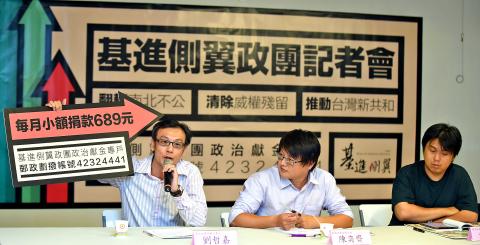
Photo: Liu Hsin-de, Taipei Times
“The Radical Flank is the only newly established party that has electoral experience,” said Huang Chien-lung (黃建龍), a member of the party’s Central Standing Committee, adding that the party’s candidates posted the best overall results among smaller parties in last year’s nine-in-one elections.
The group fielded five city council candidates in Kaohsiung and Hsinchu. None of them were elected, with candidates on average receiving 5.5 percent of the vote in their multi-seat constituencies, Radical Flank said.
“Given our experience, we have the opportunity to play a definite role in this election, in part by providing help in winning votes south of the Jhuoshuei River (濁水溪),” Huang said.
The river runs along the boundary of Changhua County and Yunlin County.
A clear “anti-KMT” stance would be the premise for cooperation with other parties, Chen said, adding that the party’s main objective is to mobilize “deep-green” voters dissatisfied with the Democratic Progressive Party (DPP), while influencing “third force” parties to support independence.
“As far as we are concerned, both the blue and green political camps have problems, but the blue camp is a ‘poisonous apple,’ while the ‘green’ camp is only ‘rotten,’” he said.
There is no way the party would accept a political stance that criticizes both camps equally, he said.
As long as other parties agreed with Radical Flank’s principles, it could “agree to disagree” on specific policy positions, he said.
The group’s political stance appears to put them closest to the New Power Party (NPP) among major “third force” parties.
Integration talks between the NPP and the Social Democratic Party (SDP) and Green Party Taiwan broke down last month, with the NPP saying that the major issue of contention was whether to support DPP presidential candidate Tsai Ing-wen (蔡英文). Several NPP candidates have since taken campaign photos with Tsai.
According to a poll released yesterday by the Chinese-languge Liberty Times (the Taipei Times’ sister paper), support for the NPP and the Green-SDP alliance falls short of the 5 percent threshold of total votes needed to win at-large legislative seats. The poll placed NPP support at 1.3 percent, while the Green-SDP alliance had 0.46 percent.

Considering that most countries issue more than five denominations of banknotes, the central bank has decided to redesign all five denominations, the bank said as it prepares for the first major overhaul of the banknotes in more than 24 years. Central bank Governor Yang Chin-lung (楊金龍) is expected to report to the Legislative Yuan today on the bank’s operations and the redesign’s progress. The bank in a report sent to the legislature ahead of today’s meeting said it had commissioned a survey on the public’s preferences. Survey results showed that NT$100 and NT$1,000 banknotes are the most commonly used, while NT$200 and NT$2,000

The Centers for Disease Control (CDC) yesterday reported the first case of a new COVID-19 subvariant — BA.3.2 — in a 10-year-old Singaporean girl who had a fever upon arrival in Taiwan and tested positive for the disease. The girl left Taiwan on March 20 and the case did not have a direct impact on the local community, it said. The WHO added the BA.3.2 strain to its list of Variants Under Monitoring in December last year, but this was the first imported case of the COVID-19 variant in Taiwan, CDC Deputy Director-General Lin Ming-cheng (林明誠) said. The girl arrived in Taiwan on

South Korea is planning to revise its controversial electronic arrival card, a step Taiwanese officials said prompted them to hold off on planned retaliatory measures, a South Korean media report said yesterday. A Yonhap News Agency report said that the South Korean Ministry of Foreign Affairs is planning to remove the “previous departure place” and “next destination” fields from its e-arrival card system. The plan, reached after interagency consultations, is under review and aims to simplify entry procedures and align the electronic form with the paper version, a South Korean ministry official said. The fields — which appeared only on the electronic form

The Ministry of Foreign Affairs (MOFA) is suspending retaliation measures against South Korea that were set to take effect tomorrow, after Seoul said it is updating its e-arrival system, MOFA said today. The measures were to be a new round of retaliation after Taiwan on March 1 changed South Korea's designation on government-issued alien resident certificates held by South Korean nationals to "South Korea” from the "Republic of Korea," the country’s official name. The move came after months of protests to Seoul over its listing of Taiwan as "China (Taiwan)" in dropdown menus on its new online immigration entry system. MOFA last week


 RSS
RSS