


Horticulturalists yesterday commented on the multitude of road trees brought down by the passage of Typhoon Soudelor, reportedly numbering 6,182 nationwide, saying that authorities should abandon erroneous horticultural practices currently in use to prevent trees from being destroyed.
The sheer number of trees toppled by the typhoon drew the attention of environmental activists, including veteran environmentalist Lin Chang-mao (林長茂) and National Chung Hsing University professor of horticulture Liu Tung-chi (劉東啟), who expounded on what they said were problems facing trees overseen by government agencies.
Lin, a self-taught horticulturalist, criticized the methods employed by most public-sector horticulturalists, saying there is much to consider when planting trees rather than simply “plunging a plant into the ground.”
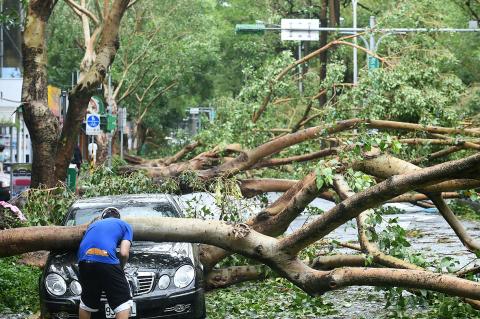
Photo: Chien Jung-fong, Taipei Times
He attributed the large number of wind-toppled trees to inappropriate trimming of twigs and an overreliance on frames used to prop up trees.
He said that twigs form V-shaped or L-shaped tree forks from the main trunk shortly after they sprout, and that V-shaped forks should be removed, as they are more prone to “included bark junctions,” which make long rifts in the trunk, undermining a tree’s sturdiness.
He said that twigs in V-shaped tree forks should be removed at an early stage, when the twigs are less than 3cm long, otherwise the resulting damage will be impossible to heal.
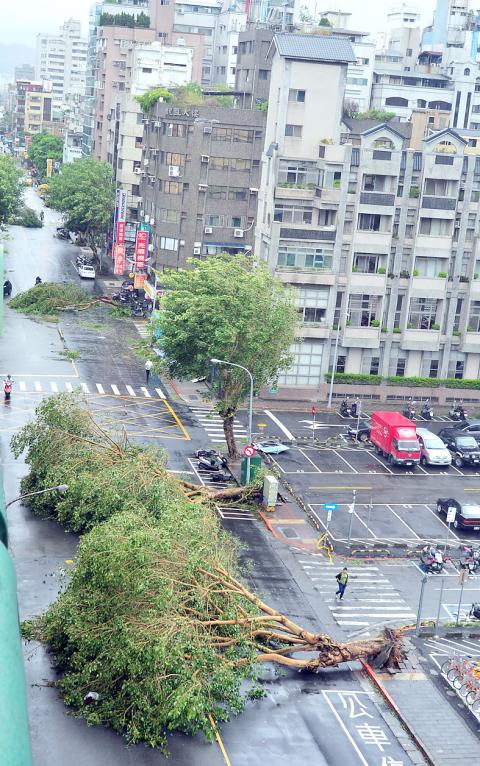
Photo: Wang Yi-sung, Taipei Times
“Since the two limbs of a V-shaped tree fork sway in different directions, which widens the separation, removing twigs measuring more than 3cm in length would result in cuts that are impossible to heal completely,” he said.
“Consequently, bacteria and fungi can gain a foothold in joints between the limbs and the trunk, and from there slowly hollow out the tree. Eventually, the tree will collapse,” he said.
Lin said government agencies overseeing plants often use props to stabilize trees over an excessive amount of time, which hampers the growth of roots, as the practice makes it difficult for trees to adapt to wind.
“Once the props are removed, the trees, having underdeveloped roots, can easily collapse,” he said, adding that all shores should be removed within three years so that an evaluation can be performed on whether a tree has developed roots strong enough to withstand strong winds.
Meanwhile, Liu said that while many of the horticultural practices in use by government agencies are wrong, he would not assign blame.
Liu, a member of the Taiwan Greening Technology Association, said he instead plans to launch a campaign calling on members of the public to take photographs of felled trees and send them to the association for analysis.
“From the pictures, we will be able to tell whether the trees collapsed due to improper trimming or if they were felled by strong winds,” he said.
This approach would enable him and other tree protection workers to get to the bottom of problems by “learning from” trees, both standing and felled.
He said that tree surgery, which was banned by the American National Standards Institute in 1990, is still widely performed in collaborations between the public and private sectors, and that his organization would launch workshops to disseminate correct tree protection knowledge.

Considering that most countries issue more than five denominations of banknotes, the central bank has decided to redesign all five denominations, the bank said as it prepares for the first major overhaul of the banknotes in more than 24 years. Central bank Governor Yang Chin-lung (楊金龍) is expected to report to the Legislative Yuan today on the bank’s operations and the redesign’s progress. The bank in a report sent to the legislature ahead of today’s meeting said it had commissioned a survey on the public’s preferences. Survey results showed that NT$100 and NT$1,000 banknotes are the most commonly used, while NT$200 and NT$2,000

The Centers for Disease Control (CDC) yesterday reported the first case of a new COVID-19 subvariant — BA.3.2 — in a 10-year-old Singaporean girl who had a fever upon arrival in Taiwan and tested positive for the disease. The girl left Taiwan on March 20 and the case did not have a direct impact on the local community, it said. The WHO added the BA.3.2 strain to its list of Variants Under Monitoring in December last year, but this was the first imported case of the COVID-19 variant in Taiwan, CDC Deputy Director-General Lin Ming-cheng (林明誠) said. The girl arrived in Taiwan on

South Korea is planning to revise its controversial electronic arrival card, a step Taiwanese officials said prompted them to hold off on planned retaliatory measures, a South Korean media report said yesterday. A Yonhap News Agency report said that the South Korean Ministry of Foreign Affairs is planning to remove the “previous departure place” and “next destination” fields from its e-arrival card system. The plan, reached after interagency consultations, is under review and aims to simplify entry procedures and align the electronic form with the paper version, a South Korean ministry official said. The fields — which appeared only on the electronic form

The Ministry of Foreign Affairs (MOFA) is suspending retaliation measures against South Korea that were set to take effect tomorrow, after Seoul said it is updating its e-arrival system, MOFA said today. The measures were to be a new round of retaliation after Taiwan on March 1 changed South Korea's designation on government-issued alien resident certificates held by South Korean nationals to "South Korea” from the "Republic of Korea," the country’s official name. The move came after months of protests to Seoul over its listing of Taiwan as "China (Taiwan)" in dropdown menus on its new online immigration entry system. MOFA last week


 RSS
RSS