


A private zoo in Tainan’s Madou District (麻豆) is to close for good in January next year, with the owner complaining that the newly revised Animal Protection Act will make his business too challenging to run.
“It is a painful decision,” Madou Crocodile King Zoo owner Chiu Hsi-ho (邱鍚河) said yesterday.
Once the revisions to the Animal Protection Act (動物保護法) take effect on Jan. 23 next year, it will be increasingly difficult for small-scale private zoos to survive, Chiu said.
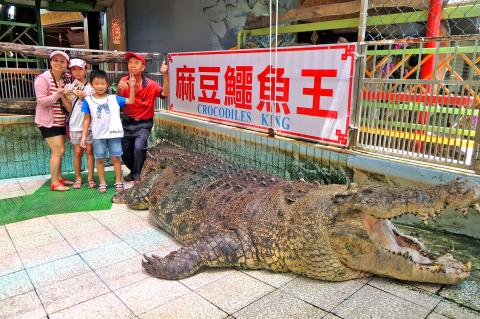
Photo: Liu Wan-chun, Taipei Times
Chiu said the laws will become much stricter than when he started his business nearly 40 years ago, making it impossible for him to continue operating.
The death of a male hippopotamus named “A-ho” (阿河) late last year at another private zoo in Taichung triggered a public outcry over the treatment of animals at such zoos, prompting lawmakers to amend the Animal Protection Act.
The revision, passed on Jan. 23, stipulates that an “animal show vendor” must have a license prior to opening for commercial operation.
A-ho, who had been a long-time favorite with tourists that flocked to its home at Taichung’s Skyzoo recreational farm, died on Dec. 29 last year, apparently from injuries sustained when it jumped from a moving truck and later fell a second time while suspended in mid-air over a pond at a farm in Miaoli where it was supposed to be treated.
A nearly 40-year-old crocodile, named “Xiao He” (小河), is a star animal at Chiu’s zoo.
At a length of 5.8m and a weight of 1,250kg, Xiao He has been “trained” by Chiu to “perform” in the zoo’s regular animal shows, Chiu said.
It even allowed visitors to sit on its back for photographs, he said.
Xiao He has drawn many business opportunities for the zoo, Chiu said.
Apart from the crocodile, Chiu’s zoo is also known for keeping “unusual” animals, such as a turtle with three heads, a crocodile without a tail and featherless chickens.
However, over the past few years, his shows have been blasted by animal protection groups, who accuse Chiu of abusing his animals.
His zoo has been singled out as one of Taiwan’s top 10 worst animal farms, he said, adding that “it made me feel terribly bad,” since he has always spared no efforts in attending to the “rare animals” he keeps.
Chiu said he had never violated the existing act and that he has taken many measures to improve his zoo.
However, the regulations are becoming increasingly strict, thanks to increasing awareness of animal welfare.
“It is almost impossible for a small zookeeper to follow them,” Chiu said.

Considering that most countries issue more than five denominations of banknotes, the central bank has decided to redesign all five denominations, the bank said as it prepares for the first major overhaul of the banknotes in more than 24 years. Central bank Governor Yang Chin-lung (楊金龍) is expected to report to the Legislative Yuan today on the bank’s operations and the redesign’s progress. The bank in a report sent to the legislature ahead of today’s meeting said it had commissioned a survey on the public’s preferences. Survey results showed that NT$100 and NT$1,000 banknotes are the most commonly used, while NT$200 and NT$2,000

The Centers for Disease Control (CDC) yesterday reported the first case of a new COVID-19 subvariant — BA.3.2 — in a 10-year-old Singaporean girl who had a fever upon arrival in Taiwan and tested positive for the disease. The girl left Taiwan on March 20 and the case did not have a direct impact on the local community, it said. The WHO added the BA.3.2 strain to its list of Variants Under Monitoring in December last year, but this was the first imported case of the COVID-19 variant in Taiwan, CDC Deputy Director-General Lin Ming-cheng (林明誠) said. The girl arrived in Taiwan on

South Korea is planning to revise its controversial electronic arrival card, a step Taiwanese officials said prompted them to hold off on planned retaliatory measures, a South Korean media report said yesterday. A Yonhap News Agency report said that the South Korean Ministry of Foreign Affairs is planning to remove the “previous departure place” and “next destination” fields from its e-arrival card system. The plan, reached after interagency consultations, is under review and aims to simplify entry procedures and align the electronic form with the paper version, a South Korean ministry official said. The fields — which appeared only on the electronic form

The Ministry of Foreign Affairs (MOFA) is suspending retaliation measures against South Korea that were set to take effect tomorrow, after Seoul said it is updating its e-arrival system, MOFA said today. The measures were to be a new round of retaliation after Taiwan on March 1 changed South Korea's designation on government-issued alien resident certificates held by South Korean nationals to "South Korea” from the "Republic of Korea," the country’s official name. The move came after months of protests to Seoul over its listing of Taiwan as "China (Taiwan)" in dropdown menus on its new online immigration entry system. MOFA last week


 RSS
RSS