


KMT lawmakers yesterday advised Chinese Nationalist Party (KMT) presumptive presidential candidate Hung Hsiu-chu (洪秀柱) to focus on internal affairs and economic policies.
KMT Legislator Lo Shu-lei (羅淑蕾) said the lunchtime discussion was about public policy.
“I told her that a nation’s leader is unworthy of the title if they cannot provide young people with a vision, make housing affordable and encourage them to have children,” Lo said.
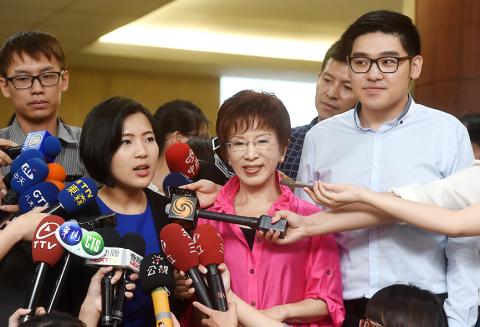
Photo: Chien Jung-fong, Taipei Times
“[Hung] agreed, so she should now begin to work on issues concerning the economy, internal affairs and how to enhance people’s well-being, including by narrowing the wealth gap,” Lo said.
“Hung was humble and polite, stressing that she would like lawmakers to offer their opinions, as she is not so familiar with financial and economic issues,” KMT Legislator Lai Shih-bao (賴士葆) said.
Lai said that he found Hung to be “more knowledgeable than I expected,” adding that he has faith in her.
Lo said President Ma Ying-jeou (馬英九) and Vice President Wu Den-yih (吳敦義) should be included in a proposed campaign tactic.
KMT Legislator Apollo Chen (陳學聖) on Friday said that Hung should form an “iron triangle” with KMT Chairman Eric Chu (朱立倫) and Legislative Speaker Wang Jin-pyng (王金平) to promote the party in the run-up to next year’s presidential and legislative elections.
However, Lo said the strategy should be a “pentagon,” adding that “victory would only eventuate if all five angles are solid and stable.”
Lo called on Hung to help resolve tensions between Ma and Wang.
Hung said Wang “has always been an asset to the party,” adding that the media should not “make a fuss about [the supposed Ma-Wang row].”
Hung shunned questions about her “one China, same interpretation” proposal for cross-strait relations after being asked about reports from KMT lawmakers that she had promised to drop the term.
“The proposal was simply a return to the party’s political platform, which is consolidation of the [so-called] 1992 consensus,” Hung said, referring to a term former Mainland Affairs Council chairman Su Chi (蘇起) admitted making up in 2000 — a tacit understanding between the KMT and the Chinese government that both sides of the Strait acknowledge there is “one China,” with each side having its own interpretation of what “China” means.
“You guys [journalists] are never able to correctly understand my remarks,” she said.
“It is not that I look down on [your ability to comprehend], but [I could not explain my ideas completely] in the short time we have,” she said.
“Let us simply say that [my policy] is to return to the party’s platform and maintain stable and long-term peace for Taiwan,” Hung said.

Considering that most countries issue more than five denominations of banknotes, the central bank has decided to redesign all five denominations, the bank said as it prepares for the first major overhaul of the banknotes in more than 24 years. Central bank Governor Yang Chin-lung (楊金龍) is expected to report to the Legislative Yuan today on the bank’s operations and the redesign’s progress. The bank in a report sent to the legislature ahead of today’s meeting said it had commissioned a survey on the public’s preferences. Survey results showed that NT$100 and NT$1,000 banknotes are the most commonly used, while NT$200 and NT$2,000

The Centers for Disease Control (CDC) yesterday reported the first case of a new COVID-19 subvariant — BA.3.2 — in a 10-year-old Singaporean girl who had a fever upon arrival in Taiwan and tested positive for the disease. The girl left Taiwan on March 20 and the case did not have a direct impact on the local community, it said. The WHO added the BA.3.2 strain to its list of Variants Under Monitoring in December last year, but this was the first imported case of the COVID-19 variant in Taiwan, CDC Deputy Director-General Lin Ming-cheng (林明誠) said. The girl arrived in Taiwan on

South Korea is planning to revise its controversial electronic arrival card, a step Taiwanese officials said prompted them to hold off on planned retaliatory measures, a South Korean media report said yesterday. A Yonhap News Agency report said that the South Korean Ministry of Foreign Affairs is planning to remove the “previous departure place” and “next destination” fields from its e-arrival card system. The plan, reached after interagency consultations, is under review and aims to simplify entry procedures and align the electronic form with the paper version, a South Korean ministry official said. The fields — which appeared only on the electronic form

The Ministry of Foreign Affairs (MOFA) is suspending retaliation measures against South Korea that were set to take effect tomorrow, after Seoul said it is updating its e-arrival system, MOFA said today. The measures were to be a new round of retaliation after Taiwan on March 1 changed South Korea's designation on government-issued alien resident certificates held by South Korean nationals to "South Korea” from the "Republic of Korea," the country’s official name. The move came after months of protests to Seoul over its listing of Taiwan as "China (Taiwan)" in dropdown menus on its new online immigration entry system. MOFA last week


 RSS
RSS