


China’s Taiwan Affairs Office (TAO) has responded to the Chinese Nationalist Party’s (KMT) call for aid, with Chinese enterprises promising to donate 10 million yuan (US$1.61 million) worth of artificial skin to treat people affected by the dust explosions and fire at the Formosa Fun Coast (八里海岸) water park in New Taipei City’s Bali District (八里), the KMT said yesterday.
China’s Association for Relations Across the Taiwan Straits (ARATS) also told the Strait Exchange Foundation that 20 million yuan of cadaver skin would be provided, the KMT said.
KMT Chairman Eric Chu (朱立倫) said on Wednesday that the nation is in desperate need of medical supplies and staff in the aftermath of the accident, which saw partygoers on Saturday last week enveloped by fireballs when cornstarch being sprayed on the crowd caught fire.
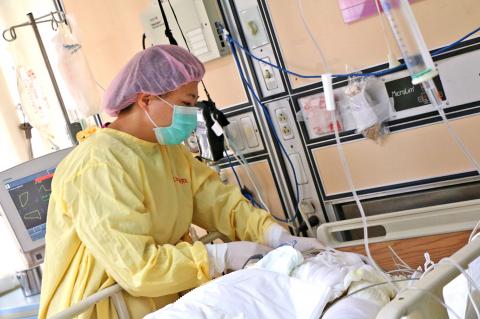
Photo: CNA
Chu asked KMT Mainland Affairs Department director Kao Koong-lian (高孔廉) to contact China to make the request, he said.
The office said that it has prepared medical supplies to assist with treatments, including cadaver skin donated by Chinese burn specialist Sheng Zhiyong (盛志勇).
TAO Minister Zhang Zhijun (張志軍) on Wednesday said in Tianjin that China is willing to share its experience in treating people affected by dust explosions and provide medical assistance.
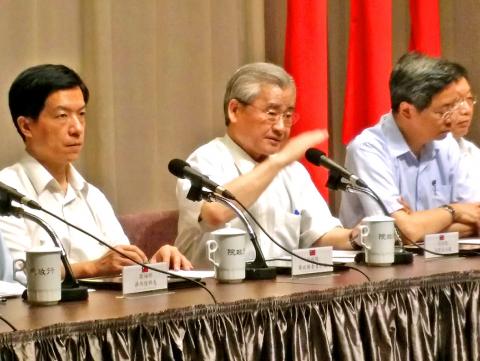
Photo: CNA
The office yesterday said that help from China would be arriving after the proper procedures had been followed.
The Chinese National Health and Family Planning Commission has drawn up a plan to send medical personnel, including burns experts, to Taiwan.
In related news, Premier Mao Chi-kuo (毛治國) said the government would establish a foundation to provide long-term care for people caught up in the tragedy.
The foundation is to combine government and private-sector resources, but its exact form and funding are still being discussed, Mao told a news conference.
He said that the government welcomes suggestions on the issue from all sectors of society.
Mao said the first meeting of an inter-ministerial task force formed in response to the tragedy is set for today.
In addition to emergency medical assistance, the task force, led by Vice Premier Simon Chang (張善政), would also assist people with insurance and compensation claims and protect their rights, Mao said.
Mao vowed to discover who is responsible for the incident, adding that the government’s Consumer Protection Committee would assist people with filing lawsuits and compensation claims.
Separately, a local gay rights group announced that it would put off a planned march until Saturday next week out of sympathy for the people affected by the disaster.
The Taiwan Alliance to Promote Civil Partnership Rights issued a statement expressing sympathy for the people affected and said the march would be revised to raise money for treatment.
Any donations would go to the Sunshine Social Welfare Foundation, a nonprofit organization that is dedicated to providing services and rehabilitation for burns patients, the alliance’s Web site said.
The alliance originally planned to hold a march in Taipei tomorrow following last week’s ruling by the US Supreme Court that said US states are required to recognize same-sex marriages.
The marchers plan to go to the headquarters of both the KMT and the Democratic Progressive Party to demand the inclusion of a marriage equality bill in the next legislative session, which is to begin in September, the alliance said.

Considering that most countries issue more than five denominations of banknotes, the central bank has decided to redesign all five denominations, the bank said as it prepares for the first major overhaul of the banknotes in more than 24 years. Central bank Governor Yang Chin-lung (楊金龍) is expected to report to the Legislative Yuan today on the bank’s operations and the redesign’s progress. The bank in a report sent to the legislature ahead of today’s meeting said it had commissioned a survey on the public’s preferences. Survey results showed that NT$100 and NT$1,000 banknotes are the most commonly used, while NT$200 and NT$2,000

The Centers for Disease Control (CDC) yesterday reported the first case of a new COVID-19 subvariant — BA.3.2 — in a 10-year-old Singaporean girl who had a fever upon arrival in Taiwan and tested positive for the disease. The girl left Taiwan on March 20 and the case did not have a direct impact on the local community, it said. The WHO added the BA.3.2 strain to its list of Variants Under Monitoring in December last year, but this was the first imported case of the COVID-19 variant in Taiwan, CDC Deputy Director-General Lin Ming-cheng (林明誠) said. The girl arrived in Taiwan on

South Korea is planning to revise its controversial electronic arrival card, a step Taiwanese officials said prompted them to hold off on planned retaliatory measures, a South Korean media report said yesterday. A Yonhap News Agency report said that the South Korean Ministry of Foreign Affairs is planning to remove the “previous departure place” and “next destination” fields from its e-arrival card system. The plan, reached after interagency consultations, is under review and aims to simplify entry procedures and align the electronic form with the paper version, a South Korean ministry official said. The fields — which appeared only on the electronic form

The Ministry of Foreign Affairs (MOFA) is suspending retaliation measures against South Korea that were set to take effect tomorrow, after Seoul said it is updating its e-arrival system, MOFA said today. The measures were to be a new round of retaliation after Taiwan on March 1 changed South Korea's designation on government-issued alien resident certificates held by South Korean nationals to "South Korea” from the "Republic of Korea," the country’s official name. The move came after months of protests to Seoul over its listing of Taiwan as "China (Taiwan)" in dropdown menus on its new online immigration entry system. MOFA last week


 RSS
RSS