


Environmentalists were angered to discover that Styrofoam allegedly used by local oyster farmers was scattered along the coast of Sihkunshen (四鯤鯓) in Tainan’s South District (南區).
The group accused a local fishermen’s association of neglecting its responsibility to clean up the mess, while calling on the Tainan City Government to ban the use of Styrofoam.
Environmental campaigner Chao Jui-guang, (晁瑞光), a Tainan resident, said he found out about the Styrofoam yesterday morning.
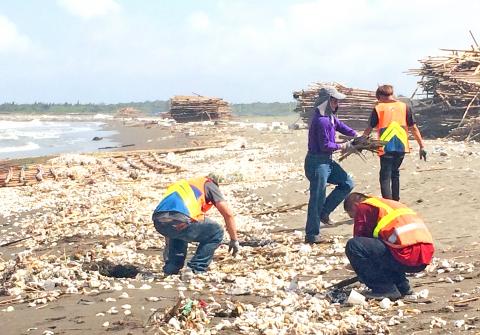
Photo: Tsai Wen-chu, Taipei Times
He said that local oyster farms should have gathered up most of the Styrofoam washed ashore, but a beach-cleaning activity undertaken by a community college almost two weeks ago picked up about 200 chunks of Styrofoam, which oyster farmers use in their work.
Chao said the fishermen’s association had “slacked off” in their work to remove the trash, adding that the situation this month is worse than in previous years.
Chao said that Styrofoam was strewn along the coast from Sihkunshen to the mouth of the Tsengwen River (曾文溪), a distance of more than 20km.
He said that Japanese research in 2012 showed that Styrofoam releases toxic chemicals, while a South Korean study published last year indicated that using Styrofoam to farm oysters poses a risk to nearby fish farming.
The city government should prohibit the use of the material and encourage the use of polyethylene, Chao said, adding that oyster farmers should use the more eco-friendly polyethylene foam — which is similar to the material used to make surfboards and does not easily dissolve in seawater.
City officials and fishermen’s association representatives held a meeting yesterday, agreeing that the Tainan Environmental Protection Bureau would gather the Styrofoam to three locations designated by the association, after which the association would clear away the trash and the bureau would send beach-cleaning vehicles to finish the job.
Chao lambasted the agreement, saying that the association should clean up the mess rather than shifting the responsibility to city officials and exploiting public resources.
“The Environmental Protection Bureau should be in charge of fining polluters, not picking up their trash,” he said.
Tainan Fishing Ports and Coastal Waters Management Office official Wu Kuo-lin (吳國霖) said that the Styrofoam was carried ashore by waves propelled by a southwesterly air stream.
Wu said that no penalties were imposed because the problem was the aftermath of a “natural event” and that the mess was accidental.
Some of the Styrofoam found in Sihkunshen showed little signs of wear, Wu said, adding that waste Styrofoam from oyster farms would not be in such good condition.
To curb pollution, the office pays fish farmers NT$30 for each piece of Styrofoam they recycle, which on average measures 90cm by 45cm by 30cm, Wu said.
He said that the fishermen’s association has more equipment for waste removal than the city government, but is short on staff, which led to the arrangements made between the two groups.
The office would work to improve the distribution of labor, Wu said.
Tainan Environmental Protection Bureau official Chu Hung-che (朱宏哲) said that the bureau had dispatched employees to collect the Styrofoam, adding that the operation could take several days given the wide distribution of the trash.
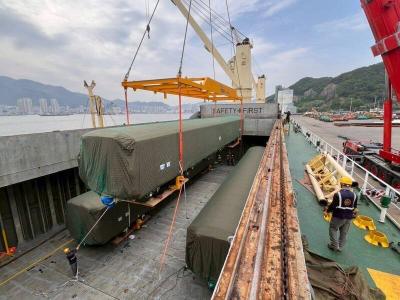
The first of 10 new high-capacity trains purchased from South Korea’s Hyundai Rotem arrived at the Port of Taipei yesterday to meet the demands of an expanding metro network, Taipei Rapid Transit Corp (TRTC) said yesterday. The train completed a three-day, 1,200km voyage from the Port of Masan in South Korea, the company said. Costing NT$590 million (US$18.79 million) each, the new six-carriage trains feature a redesigned interior based on "human-centric" transportation concepts, TRTC said. The design utilizes continuous longitudinal seating to widen the aisles and optimize passenger flow, while also upgrading passenger information displays and driving control systems for a more comfortable
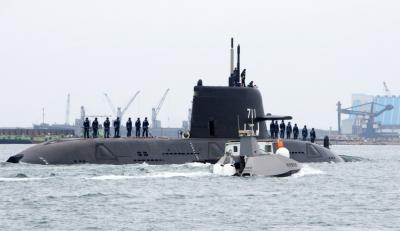
Taiwan's first indigenous defense submarine, the SS-711 Hai Kun (海鯤, or Narwhal), departed for its 13th sea trial at 7am today, marking its seventh submerged test, with delivery to the navy scheduled for July. The outing also marked its first sea deployment since President William Lai (賴清德) boarded the submarine for an inspection on March 19, drawing a crowd of military enthusiasts who gathered to show support. The submarine this morning departed port accompanied by CSBC Corp’s Endeavor Manta (奮進魔鬼魚號) uncrewed surface vessel and a navy M109 assault boat. Amid public interest in key milestones such as torpedo-launching operations and overnight submerged trials,
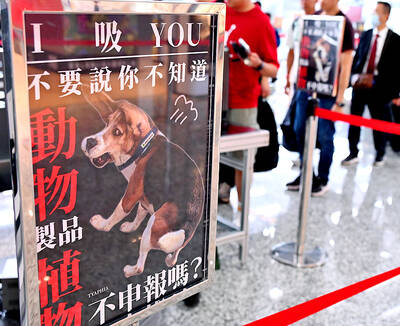
Quarantine awareness posters at Taiwan Taoyuan International Airport have gone viral for their use of wordplay. Issued by the airport branch of the Animal and Plant Health Inspection Agency, the posters feature sniffer dogs making a range of facial expressions, paired with advisory messages built around homophones. “We update the messages for holidays and campaign needs, periodically refreshing materials to attract people’s attention,” quarantine officials said. “The aim is to use the dogs’ appeal to draw focus to quarantine regulations.” A Japanese traveler visiting Taiwan has posted a photo on X of a poster showing a quarantine dog with a
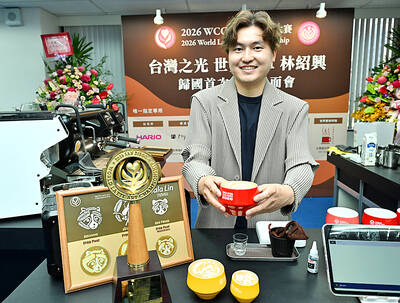
Taiwan’s coffee community has launched a “one-person-one-e-mail” campaign, calling for people to send a protest-e-mail to the World Coffee Championships (WCC) urging it to redesignate Taiwanese competitors as from “Taiwan,” rather than “Chinese Taipei.” The call followed sudden action last week after the WCC changed all references to Taiwanese competitors from “Taiwan” to “Chinese Taipei,” including recent World Latte Art champion Bala (林紹興), who won the World Latte Art Championship in San Diego earlier this month. When Bala received the trophy, he was referred to as representing Taiwan, as well as in the announcement on the WCC’s Web site, until it


 RSS
RSS