


Taiwan and Japan tied for fourth place in a global math and science education ranking administered by the Organisation for Economic Co-operation and Development (OECD), with Asian nations taking the top five spots, the BBC reported yesterday.
Singapore ranked best in the world, followed by Hong Kong, the BBC reported.
South Korea took third in the OECD’s biggest global school rankings to date. Taiwan and Japan tied in fourth place, the report said.
Vietnam was the next-highest Asian nation — in 12th place — ahead of Germany and Australia. The UK ranked 20th, while the US placed 28th — below less-weathy nations, such as the Czech Republic and Poland, the report said.
At No. 6, Finland was the first non-Asian nation to be in the top six rankings, while Ghana came in last place.
The other nations in the top 10 were Estonia, Switzerland, the Netherlands and Canada, in that order.
The findings, based on math and science scores of 15-year-old students, are to be formally presented at the World Education Forum in South Korea next week.
The OECD examined 76 countries of varying economic status for the study, 11 more than the previous Program for International Student Assessment (PISA) test it conducted in 2012. The PISA test traditionally focuses on affluent nations.
“This is the first time we have a truly global scale of the quality of education,” the BBC quoted OECD education director Andreas Schleicher as saying.
Schleicher added that Singapore had high levels of illiteracy into the 1960s.
He said that the findings could help “give more countries, rich and poor, access to comparing themselves against the world’s education leaders, to discover their relative strengths and weaknesses, and to see what the long-term economic gains from improved quality in schooling could be for them.”
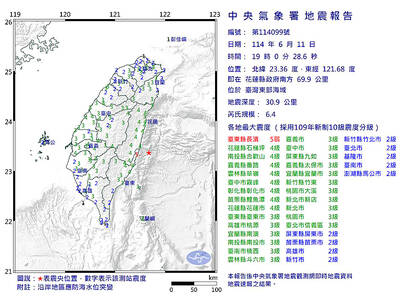
A magnitude 6.4 earthquake struck off the coast of Hualien County in eastern Taiwan at 7pm yesterday, the Central Weather Administration (CWA) said. The epicenter of the temblor was at sea, about 69.9km south of Hualien County Hall, at a depth of 30.9km, it said. There were no immediate reports of damage resulting from the quake. The earthquake’s intensity, which gauges the actual effect of a temblor, was highest in Taitung County’s Changbin Township (長濱), where it measured 5 on Taiwan’s seven-tier intensity scale. The quake also measured an intensity of 4 in Hualien, Nantou, Chiayi, Yunlin, Changhua and Miaoli counties, as well as
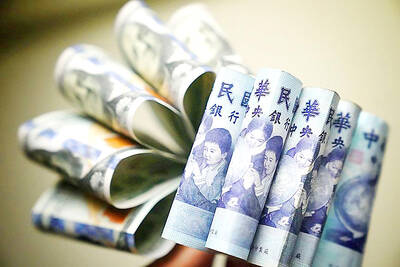
Credit departments of farmers’ and fishers’ associations blocked a total of more than NT$180 million (US$6.01 million) from being lost to scams last year, National Police Agency (NPA) data showed. The Agricultural Finance Agency (AFA) said last week that staff of farmers’ and fishers’ associations’ credit departments are required to implement fraud prevention measures when they serve clients at the counter. They would ask clients about personal financial management activities whenever they suspect there might be a fraud situation, and would immediately report the incident to local authorities, which would send police officers to the site to help, it said. NPA data showed
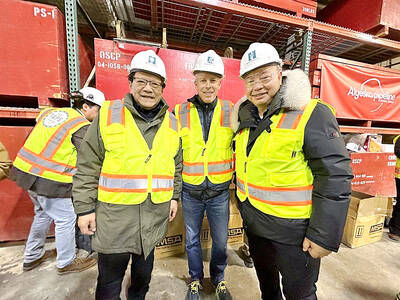
ENERGY RESILIENCE: Although Alaska is open for investments, Taiwan is sourcing its gas from the Middle East, and the sea routes carry risks, Ho Cheng-hui said US government officials’ high-profile reception of a Taiwanese representative at the Alaska Sustainable Energy Conference indicated the emergence of an Indo-Pacific energy resilience alliance, an academic said. Presidential Office Secretary-General Pan Men-an (潘孟安) attended the conference in Alaska on Thursday last week at the invitation of the US government. Pan visited oil and gas facilities with senior US officials, including US Secretary of the Interior Doug Burgum, US Secretary of Energy Chris Wright, Alaska Governor Mike Dunleavy and US Senator Daniel Sullivan. Pan attending the conference on behalf of President William Lai (賴清德) shows a significant elevation in diplomatic representation,
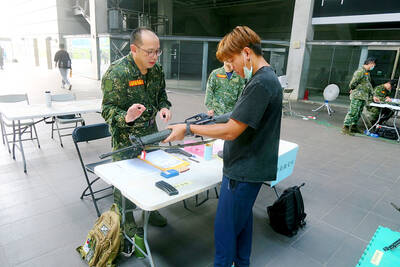
The Taipei City Reserve Command yesterday initiated its first-ever 14-day recall of some of the city’s civilian service reservists, who are to undergo additional training on top of refresher courses. The command said that it rented sites in Neihu District (內湖), including the Taipei Tennis Center, for the duration of the camp to optimize tactical positioning and accommodate the size of the battalion of reservists. A battalion is made up of four companies of more than 200 reservists each, it said. Aside from shooting drills at a range in New Taipei City’s Linkou District (林口), the remainder of the training would be at


 RSS
RSS