


In a departure from mainstream pop music, veteran independent musician Hsiao Fu-te (蕭福德) in his decades-long career has made music concerned with the issues facing people on the bottom tier of society.
With his grizzled hair hanging loose at shoulder length, the 50-year-old artist described himself as someone who tries to “present the resolute spirit of rock ’n’ roll from a gentle perspective.”
Born in a Christian household in Changhua County in 1965, he grew up listening to gospel music until rock ’n’ roll came into his life, he said.
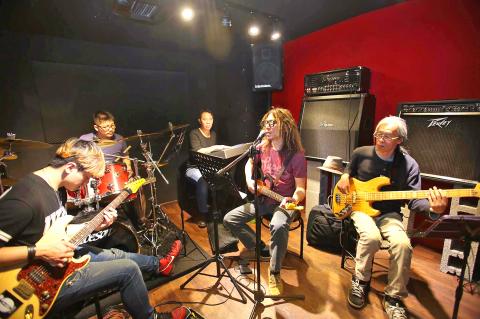
Photo: Yeh Kuan-yu, Taipei Times
He came across an eye-opening performance that introduced him to the world of rock ’n’ roll when he was a high-school student in Tainan, and he later learned to play bass and discovered a wide range of musical genres, including heavy metal, blues and jazz, he said.
Like every young person of that time, he yearned for the bright future seemingly promised by the metropolis and went to Taipei to start his career as a salesman after he finished military service, he said.
He played music in restaurants and bars after work, but viewed performing as just an interesting sideline, until a friend sent his demo tapes to UFO Records — the predecessor of Warner Music Taiwan — whereupon the company offered Hsaio his first record contract.
Shortly before the release of Hsiao’s first album in 1992, musician Lim Giong (林強) made his debut with the game-changing album Marching Forward (向前走) in 1990, which revolutionized the music scene by introducing Taiwanese themes into pop-rock culture, Hsiao said.
While Hsiao might well have ridden that wave, he chose “to care for the toiling masses” and adopted a much more difficult approach instead, he said.
“It’s very easy to write a love song. Just [tap into] lovers’ laments and write something personal and sentimental. However, to write a meaningful song that resonates with the audience is very difficult, and that’s what I have been trying to do,” he said.
His debut album, A Flower on Huasi Street (華西街的一蕊花), was an effort to relate to a campaign to end child prostitution that started in the late 1980s, he said.
The album’s titular title track is a lyrical description of sex workers in Taipei’s Wanhua District (萬華), where the practice of prostitution was common and where he first lived when he came to the city, he said.
Outlining the plight of sex workers, the song later became the campaign’s anthem and saw him become a finalist in the Best Lyricist Award in the traditional music category of the Golden Melody Awards in 1993.
Hsiao said that he insists on singing and writing in Hoklo (commonly known as Taiwanese) because he does not speak fluent Mandarin.
“There’s no way that I can pronounce every word correctly the way people speak Mandarin in Beijing,” he said.
He loves the distinctive intonation and rhythm of Hoklo, he said, adding that the language gives his work a particular resonance.
He said that in the early 1990s he had to put up a fight when his agent asked him to appear on television variety shows to gain publicity like his fellow artists did, including Cantonese singer Gloria Yip (葉蘊儀) and Taiwanese boy band the Little Tigers (小虎隊).
“I am not a regular singer; tell the company not to make me one. Don’t ask me to go on shows that play games,” he said he told his agent.
At that time, he wrote the song Who is a Hero? (誰人是英雄) to ridicule the now-defunct national assembly, most of whose members remained in their positions from 1947 to 1992 without standing in regular elections.
“What is real justice? What is the real you? Do you dare to care what happens around you?” the lyrics of the song ask.
However, lyrics such as these representing the artist’s discontent with social injustice were met with strong objections from the record company, and he was asked to self-censor, Hsiao said.
Hsiao said his idealism did not make for an easily marketable product, so he turned to independent production after releasing three albums with UFO Records and Rock Records.
He started a record label with a couple of other musicians in 1996, but later quit due to conflicts, he said.
He later established the project “Jesus Rocks” with musician Jutoupi (豬頭皮), seeking to redefine church music by connecting Christianity with rock ’n’ roll in an appeal to young people.
Hsiao said that the pair have performed at churches and protest rallies nationwide for more than a decade, adding “we will be there whenever there is an event in support of minority groups and social justice.”
He occasionally writes songs or lyrics for other musicians, including a piece used in Taipei Mayor Ko Wen-je’s (柯文哲) campaign album Taipei Tone (台北調).
Saying there is no record label willing to release an album for him and that he has few connections with the industry except via social media concerned with music, Hsiao, with self-deprecating humor, added: “I have nothing but a steady output of musical creativity and social criticism.”

NATIONAL SECURITY: Authorities are working to confirm the identities of the military personnel involved and investigating possible illegal conduct and regulatory violations Authorities are probing possible national security implications after Kinmen police and immigration officers on Sunday found a Chinese woman allegedly posing as a tourist while engaging in prostitution involving more than 10 military personnel. The woman, surnamed Chen (陳), has since been deported, authorities said, adding that investigators are still working to confirm the identities of those implicated, as the records only listed code names and aliases. The case stemmed from a report received by the Kinmen District Prosecutors’ Office on Friday last week from the Jinhu Precinct of the Kinmen County Police Bureau. On Sunday, police, along with the National Immigration

GLOBALGIVING: ‘ Caving to external pressure is not acceptable for an organization that has cultivated justice reform and human rights for 30 years,’ one NGO said A slew of non-government organizations (NGOs) have withdrawn from the GlobalGiving fundraising platform after it announced it would use “Chinese Taipei” instead of “Taiwan” from next month. The Taiwan Good Rice Association wrote on Facebook on Friday that it was informed on April 28 via a teleconference call of the change, which was made because the platform wanted to operate in China. Taiwan Good Rice is to terminate all cooperative relationships with GlobalGiving in response to the platform’s “unilateral and non-negotiable” decision to remove references to Taiwan, the NGO said. “Taiwan is in the official name of Taiwan Good Rice Association and the

HEAVY WEATHER: Typhoon Jangmi is due to crash straight into the Ryukyus as airlines look to shift flights to larger aircraft or cancel flights to Okinawa entirely Taiwan’s international air carriers announced flight adjustments over the weekend as Typhoon Jangmi is forecast to hit the Ryukyu Islands today and tomorrow. The Central Weather Administration (CWA) upgraded Jangmi from a tropical storm to a typhoon at 8am yesterday, with the eye located 580km south of Naha city. It was moving north at 19kph. Today, China Airlines’ CI-120, CI-121, CI-122 and CI-123 flights between Taoyuan and Naha, Okinawa, have been canceled as well as CI-132 and CI-133 between Kaohsiung and Naha. EVA Air’s BR-112, BR-113, BR-186 and BR-185 flights between Taoyuan and Naha are also canceled. Low-cost carrier Tigerair Taiwan canceled IT-230,

REASONS FOR TRAVEL: An assistant professor said that proposed amendments to penalize drivers if they used drugs overseas would not deter people from traveling People who operate a motor vehicle under the influence of marijuana would have their driver’s license revoked, even if they used the substance while overseas, the Ministry of Transportation and Communications said yesterday, citing proposed amendments to the Road Traffic Management and Penalty Act (道路交通管理處罰條例). The amendments would also authorize the government to revoke the licenses of people determined to have used Category 1 or Category 2 narcotics, even if they were not operating a vehicle while under the influence of drugs, as well as ban them from taking the license test for three years, the ministry said. People aged 18 or


 RSS
RSS