


Kaohsiung City Government officials yesterday rebutted Premier Mao Chih-kuo’s (毛治國) comments that southern Taiwan lacked job opportunities in the high-tech sector, saying the central government must shoulder some of the blame.
When visiting the Kaohsiung Software Park and experiencing first-hand some of the products yesterday, Mao said that a friend living in southern Taiwan told him that his son had recently gained a university degree but was unable to find a job in the technology industry in southern Taiwan.
The friend said that if his son looked for a job in northern Taiwan, he would have to dip into his retirement fund to help, Mao said, adding that his friend asked whether the government would be able to do something about the matter.
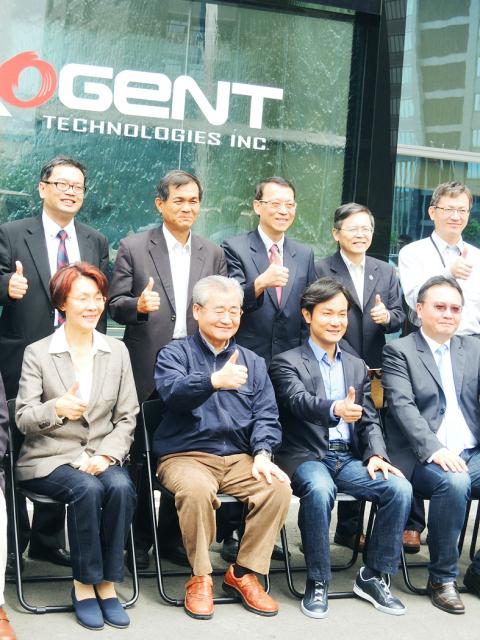
Photo: Ke Yu-hao, Taipei Times
Kaohsiung Deputy Mayor Hsu Li-ming (許立明), the city’s Economic Development Bureau Director Tseng Wen-sheng (曾文生) and a number of southern Taiwan university deans, present at the talk, appeared unhappy on hearing the comment.
Mao went on to say that he hoped Brogent Technologies, the booth he was visiting at the time, would help the nation find its path in the information technology industry, adding that he hoped the nation’s information and communication technology companies would step up its transition to add value to the industry.
After the event, Tseng, in response to reporters’ questions about Mao’s comments, said that Kaohsiung has made great strides in improving the performance of its industries, adding that as industrial planning and development policies were in the hands of the central government, it was also responsible for the lack of high-tech industry firms based in southern Taiwan.
A member of the public attending the event added that the Chinese Nationalist Party (KMT), had designated Kaohsiung as the nation’s main area for the petrochemical and iron industries, adding that any move toward high technology was after the city government developed the software park.
“The premier’s comments come as a slap in the face to the local government as well as to his own [central government],” said the member of the public who declined to be named.
Kaohsiung’s National Sun Yat-sen University dean Yang Hung-tun (楊弘敦) said that the industrial sector is beginning to take shape in the city, adding that 25 junior colleges as well as 10 to 20 businesses have formed an association to help students find jobs in the industry.
“We hope that students from southern Taiwan will be encouraged to stay and will not have to go to Taipei just to find a job,” Yang said.
Meanwhile, Kaohsiung City Councilor Lee Po-yi (李柏毅) of the Democratic Progressive Party (DPP) said that when Kaohsiung was rocked by the gas pipeline explosions last year, Mao, then-vice premier, did not visit, adding that since Mao became premier earlier this year, he had only visited the municipality two or three times.
“A premier who is not concerned about Kaohsiung is in no position to make such comments,” Lee said, adding that “Mao should be working with Kaohsiung and formulating policies that help the municipality’s high-tech industry find its footing instead of offering criticism.”

NATIONAL SECURITY: Authorities are working to confirm the identities of the military personnel involved and investigating possible illegal conduct and regulatory violations Authorities are probing possible national security implications after Kinmen police and immigration officers on Sunday found a Chinese woman allegedly posing as a tourist while engaging in prostitution involving more than 10 military personnel. The woman, surnamed Chen (陳), has since been deported, authorities said, adding that investigators are still working to confirm the identities of those implicated, as the records only listed code names and aliases. The case stemmed from a report received by the Kinmen District Prosecutors’ Office on Friday last week from the Jinhu Precinct of the Kinmen County Police Bureau. On Sunday, police, along with the National Immigration

GLOBALGIVING: ‘ Caving to external pressure is not acceptable for an organization that has cultivated justice reform and human rights for 30 years,’ one NGO said A slew of non-government organizations (NGOs) have withdrawn from the GlobalGiving fundraising platform after it announced it would use “Chinese Taipei” instead of “Taiwan” from next month. The Taiwan Good Rice Association wrote on Facebook on Friday that it was informed on April 28 via a teleconference call of the change, which was made because the platform wanted to operate in China. Taiwan Good Rice is to terminate all cooperative relationships with GlobalGiving in response to the platform’s “unilateral and non-negotiable” decision to remove references to Taiwan, the NGO said. “Taiwan is in the official name of Taiwan Good Rice Association and the

HEAVY WEATHER: Typhoon Jangmi is due to crash straight into the Ryukyus as airlines look to shift flights to larger aircraft or cancel flights to Okinawa entirely Taiwan’s international air carriers announced flight adjustments over the weekend as Typhoon Jangmi is forecast to hit the Ryukyu Islands today and tomorrow. The Central Weather Administration (CWA) upgraded Jangmi from a tropical storm to a typhoon at 8am yesterday, with the eye located 580km south of Naha city. It was moving north at 19kph. Today, China Airlines’ CI-120, CI-121, CI-122 and CI-123 flights between Taoyuan and Naha, Okinawa, have been canceled as well as CI-132 and CI-133 between Kaohsiung and Naha. EVA Air’s BR-112, BR-113, BR-186 and BR-185 flights between Taoyuan and Naha are also canceled. Low-cost carrier Tigerair Taiwan canceled IT-230,

Chinese Nationalist Party (KMT) Chairwoman Cheng Li-wun (鄭麗文) yesterday briefed her party’s Central Standing Committee regarding her scheduled visit to the US between Monday next week and June 16, saying that her purpose would be to persuade the US that the Republic of China (ROC) Constitution was a “one China” constitution that would foster stable and peaceful cross-strait relations. The ROC Constitution is the most important defense for all Taiwanese citizens, as it upholds our democracy and has contributed to our robust economy, which aligns with international and US interests, she said. “We would not be troublemakers and drag the US under,”


 RSS
RSS