


The only crew member to survive Wednesday’s crash of TransAsia Airways Flight GE235 remains conscious and stable, but is being closely monitored in an intensive care unit, the Taipei Medical University Hospital said yesterday.
Flight attendant Huang Ching-ya (黃敬雅), 27, was rushed to the hospital at 12:20pm on Wednesday, about 90 minutes after the plane carrying 53 passengers and five crew members crashed into the Keelung River in Taipei’s Nangang District (南港), killing at least 31 and injuring 17.
“Huang was severely injured, sustaining pulmonary contusions, rib fractures, internal bleeding caused by kidney lacerations and multiple contused wounds. Fortunately, her conditions have stabilized after emergency treatment,” the hospital said in a statement yesterday.
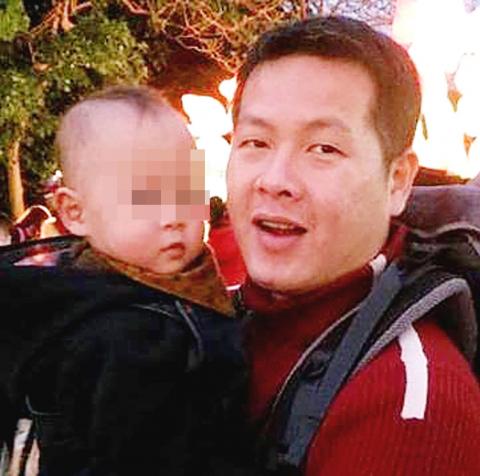
Screen grab from Lee Ming-wei’s Facebook account
It was not the first time Huang has cheated death.
She told her parents that she would have been on board TransAsia Airways Flight GE222 that crashed in Penghu during poor weather on July 23 last year, if she had not changed shifts with another colleague at the last minute.
Flight GE222 crashed just outside Magong Airport after aborting a prior landing attempt because of severe weather conditions caused by Typhoon Matmo. Of the 58 passengers and crew on board, 48 were killed.
After visiting her in hospital, Huang’s parents quoted her as saying: “I thought I would have died.”
A 15-month-old passenger, surnamed Lin (林), who is suffering from pneumonia and a fever, and remained in intensive care at Taipei City Hospital’s Zhongxiao Branch as of press time yesterday, is also among the lucky few survivors.
Lin was traveling with his 34-year-old father, Lin Ming-wei (林明威), and mother, Chiang Yu-ying (江郁穎), both of whom were only mildly injured.
According to the boy’s uncle, Lin Ming-yi (林明毅), the family of three might not have escaped death if Lin Ming-wei had not requested to move his family toward the rear of the plane after boarding.
The decision allowed the trio to make it out of the plane without being blocked by obstacles, he said.
“My brother told me that after the crash he was held in his seat by his seat belt and was not thrown out of the plane. The minute he saw water flooding into the cabin, he immediately unfastened himself to save his wife and kid,” Lin Ming-yi told reporters.
Lin Ming-yi said that although by the time Lin Ming-wei found his son, he had already been submerged upside down in cold water for three minutes and his heart had stopped beating, he was able to resuscitate his boy by swiftly removing mud out of his mouth and administering cardiopulmonary resuscitation.
In addition to deceased 42-year-old pilot, Liao Chien-tsung (廖建宗), who was believed to have tried to steer the plane away from buildings to avoid further casualties, a 72-year-old passenger, named Huang Ching-shun (黃金順), has also received wide applause for reportedly helping four other passengers near him to unfasten their seat belts and escape.
In an interview with reporters yesterday, Hunag, who only sustained minor injuries, said he could tell how much Liao had tried to avoid crashing into buildings, before giving his best wishes to the people he tried to pull out of the plane.
Asked if he would avoid traveling by plane in future, Huang said: “Life and death are all predestined. I will still choose to travel by airplane, regardless of the airline.”

Considering that most countries issue more than five denominations of banknotes, the central bank has decided to redesign all five denominations, the bank said as it prepares for the first major overhaul of the banknotes in more than 24 years. Central bank Governor Yang Chin-lung (楊金龍) is expected to report to the Legislative Yuan today on the bank’s operations and the redesign’s progress. The bank in a report sent to the legislature ahead of today’s meeting said it had commissioned a survey on the public’s preferences. Survey results showed that NT$100 and NT$1,000 banknotes are the most commonly used, while NT$200 and NT$2,000

The Centers for Disease Control (CDC) yesterday reported the first case of a new COVID-19 subvariant — BA.3.2 — in a 10-year-old Singaporean girl who had a fever upon arrival in Taiwan and tested positive for the disease. The girl left Taiwan on March 20 and the case did not have a direct impact on the local community, it said. The WHO added the BA.3.2 strain to its list of Variants Under Monitoring in December last year, but this was the first imported case of the COVID-19 variant in Taiwan, CDC Deputy Director-General Lin Ming-cheng (林明誠) said. The girl arrived in Taiwan on

South Korea is planning to revise its controversial electronic arrival card, a step Taiwanese officials said prompted them to hold off on planned retaliatory measures, a South Korean media report said yesterday. A Yonhap News Agency report said that the South Korean Ministry of Foreign Affairs is planning to remove the “previous departure place” and “next destination” fields from its e-arrival card system. The plan, reached after interagency consultations, is under review and aims to simplify entry procedures and align the electronic form with the paper version, a South Korean ministry official said. The fields — which appeared only on the electronic form

The Ministry of Foreign Affairs (MOFA) is suspending retaliation measures against South Korea that were set to take effect tomorrow, after Seoul said it is updating its e-arrival system, MOFA said today. The measures were to be a new round of retaliation after Taiwan on March 1 changed South Korea's designation on government-issued alien resident certificates held by South Korean nationals to "South Korea” from the "Republic of Korea," the country’s official name. The move came after months of protests to Seoul over its listing of Taiwan as "China (Taiwan)" in dropdown menus on its new online immigration entry system. MOFA last week


 RSS
RSS