


An exhibition featuring Chinese wood engravings depicting artistic representations of Taiwan around the time of the 228 Incident is currently on display in Greater Tainan.
The exhibition presents artworks by Chinese expatriates who lived in Taiwan between 1945 and 1949, the years when Taiwan experienced a turbulent shift from Japanese colonial rule to the Chinese Nationalist Party (KMT) regime, the 228 Memorial Foundation said.
The 228 Incident, which began on Feb. 27, 1947, refers to an uprising against the then-Chinese Nationalist Party (KMT) administration, which led to the murder of thousands of civilians, and nearly four decades of martial law in Taiwan.
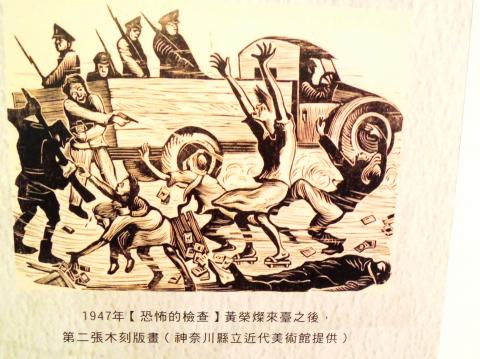
Photo: Tsai Wen-chu, Taipei Times
According to the foundation, the Chinese artists engraved Taiwan’s landscape against the background of contemporary society under the then-KMT regime.
Among them was Huang Rongcan (黃榮燦), an artist from Chongqing in China’s Sichuan Province.
An editor at a newspaper in Taiwan when the 228 Incident took place, Huang subsequently carved Horrifying Inspection (恐怖的檢查) in secret based on what he had heard from his colleagues, the foundation said.
Published in the Shanghai-based Wenhui Daily newspaper two months later, the piece became an iconic symbol of the massacre.
As the Chinese Civil War between the KMT and the Chinese Communist Party in China escalated, the political climate within Taiwan became increasingly volatile, prompting the artists to return to China, the foundation said, adding that since the KMT regime retreated to Taiwan and purged the island of “communist activities,” Taiwan has not seen any uncensored wood engraving since 1951.
The curator, Hung Wei-chien Studio, hunted through numerous collectors’ galleries to rediscover the precious artworks, whose artistic value is as significant as their visual documentation of the 228 Incident, the foundation said.
In addition to Huang’s engravings, the exhibition showcases nearly 100 artworks, including that of Zhu Minggang (朱鳴岡), Huang Yan, Wang Maigan (王麥桿), Huang Yongyu (黃永玉), Qiu Ling (邱陵), Wang Renfeng (汪刃鋒), Wu Zhonghan (吳忠翰), Zhang Xiya and Mai Fei (麥非).
The foundation said the exhibition had its opening at the National 228 Museum in Taipei last year, and was then held in Taitung, Hualien and Pingtung counties.
Its Tainan tour began on Saturday and is scheduled to run through Feb. 8.

Considering that most countries issue more than five denominations of banknotes, the central bank has decided to redesign all five denominations, the bank said as it prepares for the first major overhaul of the banknotes in more than 24 years. Central bank Governor Yang Chin-lung (楊金龍) is expected to report to the Legislative Yuan today on the bank’s operations and the redesign’s progress. The bank in a report sent to the legislature ahead of today’s meeting said it had commissioned a survey on the public’s preferences. Survey results showed that NT$100 and NT$1,000 banknotes are the most commonly used, while NT$200 and NT$2,000

The Centers for Disease Control (CDC) yesterday reported the first case of a new COVID-19 subvariant — BA.3.2 — in a 10-year-old Singaporean girl who had a fever upon arrival in Taiwan and tested positive for the disease. The girl left Taiwan on March 20 and the case did not have a direct impact on the local community, it said. The WHO added the BA.3.2 strain to its list of Variants Under Monitoring in December last year, but this was the first imported case of the COVID-19 variant in Taiwan, CDC Deputy Director-General Lin Ming-cheng (林明誠) said. The girl arrived in Taiwan on

South Korea is planning to revise its controversial electronic arrival card, a step Taiwanese officials said prompted them to hold off on planned retaliatory measures, a South Korean media report said yesterday. A Yonhap News Agency report said that the South Korean Ministry of Foreign Affairs is planning to remove the “previous departure place” and “next destination” fields from its e-arrival card system. The plan, reached after interagency consultations, is under review and aims to simplify entry procedures and align the electronic form with the paper version, a South Korean ministry official said. The fields — which appeared only on the electronic form

The Ministry of Foreign Affairs (MOFA) is suspending retaliation measures against South Korea that were set to take effect tomorrow, after Seoul said it is updating its e-arrival system, MOFA said today. The measures were to be a new round of retaliation after Taiwan on March 1 changed South Korea's designation on government-issued alien resident certificates held by South Korean nationals to "South Korea” from the "Republic of Korea," the country’s official name. The move came after months of protests to Seoul over its listing of Taiwan as "China (Taiwan)" in dropdown menus on its new online immigration entry system. MOFA last week


 RSS
RSS