


Big-name stars from the Chinese-language cinema industry yesterday gathered in Taipei for the 51st Golden Horse Awards ceremony.
Touted as the Chinese-language equivalent to the Oscars, the star-studded event saw Chinese celebrities Gong Li (鞏俐), Zhang Ziyi (章子怡), Hollywood actress Lily Collins and Japanese actor Masatoshi Nagase among the famous names on the red carpet ahead of a glamorous ceremony at the landmark Sun Yat-sen Memorial Hall.
Filmmakers, actors and actresses from across the Chinese-speaking world were greeted by enthusiastic crowds as they walked down the red carpet.

Photo: CNA
Collins made an appearance at the ceremony as a presenter.
A total of 38 films, including 14 Taiwanese productions, had been nominated in 21 categories.
Leading the pack this year was Chinese director Diao Yinan’s (刁亦男) thriller Black Coal, Thin Ice (白日焰火), which was a contender for best feature film, best director and best lead actor and actress.
Taiwanese director Umin Boya (馬志翔), director of the Taiwanese baseball drama Kano, said being nominated for the Golden Horse Awards allows the hard work of his film crew to be seen.
Kano was nominated for six Golden Horse awards and is the only Taiwanese production in contention for best feature film.
As of press time, the awards winners announced included best supporting actress, which went to China’s Regina Wan (萬茜). Wan claimed the award for her role as a prostitute in the Taiwanese movie Paradise in Service (軍中樂園). The award for best supporting actor went to Chinese actor Chen Jianbin (陳建斌), for his role in the same movie.
Paradise in Service is set at the height of tensions between Taiwan and China in the 1960s. It follows a young conscript as he arrives in Taiwan’s outlying island county of Kinmen to begin his military service.
Yee Chih-yen’s (易智言) Meeting Dr Sun (行動代號:孫中山) was awarded the Best Original Screenplay Golden Horse Award.
Meanwhile, Taiwanese actress Chen Shiang-chyi (陳湘琪) said she was hoping to win the best lead actress award for Taiwan cinema. Chen faced competition from fellow Taiwanese actress Gwei Lun-mei (桂綸鎂) and three Chinese actresses — Gong Li (鞏俐), Tang Wei (湯唯) and Zhao Wei (趙薇).
Additional reporting by AFP
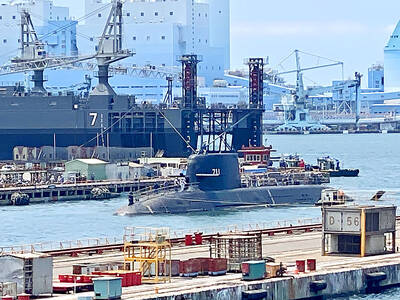
AGING: While Japan has 22 submarines, Taiwan only operates four, two of which were commissioned by the US in 1945 and 1946, and transferred to Taiwan in 1973 Taiwan would need at least 12 submarines to reach modern fleet capabilities, CSBC Corp, Taiwan chairman Chen Cheng-hung (陳政宏) said in an interview broadcast on Friday, citing a US assessment. CSBC is testing the nation’s first indigenous defense submarine, the Hai Kun (海鯤, Narwhal), which is scheduled to be delivered to the navy next month or in July. The Hai Kun has completed torpedo-firing tests and is scheduled to undergo overnight sea trials, Chen said on an SET TV military affairs program. Taiwan would require at least 12 submarines to establish a modern submarine force after assessing the nation’s operational environment and defense

A white king snake that frightened passengers and caused a stir on a Taipei MRT train on Friday evening has been claimed by its owner, who would be fined, Taipei Rapid Transit Corp (TRTC) said yesterday. A person on Threads posted that he thought he was lucky to find an empty row of seats on Friday after boarding a train on the Bannan (Blue) Line, only to spot a white snake with black stripes after sitting down. Startled, he jumped up, he wrote, describing the encounter as “terrifying.” “Taipei’s rat control plan: Release snakes on the metro,” one person wrote in reply, referring
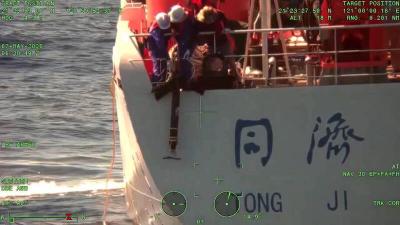
The coast guard today said that it had disrupted "illegal" operations by a Chinese research ship in waters close to the nation and driven it away, part of what Taipei sees a provocative pattern of China's stepped up maritime activities. The coast guard said that it on Thursday last week detected the Chinese ship Tongji (同濟號), which was commissioned only last year, 29 nautical miles (54km) southeast of the southern tip of Taiwan, although just outside restricted waters. The ship was observed lowering ropes into the water, suspected to be the deployment of scientific instruments for "illegal" survey operations, and the coast
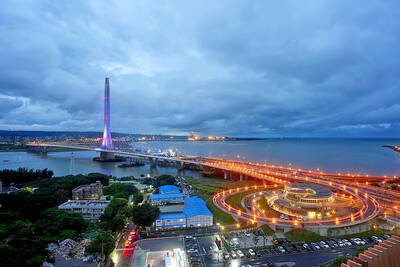
An inauguration ceremony was held yesterday for the Danjiang Bridge, the world’s longest single-mast asymmetric cable-stayed bridge, ahead of its official opening to traffic on Tuesday, marking a major milestone after nearly three decades of planning and construction. At the ceremony in New Taipei City attended by President William Lai (賴清德), Premier Cho Jung-tai (卓榮泰), Minister of Transportation and Communications Chen Shih-kai (陳世凱) and New Taipei City Mayor Hou Yu-ih (侯友宜), the bridge was hailed as both an engineering landmark and a long-awaited regional transport link connecting Tamsui (淡水) and Bali (八里)


 RSS
RSS