


At 70 years old, Taiwan’s World War II-era Hai Pao submarine would not be out of place in a museum, but the antique vessel is still part of the navy — a sign of the nation’s ongoing struggle to strengthen its fleet.
The sub’s interior gleams with highly polished copper and is the pride of its crew, but the fact that the former US warship is still on active duty is testament to Taiwan’s decades-long battle to build up its submarine force, with potential suppliers wary of jeopardizing relations with China.
China has opposed any arms sales to Taiwan.
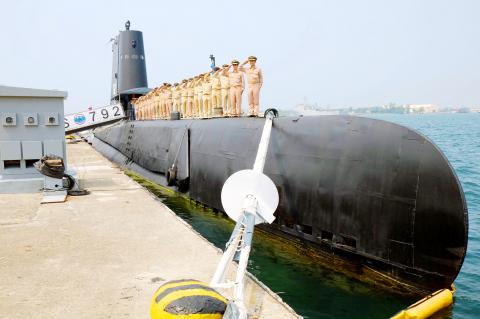
Photo: AFP
Yet a modern submarine fleet is critical for Taiwan’s defense, analysts say.
“Submarines would be a credible, survivable deterrent to an opponent’s use of force and thus make use of force less likely,” said Mark Stokes, executive director of the Project 2049 Institute, a US-based think tank on Asian security and public policy. “They would complicate [China’s] People’s Liberation Army planning in a variety of scenarios.”
Then-US president George W. Bush approved the sale of eight conventional submarines to Taiwan in April 2001, but they never materialized as Washington focused on its development of nuclear subs.
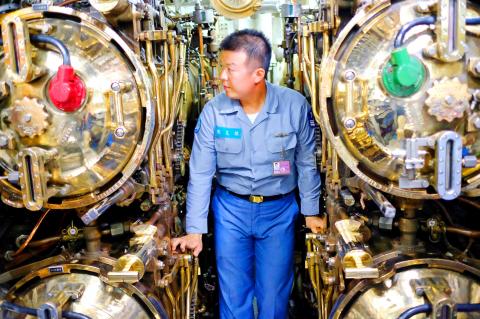
Photo: AFP
Germany and Spain, two of the world’s few submarine exporting countries, have also declined to supply Taiwan in what commentators interpret as fear of offending China.
Aside from two aging subs built in the 1940s, Taiwan’s navy operates two other Dutch-built submarines which were commissioned in the late 1980s.
The number is in stark contrast to the Chinese navy, which now owns more than 60 submarines, including 14 that are nuclear-powered.
An official evaluation this year of a potential domestic submarine-building project was “pretty positive,” Chinese Nationalist Party (KMT) Legislator Lin Yu-fang (林郁方) said, who sits on the legislature’s Foreign Affairs and National Defense Committee.
“The government might set aside a budget to officially launch the Indigenous Defense Submarine project,” he said, though the proposals have yet to be given the green light.
Taiwan is seeking to collaborate with the US on the project, Lin said.
The US remains the nation’s leading arms supplier, despite a lack of diplomatic ties.
Taiwan produced 130 Indigenous Defense Fighter (IDF) jets with technological aid from the US in the 1990s.
That project came after the US had refused to sell jet fighters to Taiwan, under pressure from Beijing.
Lin and a legislative group recently returned from Washington, where they discussed defense supply plans with government officials and representatives, focusing on the potential sub program.
“They used to be cold on the issue [of submarines], but this time was different. They were listening attentively when we raised the issue again. They have changed their attitude because we have become active on the deal,” Lin said.
Supporters of the project say Washington could reduce political pressure from Beijing if it supplies fighting systems and know-how, rather than the new submarines themselves.
For now, Taiwan’s two World War II-era Guppy submarines — including the Hai Pao. whose name means “Seal” — remain central to their fleet.
Taiwan bought the Hai Pao, then called Tusk, from the US in 1973 and the vintage sub recently returned from the nation’s biggest annual naval war game.
The fleet also includes the aging Hai Shih, or “Sea Lion” — another former US submarine built in the 1940s.
Captain of the Hai Pao Liu Si-wei said that his US peers were astonished to hear the antique subs were still in service.
Liu finished an advanced submarine officer training program in the US last year and several of his classmates are now captains of US nuclear-powered submarines.
“When they heard that the two submarines were still on active duty, several of my classmates said: ‘Fantastic.’ They told me, if permitted, they would like very much to have a look at them,” Liu said from on board the Hai Pao, which was docked at the Tso-ying naval base.
The navy is planning to spend more than NT$800 million (US $26.35 million) to overhaul one of the old subs next year.
Both will get new hulls as they are currently unable to dive more than 20m — less than a 10th of their design depth — due to warped pressure hulls and metal fatigue.
Taiwan’s ultimate ambitions to build its own subs are not pie in the sky, says Stokes — Taiwan has already built a 400,000-tonne oil tanker and seven navy frigates, among other vessels.
“The submarine program would mostly likely be based on a new design or a significant modification of an existing design,” Stokes said.
“Taiwan’s shipbuilding industry is one of the best in the world,” he said.

NATIONAL SECURITY: Authorities are working to confirm the identities of the military personnel involved and investigating possible illegal conduct and regulatory violations Authorities are probing possible national security implications after Kinmen police and immigration officers on Sunday found a Chinese woman allegedly posing as a tourist while engaging in prostitution involving more than 10 military personnel. The woman, surnamed Chen (陳), has since been deported, authorities said, adding that investigators are still working to confirm the identities of those implicated, as the records only listed code names and aliases. The case stemmed from a report received by the Kinmen District Prosecutors’ Office on Friday last week from the Jinhu Precinct of the Kinmen County Police Bureau. On Sunday, police, along with the National Immigration
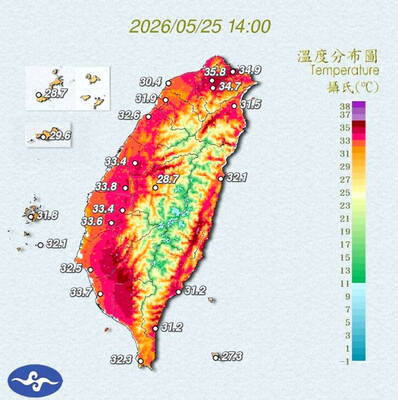
STAY COOL: The HPA recommended that people stay hydrated, use air-conditioning or fans while indoors, wear loose-fitting clothes and walk in the shade while outdoors Employers must implement measures such as installing cooling equipment, and providing drinking water and rest breaks for outdoor workers starting from Monday next week, the Taipei Department of Labor said on Sunday. Employers who fail to comply could face fines of NT$30,000 to NT$300,000 under the Occupational Safety and Health Act (職業安全衛生法), the department said. Businesses in Taipei employing fewer than 100 workers, as well as registered self-employed workers with labor insurance coverage, could receive on-site assessments and guidance from occupational safety consultants to help them apply for central government subsidies to implement or improve heat-protection measures, it said. Under the Ministry of

GLOBALGIVING: ‘ Caving to external pressure is not acceptable for an organization that has cultivated justice reform and human rights for 30 years,’ one NGO said A slew of non-government organizations (NGOs) have withdrawn from the GlobalGiving fundraising platform after it announced it would use “Chinese Taipei” instead of “Taiwan” from next month. The Taiwan Good Rice Association wrote on Facebook on Friday that it was informed on April 28 via a teleconference call of the change, which was made because the platform wanted to operate in China. Taiwan Good Rice is to terminate all cooperative relationships with GlobalGiving in response to the platform’s “unilateral and non-negotiable” decision to remove references to Taiwan, the NGO said. “Taiwan is in the official name of Taiwan Good Rice Association and the

Chinese Nationalist Party (KMT) Chairwoman Cheng Li-wun (鄭麗文) yesterday briefed her party’s Central Standing Committee regarding her scheduled visit to the US between Monday next week and June 16, saying that her purpose would be to persuade the US that the Republic of China (ROC) Constitution was a “one China” constitution that would foster stable and peaceful cross-strait relations. The ROC Constitution is the most important defense for all Taiwanese citizens, as it upholds our democracy and has contributed to our robust economy, which aligns with international and US interests, she said. “We would not be troublemakers and drag the US under,”


 RSS
RSS