


The Mainland Affairs Council (MAC) on Thursday blasted China’s Taiwan Affairs Office for “lacking wisdom” in its response to President Ma Ying-jeou’s (馬英九) expressions of sympathy for pro-democracy protesters in Hong Kong.
“We would hope the mainland side has the wisdom to deal with President Ma’s [Double Ten National Day] speech in a rational manner, but as of present they have evidently not done so,” MAC spokeswoman Wu Mei-hung (吳美紅) said.
She said that Ma’s remarks were made out of goodwill, as “people from both sides of the Taiwan Strait share the same Chinese ancestry.”
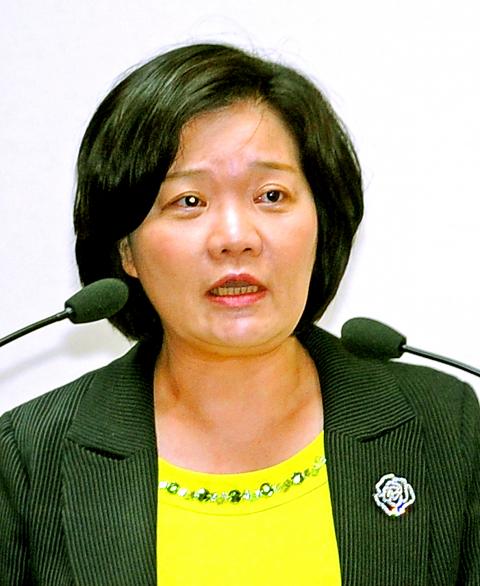
Photo: Fang Pin-chao, Taipei Times
Democracy and the rule of law “can close the psychological gap” between Taiwanese and Chinese and is deeply meaningful to the long-term development of cross-strait relations, she said.
Wu’s comments came a day after China’s Taiwan Affairs Office spokeswoman Fan Liqing (范麗青) said the direct election of Hong Kong’s chief executive in 2017 represents a “big stride” for the semi-autonomous region’s political system.
Fan implicitly framed Ma’s call for democracy as irresponsible and frivolous.
In his address, Ma expressed “strong support” for Hong Kongers who have been protesting for a greater say in the election of their chief executive.
“The democratic development of mainland China and Hong Kong will be determined by the wisdom and character that the mainland Chinese leaders show in their attitude toward reform,” he said.
Meanwhile, Wu on Thursday said that the MAC has yet to begin talks with China about a possible meeting between MAC Minister Wang Yu-chi (王郁琦) and China’s Taiwan Affairs Office Minister Zhang Zhijun (張志軍) during November’s APEC summit in Beijing.
“I believe we will begin our contact [on this issue] with the mainland side soon,” she said.
In related news, Chinese Nationalist Party (KMT) spokesperson Charles Chen (陳以信) on Thursday urged China to appreciate the goodwill of Taiwan evidenced by Ma touching on Hong Kong during his National Day address.
Chen reiterated that democracy is the core value of Taiwanese society and that the KMT is greatly concerned about and supports the appeals for Hong Kong democracy with peace and reason.
Chen said Ma’s remarks were his suggestion in view of global democratic trends and that the president is convinced that China is capable of implementing democracy.
Ma’s remarks were by no means irresponsible and China should welcome Taiwan’s goodwill, he added.
Chen said the KMT hopes that Chinese authorities can understand the protesters’ deep aspiration toward free elections and would allow “some people to become democratic first.”
“[This] would definitely be a win-win scenario for both the mainland and Hong Kong, and would be strongly welcomed by the people of Taiwan,” he said.

Considering that most countries issue more than five denominations of banknotes, the central bank has decided to redesign all five denominations, the bank said as it prepares for the first major overhaul of the banknotes in more than 24 years. Central bank Governor Yang Chin-lung (楊金龍) is expected to report to the Legislative Yuan today on the bank’s operations and the redesign’s progress. The bank in a report sent to the legislature ahead of today’s meeting said it had commissioned a survey on the public’s preferences. Survey results showed that NT$100 and NT$1,000 banknotes are the most commonly used, while NT$200 and NT$2,000

The Centers for Disease Control (CDC) yesterday reported the first case of a new COVID-19 subvariant — BA.3.2 — in a 10-year-old Singaporean girl who had a fever upon arrival in Taiwan and tested positive for the disease. The girl left Taiwan on March 20 and the case did not have a direct impact on the local community, it said. The WHO added the BA.3.2 strain to its list of Variants Under Monitoring in December last year, but this was the first imported case of the COVID-19 variant in Taiwan, CDC Deputy Director-General Lin Ming-cheng (林明誠) said. The girl arrived in Taiwan on

South Korea is planning to revise its controversial electronic arrival card, a step Taiwanese officials said prompted them to hold off on planned retaliatory measures, a South Korean media report said yesterday. A Yonhap News Agency report said that the South Korean Ministry of Foreign Affairs is planning to remove the “previous departure place” and “next destination” fields from its e-arrival card system. The plan, reached after interagency consultations, is under review and aims to simplify entry procedures and align the electronic form with the paper version, a South Korean ministry official said. The fields — which appeared only on the electronic form

The Ministry of Foreign Affairs (MOFA) is suspending retaliation measures against South Korea that were set to take effect tomorrow, after Seoul said it is updating its e-arrival system, MOFA said today. The measures were to be a new round of retaliation after Taiwan on March 1 changed South Korea's designation on government-issued alien resident certificates held by South Korean nationals to "South Korea” from the "Republic of Korea," the country’s official name. The move came after months of protests to Seoul over its listing of Taiwan as "China (Taiwan)" in dropdown menus on its new online immigration entry system. MOFA last week


 RSS
RSS