


Brisk walking is one of the easiest weight-bearing exercises, and helps increase bone mineral density, which often decreases with age, but nearly 80 percent of walkers fail to walk at a pace vigorous enough to benefit bone density, the Taiwanese Osteoporosis Association said.
Association director-general Chen Fang-ping (陳芳萍) said that a woman’s bone mineral density usually peaks between the age of 30 and 35, but it starts decreasing by an average of 1 to 2 percent after she reaches 40.
“The rate of decrease further accelerates after menopause, by 3 to 5 percent annually,” Chen said.
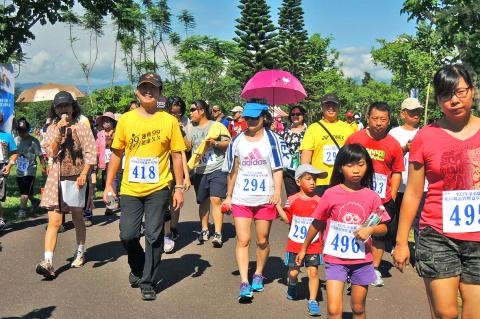
Photo: Chang Tsun-wei, Taipei Times
Chen added that men aged from 61 to 70 have a fatality rate of 22 percent one year after suffering a hip fracture, compared with just 15 percent among women in the same age group.
Citing research published in 2007 by the English-language journal Bone, Chen said research showed a 0.4 percent increase in the bone mineral density of post-menstrual women after they completed a 15-week program of brisk walking, which required them to walk 4.8km at a pace of 6.3kph to 6.4kph five times a week.
“The US Centers for Disease Control and Prevention and the Journal of the American Medical Association define brisk walking as a pace of from 4.8kph to 6.3kph, but nearly 80 percent of 500 respondents to a recent online poll conducted by Pollster Technology Marketing at the association’s request said they walked at less than 3kph,” Chen said.
Chen said in addition to doing weight-bearing exercise regularly, other effective ways to prevent osteoporosis — a disease in which the density and quality of bones is reduced — include increasing exposure to sunlight and boosting calcium intake.
Health and Exercise Association speed-walking instructor Tu Hsin-yu (涂馨友) said people should speed-walk to pop music of 90 to 120 beats per minute, such as Taiwanese diva A-mei’s (阿妹) Bad Boy, to lift their mood and help them work out longer.

Considering that most countries issue more than five denominations of banknotes, the central bank has decided to redesign all five denominations, the bank said as it prepares for the first major overhaul of the banknotes in more than 24 years. Central bank Governor Yang Chin-lung (楊金龍) is expected to report to the Legislative Yuan today on the bank’s operations and the redesign’s progress. The bank in a report sent to the legislature ahead of today’s meeting said it had commissioned a survey on the public’s preferences. Survey results showed that NT$100 and NT$1,000 banknotes are the most commonly used, while NT$200 and NT$2,000

The Centers for Disease Control (CDC) yesterday reported the first case of a new COVID-19 subvariant — BA.3.2 — in a 10-year-old Singaporean girl who had a fever upon arrival in Taiwan and tested positive for the disease. The girl left Taiwan on March 20 and the case did not have a direct impact on the local community, it said. The WHO added the BA.3.2 strain to its list of Variants Under Monitoring in December last year, but this was the first imported case of the COVID-19 variant in Taiwan, CDC Deputy Director-General Lin Ming-cheng (林明誠) said. The girl arrived in Taiwan on

South Korea is planning to revise its controversial electronic arrival card, a step Taiwanese officials said prompted them to hold off on planned retaliatory measures, a South Korean media report said yesterday. A Yonhap News Agency report said that the South Korean Ministry of Foreign Affairs is planning to remove the “previous departure place” and “next destination” fields from its e-arrival card system. The plan, reached after interagency consultations, is under review and aims to simplify entry procedures and align the electronic form with the paper version, a South Korean ministry official said. The fields — which appeared only on the electronic form

The Ministry of Foreign Affairs (MOFA) is suspending retaliation measures against South Korea that were set to take effect tomorrow, after Seoul said it is updating its e-arrival system, MOFA said today. The measures were to be a new round of retaliation after Taiwan on March 1 changed South Korea's designation on government-issued alien resident certificates held by South Korean nationals to "South Korea” from the "Republic of Korea," the country’s official name. The move came after months of protests to Seoul over its listing of Taiwan as "China (Taiwan)" in dropdown menus on its new online immigration entry system. MOFA last week


 RSS
RSS