


Democratic Progressive Party (DPP) Hsinchu City Councilor Lin Chih-chien (林智堅), running as the party’s candidate for the Hsinchu mayoral election, has been described as an “incorrigible optimist” by one of his officer staffers.
In 2000, Lin launched his political career working at DPP Legislator Ker Chien-ming’s (柯建銘) office as an aide and has slowly built up his connections and ties with Hsinchu over the past 14 years.
In a recent interview with the Liberty Times (the Taipei Times’ sister paper), Lin said he is certain that by doing his best and shouldering his responsibilities well, he can eventually shift the region’s predominantly Chinese Nationalist Party-supporting (KMT) voter base toward the DPP.
While pundits have called Lin’s decision to run for Hsinchu mayor risky, as he could run for re-election to the city council instead, which he would almost certainly win, Lin said he entered the mayoral race because “someone has to do the dirty work.”
Lin, 39, said he hopes that the Nov. 29 election will show Hsinchu City residents that the race is a clean one, devoid of political machinations and calculations.
Lin said that from when he first entered politics, he has exhibited the creativity of youth, promoting the restoration of the Hsinchu City Zoo, the Shihchieh-Datong Cultural Creative Market and the CHEESE Drama Mobile.
In the cultural creative market initiative, artists and other members of the cultural creative industry were invited to move to the intersection of Hsinchu City’s Datong and Shihchieh streets to form a small cultural creative zone. The drama mobile is a mobile platform that puts on theater shows for children.
Lin said his wide range of interests — from the quality of medical care and education, to culture and financial management — have put him in the spotlight during his time as city councilor.
Despite his busy schedule as city councilor, Lin said he nonetheless found the time to apply for and be admitted to National Taiwan University’s graduate institute of national development to pursue further studies on cross-strait politico-economic issues.
Lin said he is also extremely concerned with legal matters regarding women and children as he is father to a three year-old child and is expecting a second.
“I hope to ameliorate the issues with the city’s family policies and create a friendlier environment for families with young children,” he said.
Commenting on his rival, Hsinchu Mayor Hsu Ming-tsai (許明財) of the KMT, Lin said Hsu’s greatest mistakes were to cut subsidies for the elderly and insist on building the Taiwan Global Mall.
The project cost the city government NT$1.5 billion (US$51.13 million), but draws very few visits from local residents, Lin said.
Furthermore, Hsu has been putting city officials in a hard spot by not having the guts to own up to his mistake, Lin said, adding that Hsu’s political career is more tech-specific than his own, which may be what has decreased the mayor’s popularity.
“Hsu’s team is not using public resources adequately and that is something that I wish to change,” Lin said, adding he would show Hsinchu City residents that he is responsible and mature enough to take on city governance despite his relatively young age.


UPGRADE: The Kang Ding-class frigate is replacing its Chaparall missiles with Tien Chien II and Hua Yang VLS, which would provide it with long-range, 360° air defense Taiwan plans to produce 1,200 to 1,376 Hai Chien II missiles (海劍二, Sea Sword II) — also known as TC-2N — to serve as the standard air defense system of the navy’s surface combatant fleet, a source said yesterday. Last week, the Hai Chien II, the naval version of the Tien Kung II missile (天劍二, Sky Sword II), completed a live-fire test in waters off the National Chungshan Institute of Science and Technology’s Jiupeng facility (九鵬) in Pingtung County’s Manjhou Township (滿州). The MIM72 Chaparral and other dated air defense missiles that currently arm Taiwanese ships have inadequate range to combat Chinese

REASONS FOR TRAVEL: An assistant professor said that proposed amendments to penalize drivers if they used drugs overseas would not deter people from traveling People who operate a motor vehicle under the influence of marijuana would have their driver’s license revoked, even if they used the substance while overseas, the Ministry of Transportation and Communications said yesterday, citing proposed amendments to the Road Traffic Management and Penalty Act (道路交通管理處罰條例). The amendments would also authorize the government to revoke the licenses of people determined to have used Category 1 or Category 2 narcotics, even if they were not operating a vehicle while under the influence of drugs, as well as ban them from taking the license test for three years, the ministry said. People aged 18 or
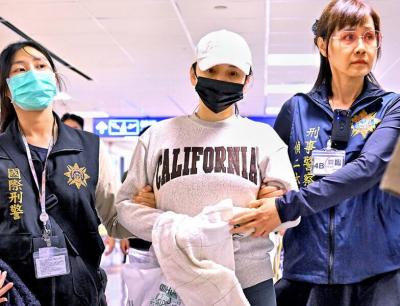
Johanne Liou (劉喬安), a Taiwanese woman who shot to unwanted fame during the Sunflower movement protests in 2014, returned to Taiwan last night after being deported from the US. She is to stand trial in Taiwan for charges involving embezzlement, fraud and drug crimes. The Criminal Investigation Bureau (CIB) said it took her into custody at Taiwan Taoyuan International Airport and would first question her before transferring her to the New Taipei District Prosecutors’ Office. She was arrested upon disembarking a flight from San Francisco that landed shortly before 7pm. Liou absconded to the US in 2019 after jumping bail
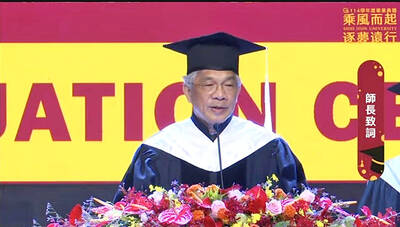
Shih Hsin University President Chen Ching-he (陳清河) yesterday issued a public apology for comments made in his commencement speech last week, stating that he has asked the school to suspend his duties and halt his wages for two months as a show of contrition. At the commencement ceremony on May 30, Chen said, “If you don’t manage your time well, or your own emotions, or your health, then I am telling every one of you — put a quick end to ‘you,’ because the world has no need for ‘you.’” The comments have sparked significant controversy online, and Chen through an open


 RSS
RSS