


Taipei City Councilor Chung Hsiao-ping (鍾小平) of the Chinese Nationalist Party (KMT) accused the Xinyi District (信義) Police Precinct of having received bribes from nightclubs and other entertainment businesses within its jurisdiction, amounting to running a protection racket.
Chung said he got the inside information direct from a nightclub owner.
“There are three different groups in the Xinyi District Police Precinct who receive ‘protection money,’ and each establishment pays up to NT$100,000 each month,” said Chung, alleging a top policeman surnamed Shih (石), former deputy chief at the precinct, demanded the highest price, about NT$100,000 to NT$150,000 from each club every month.
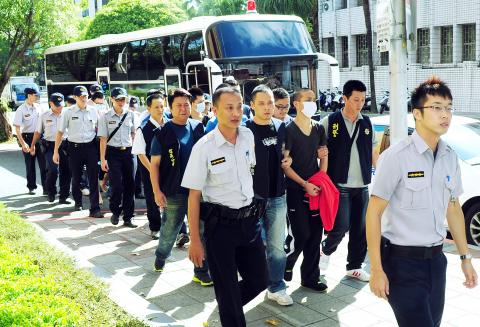
Photo: Lo Pei-der, Taipei Times
Chung filed an official complaint with the Taipei City Police Department’s Office of Ethics yesterday.
Chung said Hsueh was among the most corrupt members of the police force, alleging Hsueh played the role of a “white glove” intermediary, collecting bribes and distributing them among his precinct associates.
“I take legal responsibility on these charges. I am willing to give up my judicial immunity as a city councilor,” Chung said.
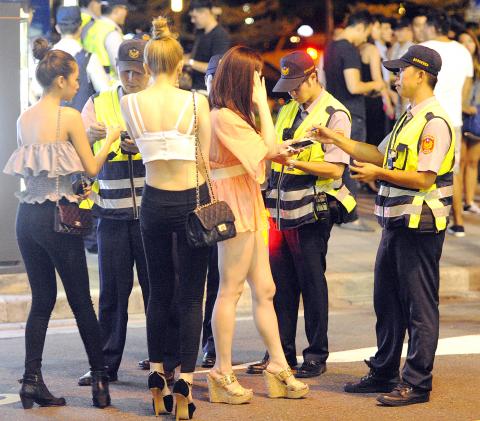
Photo: Liao Chen-huei, Taipei Times
In related developments, three military personnel have been implicated in last Sunday’s killing of an off-duty police officer outside the Spark ATT nightclub in Taipei’s Xinyi District (信義).
Police detective Hsueh Chen-kuo (薛貞國) was beaten to death in a brawl involving about 50 people. Wan Shao-cheng (萬少丞), who allegedly played a key role in the case, turned himself in to the police on Friday following a manhunt.
A report in the Chinese-language United Evening News yesterday implicated three military police officers, Wang Pei-an (王培安), Tung Yu-tang (董玉堂) and Ma Yin-hung (馬寅紘), who are in the 202nd Military Police Command, under which is the Military Police 211st Barracks, responsible for patrol and security around the Presidential Office Building.
In response to the United Evening News report, Ministry of Defense spokesman Colonel David Lo (羅紹和) yesterday said that only Tung is a military police officer. The other two are army soldiers, he said.
Lo confirmed that Tung is in the 202nd Military Police Command, but said that “Tung’s unit is for logistics support. He is not part of the 211st Barracks, and has no role in the security of the president or the vice president.”
During questioning by investigators, Tung was quoted as saying that he saw the incident unfold, but did not take part in the fighting. Wang and Ma also were quoted as saying that they were just passing by, and were not involved in the case.
Investigators said they were looking into the trio’s testimony.
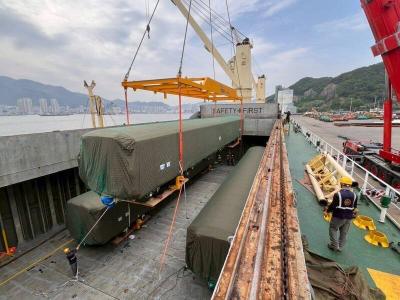
The first of 10 new high-capacity trains purchased from South Korea’s Hyundai Rotem arrived at the Port of Taipei yesterday to meet the demands of an expanding metro network, Taipei Rapid Transit Corp (TRTC) said yesterday. The train completed a three-day, 1,200km voyage from the Port of Masan in South Korea, the company said. Costing NT$590 million (US$18.79 million) each, the new six-carriage trains feature a redesigned interior based on "human-centric" transportation concepts, TRTC said. The design utilizes continuous longitudinal seating to widen the aisles and optimize passenger flow, while also upgrading passenger information displays and driving control systems for a more comfortable
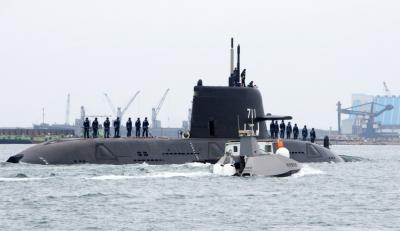
Taiwan's first indigenous defense submarine, the SS-711 Hai Kun (海鯤, or Narwhal), departed for its 13th sea trial at 7am today, marking its seventh submerged test, with delivery to the navy scheduled for July. The outing also marked its first sea deployment since President William Lai (賴清德) boarded the submarine for an inspection on March 19, drawing a crowd of military enthusiasts who gathered to show support. The submarine this morning departed port accompanied by CSBC Corp’s Endeavor Manta (奮進魔鬼魚號) uncrewed surface vessel and a navy M109 assault boat. Amid public interest in key milestones such as torpedo-launching operations and overnight submerged trials,
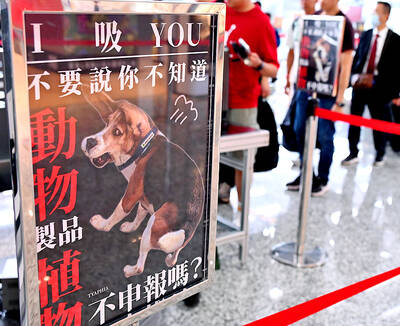
Quarantine awareness posters at Taiwan Taoyuan International Airport have gone viral for their use of wordplay. Issued by the airport branch of the Animal and Plant Health Inspection Agency, the posters feature sniffer dogs making a range of facial expressions, paired with advisory messages built around homophones. “We update the messages for holidays and campaign needs, periodically refreshing materials to attract people’s attention,” quarantine officials said. “The aim is to use the dogs’ appeal to draw focus to quarantine regulations.” A Japanese traveler visiting Taiwan has posted a photo on X of a poster showing a quarantine dog with a
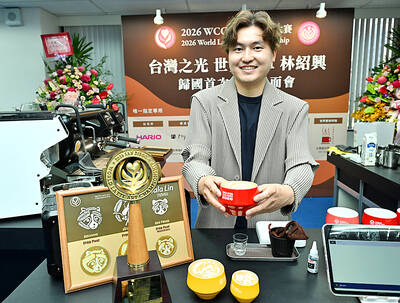
Taiwan’s coffee community has launched a “one-person-one-e-mail” campaign, calling for people to send a protest-e-mail to the World Coffee Championships (WCC) urging it to redesignate Taiwanese competitors as from “Taiwan,” rather than “Chinese Taipei.” The call followed sudden action last week after the WCC changed all references to Taiwanese competitors from “Taiwan” to “Chinese Taipei,” including recent World Latte Art champion Bala (林紹興), who won the World Latte Art Championship in San Diego earlier this month. When Bala received the trophy, he was referred to as representing Taiwan, as well as in the announcement on the WCC’s Web site, until it


 RSS
RSS