


Electric carts packed with tourists twist and turn their way past farmland and alleyways, stopping at war museums, former military facilities and scenic spots, giving visitors a glimpse of Kinmen’s wartime history and natural beauty.
The route is one of three electric cart tours offered in Kinmen, which has been designated one of the nation’s “exemplary low-carbon islands.”
The two-hour guided tour of northwestern Kinmen stops at the Guningtou War Museum, which commemorates the 1949 Battle of Guningtou.
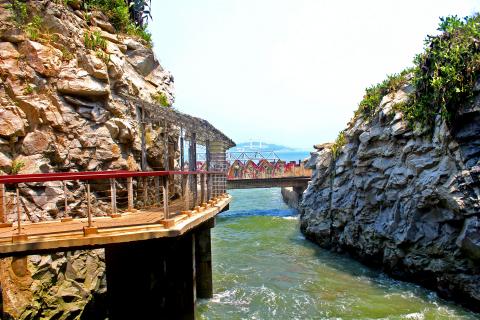
Photo: CNA
The other major stop is at Beishan Broadcasting Station, a three-story-high concrete structure holding 48 loudspeakers that were used to broadcast propaganda across the Taiwan Strait to China until the late 1970s. The station is located on a cliff 6.4km from China.
The tour, introduced in 2012, also takes visitors to traditional residential communities, rock-oyster farms, wetlands and a peace memorial park. At present, the cost is only NT$10 (US$0.33) per person, as the local government is seeking to promote green-energy choices such as the electric carts in an effort to turn Kinmen into a model low-carbon island.
“The electric carts are environmentally friendly and take visitors to places such as Beishan Broadcasting Station and Beishan Settlement, which are not easily accessible by buses and cars,” Kinmen County Tourism Department section chief Chen Ming-ling said.
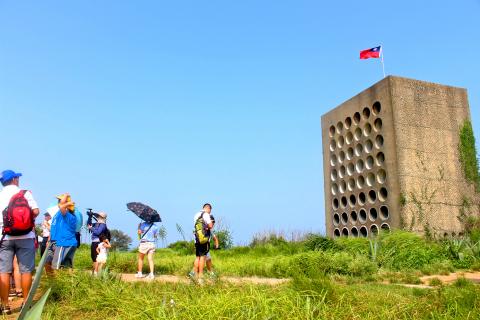
Photo: CNA
The tour brings business to shops and vendors in traditional communities, which were not previously frequented by ordinary tourists, she added.
“Many shop owners have told us that business has improved,” Chen said, adding that the electric cart tours are fully booked every day in the summer.
In May, two similar tours were launched on Lieyu (烈嶼), also known as Little Kinmen, one to war relic sites and a landmine museum, and the other to temples and other cultural and historic sites. The Lieyu tours cost NT$100 per person but customers receive an NT$50 “carbon coupon” that can be used at participating stores on the island.
For visitors who wish to travel around Lieyu by themselves, there is an eco-friendly option. A fleet of 100 electric scooters is now available for rent at Jiugong Pier in Lieyu. Non-Kinmen residents are charged NT$150 and locals NT$100 for the first four hours of use and NT$10 per hour afterward. Rental of the scooters also comes with a NT$50 carbon coupon per scooter.
Tina Wu, who works at the company that was commissioned by the county government to run the electric scooter rental service, said the new service has become popular among visitors to the island.
“The scooters save gas money, do not create air pollution, and are convenient, light and quiet,” Wu said.
As of the end of last month, more than 3,100 people had taken the Lieyu tours, the head of Kinmen County’s Environmental Protection Bureau Yang Shih-hung (楊世宏) said.
Since May, the electric scooters have been rented more than 3,900 times, he added. As part of the county government’s efforts to help local industries and households use green energy, about 3,200 solar-powered water heating systems were installed on the island last year, he said.
In addition, all of the street lights in Lieyu and more than 50 percent of those in Greater Kinmen have been changed to more environmentally friendly LED lights, he said.
The idea of making Kinmen an exemplary low-carbon island came out of the 2009 National Energy Conference. The objective was to create two low-carbon communities in each city and county in Taiwan within two years, four low-carbon cities and two low-carbon islands by this year, and four low-carbon living circles in northern, central, southern and eastern Taiwan by 2020.
The government and private sector also earmarked more than NT$4.3 billion last year for a six-year project to reduce Kinmen’s carbon dioxide emissions. The plan is to gradually build Kinmen into an island with zero-carbon emissions by 2030, according to the Environmental Protection Administration.
The agency estimated that the Kinmen project would generate NT$821 million in economic benefits per year and reduce emissions by 600,000 tonnes over the six-year period.
Visitors to the island seem to find its green focus appealing.
“It is eco-friendly and visitors can see the different faces of Kinmen, which are very different from Taiwan proper,” said Jimmy Liang, a first-time visitor to Kinmen who took the Guningtou tour.

REASONS FOR TRAVEL: An assistant professor said that proposed amendments to penalize drivers if they used drugs overseas would not deter people from traveling People who operate a motor vehicle under the influence of marijuana would have their driver’s license revoked, even if they used the substance while overseas, the Ministry of Transportation and Communications said yesterday, citing proposed amendments to the Road Traffic Management and Penalty Act (道路交通管理處罰條例). The amendments would also authorize the government to revoke the licenses of people determined to have used Category 1 or Category 2 narcotics, even if they were not operating a vehicle while under the influence of drugs, as well as ban them from taking the license test for three years, the ministry said. People aged 18 or

GLOBALGIVING: ‘ Caving to external pressure is not acceptable for an organization that has cultivated justice reform and human rights for 30 years,’ one NGO said A slew of non-government organizations (NGOs) have withdrawn from the GlobalGiving fundraising platform after it announced it would use “Chinese Taipei” instead of “Taiwan” from next month. The Taiwan Good Rice Association wrote on Facebook on Friday that it was informed on April 28 via a teleconference call of the change, which was made because the platform wanted to operate in China. Taiwan Good Rice is to terminate all cooperative relationships with GlobalGiving in response to the platform’s “unilateral and non-negotiable” decision to remove references to Taiwan, the NGO said. “Taiwan is in the official name of Taiwan Good Rice Association and the

HEAVY WEATHER: Typhoon Jangmi is due to crash straight into the Ryukyus as airlines look to shift flights to larger aircraft or cancel flights to Okinawa entirely Taiwan’s international air carriers announced flight adjustments over the weekend as Typhoon Jangmi is forecast to hit the Ryukyu Islands today and tomorrow. The Central Weather Administration (CWA) upgraded Jangmi from a tropical storm to a typhoon at 8am yesterday, with the eye located 580km south of Naha city. It was moving north at 19kph. Today, China Airlines’ CI-120, CI-121, CI-122 and CI-123 flights between Taoyuan and Naha, Okinawa, have been canceled as well as CI-132 and CI-133 between Kaohsiung and Naha. EVA Air’s BR-112, BR-113, BR-186 and BR-185 flights between Taoyuan and Naha are also canceled. Low-cost carrier Tigerair Taiwan canceled IT-230,
MULTIPRONGED APPROACH: China has sought to pressure Palau across a number of fronts, but the island nation has staunchly resisted overtures to ditch Taiwan Palau has been firm in backing Taiwan despite Chinese pressure that uses tourism economics, cyberattacks and criminal infiltration as tools to threaten the Pacific ally into renouncing its recognition of Taiwan as a sovereign state. The Presidential Office yesterday announced that Vice President Hsiao Bi-khim (蕭美琴) would visit Palau from Saturday to Wednesday next week at the invitation of Palauan President Surangel Whipps Jr. Whipps in April said in an interview that China had outspokenly asked Palau to “denounce Taiwan.” “And we have said: ‘We have no enemies, but nobody tells us who our friends are,’” he said. Whipps has told reporters multiple times


 RSS
RSS