


Renewed suggestions to amalgamate Taipei, New Taipei City and Keelung have reignited intense discussions, with neither members of the public, nor local and central government officials able to see eye to eye on the divisive matter.
Following former Taipei county’s upgrade to a special municipality renamed New Taipei City in late 2010, the municipality has had increasingly more interactions with Taipei, inciting calls for it to be consolidate with the capital.
Keelung, which is next to New Taipei City, has also long been the topic of a potential municipality merger, as its residents’ lives are closely intertwined with those of the two other cities.
In June 2009, the Ministry of the Interior held a meeting on the reorganization of municipalities, in which it passed an attached resolution encouraging the integration of the three cities to make the trio more competitive.
Since then, the possible amalgamation of Keelung, New Taipei City and Taipei, or the merger of Keelung with New Taipei City have been repeatedly raised by politicians.
Taipei Mayor Hau Lung-bin (郝龍斌) at one point backed merging the three cities, while former minister of the interior Lee Hong-yuan (李鴻源) deemed that endeavor too difficult and put his weight behind combining Keelung and New Taipei City instead, and former Presidential Office deputy secretary-general Lo Chih-chiang (羅智強) recently called for a third option of amalgamating Keelung and Taipei.
National Taiwan University Associate professor Thomas Peng (彭錦鵬) and Chinese Nationalist Party (KMT) Legislator Chiang Huei-chen (江惠貞), who represents New Taipei City, think that consolidating the three cities would be good as it would result in the formation of a global megacity that would have seaports, an airport and a vast hinterland.
That would make the overall planning of regional matters, public infrastructure and transportation easier, the two said.
However, the general public have conflicting views on the matter.
While some believe the merger of Keelung and the capital could attract more resources to the former, others remain unconvinced by the proposal, worrying that Keelung would be subsequently marginalized.
Some have urged the central government to carefully evaluate the matter from the perspective of national land use planning, voicing concerns that the mega-merger would result in imbalanced regional development.
The interior ministry held public hearings on the amalgamation proposals in each of the three potentially affected cities last year, but no consensus was reached.
The ministry said that consolidating the three cities into a megacity with a population of 7 million, or close to one-third of the country’s total population, is a call that should be made from the bottom-up.
“Similarly, getting married is a decision that requires both parties’ consent,” Minister of the Interior Chen Wei-jen (陳威仁) said.
Democratic Progressive Party Keelung City Councilor Tsai Shih-ying (蔡適應), who is pro-merger, said that since none of the three cities’ populaces are voicing strong support for the idea, it would not be possible if the central government does not take the initiative.

The military has spotted two Chinese warships operating in waters near Penghu County in the Taiwan Strait and sent its own naval and air forces to monitor the vessels, the Ministry of National Defense (MND) said. Beijing sends warships and warplanes into the waters and skies around Taiwan on an almost daily basis, drawing condemnation from Taipei. While the ministry offers daily updates on the locations of Chinese military aircraft, it only rarely gives details of where Chinese warships are operating, generally only when it detects aircraft carriers, as happened last week. A Chinese destroyer and a frigate entered waters to the southwest

The eastern extension of the Taipei MRT Red Line could begin operations as early as late June, the Taipei Department of Rapid Transit Systems said yesterday. Taipei Rapid Transit Corp said it is considering offering one month of free rides on the new section to mark its opening. Construction progress on the 1.4km extension, which is to run from the current terminal Xiangshan Station to a new eastern terminal, Guangci/Fengtian Temple Station, was 90.6 percent complete by the end of last month, the department said in a report to the Taipei City Council's Transportation Committee. While construction began in October 2016 with an

NON-RED SUPPLY: Boosting the nation’s drone industry is becoming increasingly urgent as China’s UAV dominance could become an issue in a crisis, an analyst said Taiwan’s drone exports to Europe grew 41.7-fold from 2024 to last year, with demand from Ukraine’s fight against Russian aggression the most likely driver of growth, a study showed. The Institute for Democracy, Society and Emerging Technology (DSET) in a statement on Wednesday said it found that many of Taiwan’s uncrewed aerial vehicle (UAV) sales were from Poland and the Czech Republic. These countries likely transferred the drones to Ukraine to aid it in its fight against the Russian invasion that started in 2022, it said. Despite the gains, Taiwan is not the dominant drone exporter to these markets, ranking second and fourth
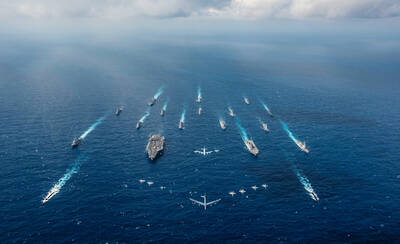
Japanese Prime Minister Sanae Takaichi’s comment last year on Tokyo’s potential reaction to a Taiwan-China conflict has forced Beijing to rewrite its invasion plans, a retired Japanese general said. Takaichi told the Diet on Nov. 7 last year that a Chinese naval blockade or military attack on Taiwan could constitute a “survival-threatening situation” for Japan, potentially allowing Tokyo to exercise its right to collective self-defense. Former Japan Ground Self-Defense Force general Kiyofumi Ogawa said in a recent speech that the remark has been interpreted as meaning Japan could intervene in the early stages of a Taiwan Strait conflict, undermining China’s previous assumptions


 RSS
RSS