


Chen Hsiang-yin (陳香吟), one of Taiwan’s leading contemporary artists, recently praised the courage and aspirations of student activists.
The expatriate painter, who enjoys international renown, has resided in Paris, France, for the past 11 years.
Elegant and sophisticated, she is known for her classical realism-style paintings, which are on display at many art galleries. Although well-established in the Parisian art and cultural circles, Chen continues to take an active interest in Taiwan’s political and social development.
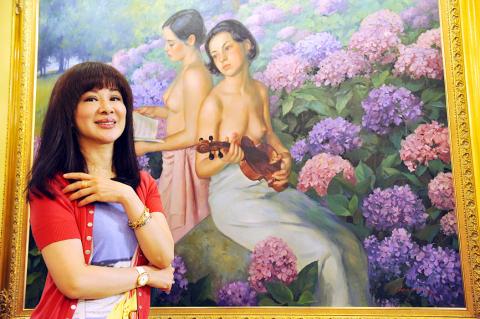
Photo: George Tsorng, Taipei Times
“Taiwan’s democracy has still some way to go to make progress. We have seen frequent protests and strikes in Europe, the US and France. When students protest, the general public respects their right to do so,” she said in a recent interview.
“Even if the strike causes inconvenience to people’s lives, and while many complain, after the griping, they still respect the appeals of the protesting groups. However, Taiwan seemed unable to accept the recent waves of civil disobedience, while some people even long for the days of martial law dictatorship,” Chen added. “It is very dangerous for citizens to have that kind of yearning to live in a country with only a superficial level of harmony and tranquility.”
“Democracy is meant for majority rule over the minority, while the majority respects the wishes of the minority. Taiwan’s democracy was won after numerous sacrifices, and many people’s blood, sweat and tears,” she said.
“However, Taiwanese have not reached maturity in looking at the progress of democracy. Too much yearning for tranquility and secure living may not be a good thing for the advancement of our democracy,” she added.
Drawing inspiration from the people and things around her for her work, Chen’s attention to details enable her to stay on top of current trends.
“We can evaluate the competency and attentive diligence of a government by looking at the details, ” she said. “Each time I walk into the Taiwan Taoyuan International Airport, my pride and self-confidence as a Taiwanese always crumples right away. There are so many things one can see which just does not reconcile with our status as an advanced country.”
Chen went on to recount her airport experiences, encountering unsightly items and designs, from the plastic trays at the security checks, layout and material make-up of railings, use of colors and lettering on the signs, the terminals’ overall aesthetic construct, along with uniforms worn by security personnel and cleaning staff and of their attitude at work.
About her current home, she said: “Paris is full of appealing aesthetics. It is beautiful to look at from almost every street corner, and every setting. This does not just come from the aesthetics and vision of its civic leaders, but is ingrained in the citizens, and comes from their respect for fellow citizens.”
Chen said that when she lived in US, her neighbor once came over to apologize for not taking care of her back garden.
“She was apologizing, because I was not able to see a nice scene when looking out from my window,” she said.
“Taiwan has placed too much focus on economic development. We are too impoverished in cultivating people’s feelings and attainment on the spiritual level,” she said.
“The government keeps emphasizing it must promote the tourism industry, but at Taiwan’s many famous tourist sites and attractions, the hardware and software have not been thought out or implemented well,” Chen said.
Earlier this year, she went on a trip to China, visiting Hangzhou’s West Lake and Wuzhen in Zhejiang Province.
“In Taiwan, we do not have the grand rivers and great mountains like those of China. Although our natural environment does not compare, we can win in the small details. We can enhance and improve the hardware and software,” Chen said.
She cited for example that in Taiwan, barriers on the lakeside should stop using railings made of concrete and colored to imitate bamboo sticks.
Chen said there should not be opposition to China on every issue.
“However, we must uphold our bottom-line, and must not tilt everything toward China. The government should seek to protect Taiwanese common interests,” she said.
“I am not an expert on financial matters, but I do know that you should never put all your eggs in one basket. If we become dependent on another country’s economy, and as people have such mistrust of the government, then it will be difficult for Taiwan’s economic development to make progress,” Chen said, adding that what is most important is to recover the people’s trust in the government.

Considering that most countries issue more than five denominations of banknotes, the central bank has decided to redesign all five denominations, the bank said as it prepares for the first major overhaul of the banknotes in more than 24 years. Central bank Governor Yang Chin-lung (楊金龍) is expected to report to the Legislative Yuan today on the bank’s operations and the redesign’s progress. The bank in a report sent to the legislature ahead of today’s meeting said it had commissioned a survey on the public’s preferences. Survey results showed that NT$100 and NT$1,000 banknotes are the most commonly used, while NT$200 and NT$2,000

The Centers for Disease Control (CDC) yesterday reported the first case of a new COVID-19 subvariant — BA.3.2 — in a 10-year-old Singaporean girl who had a fever upon arrival in Taiwan and tested positive for the disease. The girl left Taiwan on March 20 and the case did not have a direct impact on the local community, it said. The WHO added the BA.3.2 strain to its list of Variants Under Monitoring in December last year, but this was the first imported case of the COVID-19 variant in Taiwan, CDC Deputy Director-General Lin Ming-cheng (林明誠) said. The girl arrived in Taiwan on

South Korea is planning to revise its controversial electronic arrival card, a step Taiwanese officials said prompted them to hold off on planned retaliatory measures, a South Korean media report said yesterday. A Yonhap News Agency report said that the South Korean Ministry of Foreign Affairs is planning to remove the “previous departure place” and “next destination” fields from its e-arrival card system. The plan, reached after interagency consultations, is under review and aims to simplify entry procedures and align the electronic form with the paper version, a South Korean ministry official said. The fields — which appeared only on the electronic form

The Ministry of Foreign Affairs (MOFA) is suspending retaliation measures against South Korea that were set to take effect tomorrow, after Seoul said it is updating its e-arrival system, MOFA said today. The measures were to be a new round of retaliation after Taiwan on March 1 changed South Korea's designation on government-issued alien resident certificates held by South Korean nationals to "South Korea” from the "Republic of Korea," the country’s official name. The move came after months of protests to Seoul over its listing of Taiwan as "China (Taiwan)" in dropdown menus on its new online immigration entry system. MOFA last week


 RSS
RSS