


Albie Sachs, a former justice of the Constitutional Court of South Africa, has become the first winner of the Tang Prize in Rule of Law yesterday for his contributions to human rights and justice around the world.
Sachs, a lawyer and human rights activist who spent his lifetime fighting apartheid, helped write the new constitution of South Africa and was appointed by late South African president Nelson Mandela in 1994 to serve as a justice of the Constitutional Court — a position he held until 2009.
The 79-year-old is to receive a cash prize of NT$40 million (US$1.33 million) and a research grant of up to NT$10 million to be used within five years, as well as a medal and a certificate.
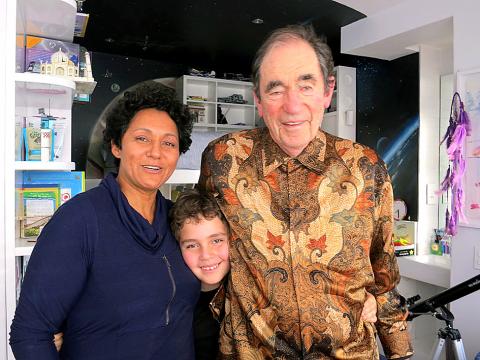
Photo courtesy of the Tang Prize Foundation
The Tang Prize was awarded to Sachs “for his many contributions to human rights and justice globally through an understanding of the rule of law in which the dignity of all persons is respected and the strengths and values of all communities are embraced, in particular through his efforts in the realization of the rule of law in a free and democratic South Africa, working as activist, lawyer, scholar, and framer of a new constitution to heal the divisions of the past and to [establish] a society that respects diversity and is based on democratic values, social justice and fundamental human rights,” Nobel laureate Lee Yuan-tseh (李遠哲) read from the citation.
Lee, who chairs the Tang Prize Selection Committee, announced the award winner at a ceremony in Taipei.
Born to politically active parents of a Jewish family, Sachs joined the anti-apartheid movement at the age of 17.
After gaining his law degree at 21, he defended people charged under repressive apartheid laws and, as a result, was several times imprisoned and tortured.
He went into exile in 1966 and spent the next 24 years studying, teaching and writing in the UK and Mozambique.
During the 1980s, Sachs helped draft the Code of Conduct and Statutes for the African National Congress (ANC), which prohibits torture of detainees under any circumstances.
In 1988, South African security agents planted a bomb in his car that blew off his right arm and blinded him in one eye, a story recounted in his autobiographical book The Soft Vengeance of a Freedom Fighter.
“To get freedom was a much more powerful vengeance than to subject the people who had done these things to us to the same harm,” Sachs wrote in the book. “If the person accused in a Mozambique Court of being responsible for placing the bomb in my car is put on trial and the evidence is insufficient and he is acquitted, that will be my soft vengeance, because we will be living under the rule of law.”
Sachs returned to his homeland in 1990 after Mandela and other ANC leaders were released from prison, where he played a key role in drafting South Africa’s new constitution and Bill of Rights, a human rights charter contained in the constitution that lays down the fundamental rights of all South Africans.
South Africa’s Bill of Rights is regarded as one of the most progressive constitutional documents in the world.
It stipulates not only traditional civil rights such as the freedom of expression and the right to assemble, but also the rights to housing, education, healthcare, food, water and social security.
During Sachs’ tenure as a judge, the South African Constitutional Court abolished the death penalty, overturned anti-homosexuality laws and legalized same-sex marriage.
In the landmark Minister of Home Affairs versus Fourie case in 2005, Sachs authored the court’s decision that legalized same-sex marriage in South Africa, making South Africa the fifth country to recognize such unions.
Sachs has honorary doctorates from over a dozen universities, including Princeton, Cambridge and the University of Edinburgh.
Winners of the award are selected by panels of judges convened by Academia Sinica.
An award ceremony for the winners in all four categories is to take place on Sept. 18 in Taipei.
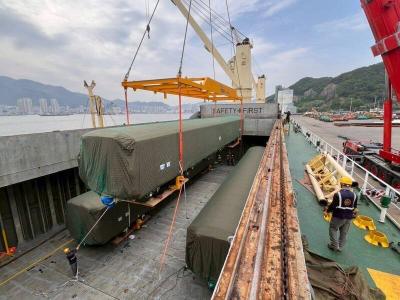
The first of 10 new high-capacity trains purchased from South Korea’s Hyundai Rotem arrived at the Port of Taipei yesterday to meet the demands of an expanding metro network, Taipei Rapid Transit Corp (TRTC) said yesterday. The train completed a three-day, 1,200km voyage from the Port of Masan in South Korea, the company said. Costing NT$590 million (US$18.79 million) each, the new six-carriage trains feature a redesigned interior based on "human-centric" transportation concepts, TRTC said. The design utilizes continuous longitudinal seating to widen the aisles and optimize passenger flow, while also upgrading passenger information displays and driving control systems for a more comfortable
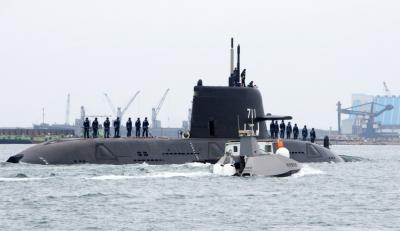
Taiwan's first indigenous defense submarine, the SS-711 Hai Kun (海鯤, or Narwhal), departed for its 13th sea trial at 7am today, marking its seventh submerged test, with delivery to the navy scheduled for July. The outing also marked its first sea deployment since President William Lai (賴清德) boarded the submarine for an inspection on March 19, drawing a crowd of military enthusiasts who gathered to show support. The submarine this morning departed port accompanied by CSBC Corp’s Endeavor Manta (奮進魔鬼魚號) uncrewed surface vessel and a navy M109 assault boat. Amid public interest in key milestones such as torpedo-launching operations and overnight submerged trials,
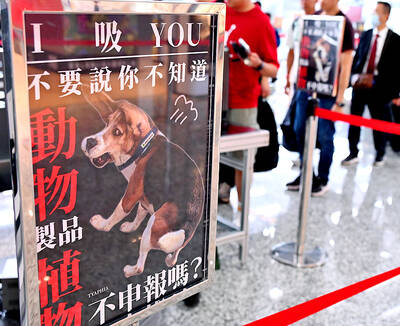
Quarantine awareness posters at Taiwan Taoyuan International Airport have gone viral for their use of wordplay. Issued by the airport branch of the Animal and Plant Health Inspection Agency, the posters feature sniffer dogs making a range of facial expressions, paired with advisory messages built around homophones. “We update the messages for holidays and campaign needs, periodically refreshing materials to attract people’s attention,” quarantine officials said. “The aim is to use the dogs’ appeal to draw focus to quarantine regulations.” A Japanese traveler visiting Taiwan has posted a photo on X of a poster showing a quarantine dog with a

Taiwan’s coffee community has launched a “one-person-one-e-mail” campaign, calling for people to send a protest-e-mail to the World Coffee Championships (WCC) urging it to redesignate Taiwanese competitors as from “Taiwan,” rather than “Chinese Taipei.” The call followed sudden action last week after the WCC changed all references to Taiwanese competitors from “Taiwan” to “Chinese Taipei,” including recent World Latte Art champion Bala (林紹興), who won the World Latte Art Championship in San Diego earlier this month. When Bala received the trophy, he was referred to as representing Taiwan, as well as in the announcement on the WCC’s Web site, until it


 RSS
RSS