


A month-long photo exhibition on the evacuation of thousands of civilians and troops from the Dachen Islands off China’s coast to Taiwan nearly six decades ago opened in Taipei yesterday.
The show, cosponsored by the Ministry of Culture and the Central News Agency, is aimed at keeping alive the memories of the years following the Chinese Civil War and raising public awareness of the origins of Taiwan’s diverse, multicultural society.
Most people are familiar with the massive evacuation that occurred in 1949, when Nationalist troops were forced to retreat to Taiwan after losing the civil war, Minister of Culture Lung Ying-tai (龍應台) said, but the evacuation of the Dachen Islands in 1955 is less well-known.
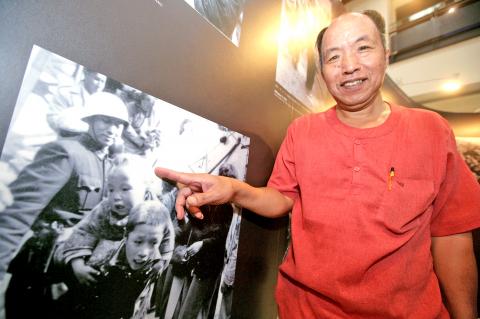
Photo: CNA
What was unusual about the Dachen retreat was that all of the residents on the islands followed instructions to leave their villages, she said.
Not everyone in Taiwan knows about the suffering of the Dachen evacuees and their difficult plight, Lung said, adding: “There are still many memory drawers that have yet to be really opened by the Taiwanese.”
She said she hoped that the show would lead to a search for those involved, including tracking down the photographers who took the pictures and the children in them, to tell the stories of the people who were forced to leave their homes.
Minister of Transportation and Communications Yeh Kuang-shih (葉匡時), whose mother was one of the evacuees, Dachen descendants and Lung attended the opening ceremony.
Chang Chun-fa (張春法) recognized himself in one of the photographs as a three-year-old being given a piggyback ride by his brother.
In the early 1950s, the Nationalist army still held a string of islands off the coast of Zhejiang Province, including the Dachen Islands, even though it was pushed out of the Chinese mainland by the communists in 1949.
The Republic of China (ROC) Army launched raids against the People’s Liberation Army (PLA) from the islands, hoping to find an opening through which it could take back the mainland.
Though the raids were repelled each time, they were enough of a thorn in the side of the communists that Beijing moved to reclaim the islands by force.
On Jan. 18, 1955, the PLA launched an all-out attack by land, sea and air on the island of Yijiangshan, north of the Dachen Islands.
Then-ROC commander General Wang Sheng-ming (王生明), who had vowed to fight to the death before the battle, ordered that a member of every father and son or brother duo serving in the army be evacuated.
Wang died in the fierce three-day battle, and the loss of Yijiangshan Island left the Dachen Islands vulnerable to communist attack.
A massive evacuation took place from Feb. 9 to 14 under the escort of the US Seventh Fleet.
It brought 10,213 civilians, 4,243 anti-communist guerrilla troops, 264 family members and relatives of Taiwan’s army, and all Nationalist troops on the islands to the port of Keelung in Taiwan, along with 2,868 tonnes of military equipment and supplies.
After staying in Keelung for about two weeks, the government helped the evacuees resume their lives as fishermen, farmers, artisans and merchants, and relocated them to other parts of Taiwan, such as Yilan, Kaohsiung, Pingtung, Hualien and Taitung.
Leaving behind their native islands, they landed on Taiwan, and after a period of adjustment, settled down, weaving the fabric of their own backgrounds into Taiwanese society and adding to its cultural diversity.
The show is divided into six themes: Islands of Heroes, Dachen Landscape, Far from Home, Emotional Departure and Arrival, Keelung Harbor, New Home in Taiwan and Cultural Legacy.
The exhibition is being held in a gallery of the Chiang Kai-shek Memorial Hall.
It will run until July 16.

FUKUOKA SITUATION: Japanese media reported that the pathogen is expected to be identified by the summer, while the CDC downplayed the idea that it was hMPV A “mysterious cold-like illness” reported in Japan’s Fukuoka Prefecture does not seem to be a new disease, but Japanese authorities have been asked about the situation, the Centers for Disease Control (CDC) said yesterday. The Fukuoka Prefectural Medical Association on Wednesday told a news conference that a “mystery cold” that has become a hot topic on social media is “highly likely to be caused by some kind of viral infection,” Japan’s KBC News reported. “Many people are experiencing symptoms starting with a sore throat, followed by a runny nose, phlegm and a severe cough,” KBC News reported, citing association officials. Health authorities are

Nvidia Corp CEO Jensen Huang (黃仁勳) arrived in Taiwan yesterday ahead of upcoming AI and technology events, saying he plans to meet with clients and Taiwan Semiconductor Manufacturing Co Chairman C.C. Wei (魏哲家) during his visit. After landing at Taipei Songshan Airport, Huang posed for photos with fans and handed out Yakult drinks to reporters and supporters waiting at the scene, saying he has “a lot to do” during the trip. Asked about reports that Nvidia’s planned headquarters site in Taipei’s Beitou Shilin Technology Park could break ground on May 27, Huang said that if the company holds an event, he would

The Ministry of Finance this afternoon announced the winning numbers for the March-April uniform invoice lottery. The winning number for the NT$10 million (US$318,060) special prize is 19531471, and the winning number for the NT$2 million grand prize is 85941329. Three numbers were drawn for the NT$200,000 first prize: 07225810, 20231230 and 83518781. Those with receipts matching the last seven digits of any of the first-prize numbers will win the NT$40,000 second prize, while those matching the last six digits will win the NT$10,000 third prize. Those whose receipts match the last five digits of the first-prize numbers can claim the NT$4,000 fourth prize,

SIX SUBSIDIES: The monthly allowance for older farmers is to increase to NT$10,000, and NT$5,000 is to be given to homemakers under the national pension system, Lai said The government is to implement major welfare policies for disadvantaged groups, including raising the monthly allowance for older farmers to NT$10,000 and providing homemakers with NT$5,000 per month, President William Lai (賴清德) said yesterday. Lai made the remarks during a visit to Wangling Temple in Chiayi County, saying that the planned increases were being introduced amid economic growth and an increase in tax revenue. Touting a policy, in which the government plans to provide a monthly allowance of NT$5,000 for every child under the age of 18 in a bid to address Taiwan’s low birthrate, Lai said that if received for the


 RSS
RSS