


Liberty Times (LT): What is the biggest mistake in the Ministry of Education’s plans for mathematics?
Lin Chang-shou (林長壽): First, what information does the Ministry of Education provide to the 11th-graders before they decide whether to take mathematics? Should students rely on their learning aptitude or on their preferences?
How many 11th-graders can make judgements based solely on the bits of information they acquire and entirely without the effects of preferences? It is like asking kids whether they would like sugar-free oatmeal or desserts for breakfast. What would most kids say?
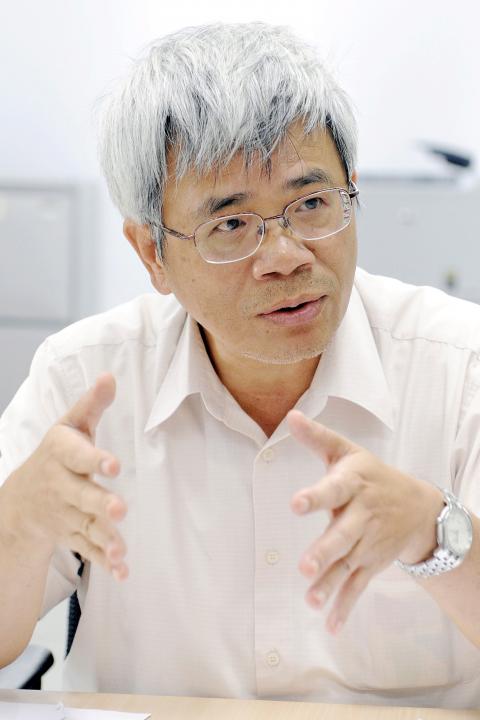
Photo: Chen Chih-chu, Taipei Times
Why? Because math is an intimidating subject.
According to career rankings conducted by the Wall Street Journal over the past six years, math-related jobs all ranked in the top 10, with actuary topping the list twice. The fact that math has become a popular elective course among US university students goes to show that the invisible reward one gets from learning math will only become more valuable as technology advances in this highly developed world.
If younger generations wish to avoid meager salaries, being proficient in math and programming is the most straightforward thing young people can rely on to escape from a life of poverty, or even become rich.
Second, to stimulate development in the nation, the government must approach its education policies with a positive and proactive attitude.
Giving the students the option to drop math just because they do not like it is a very pessimistic thing to do. The nation should at least design two guidelines, with one allowing students to have a lower level of difficulty and a flatter learning curve to cater to students of business and literature.
If the government can hire experts to devise such a guideline, the nation will be able to move in the right direction in terms of fostering new talent.
The government’s former education policies have been mostly about chanting slogans: They were not put through trial runs before they hit the road.
The Comprehensive Assessment Program [for Junior-High School Students] and increasingly excessive cramming defeat the purpose of the educational policy. However, the government never reflects upon itself about its own mistakes. It blames the parents instead.
Also, the educational policy needs to set a core curriculum and assign adequate teaching hours accordingly to allow every student to acquire sufficient basic knowledge. Math, in particular, cannot be taught by way of cramming. However, the existing policy assigns equal hours to every subject, resulting in a mish-mash of a curriculum that evaluates student’s learning with test scores, which increases their burden for no good reason.
LT: What is the biggest damage that a failed educational policy could do?
Lin: Due to the poor efficacy of school education, students are caught in a vicious circle where cram schools dominate their learning process. This forces the students to set out for school early in the morning and return home late, after 8pm or 9pm.
Moreover, it places students who come from lower-income families in an extremely disadvantageous position amid the fierce competition.
The biggest irony is that the poorer the students are, the more likely it is that they will enter expensive private universities. This forces them to hold part-time jobs to pay for their tuition.
So, conceivably, most students who are expelled due to poor grades are not from well-off families. Even if these students manage to graduate, they face a more cumbersome path when pursuing a career.
Put it this way: The education reform that the government has been pushing through has become an agent of social injustice. It is all very heartbreaking.
The [Organization for Economic Co-operation and Development (OECD)] Program for International Student Assessment [PISA] called Taiwan the “most unfair place in the world in terms of access to education.” When Taiwan first participated in PISA, its standard deviation value was 103, the third-highest in the world. (The average standard deviation value was 92 that year.)
Then, in 2009, when it participated for the second time, that value had already risen to the highest in the world, underperforming the No. 2 country by one to two points.
In 2012, Taiwan remained the nation with the highest standard deviation value, 116, which was a far cry from the second-worst number, 105. (The average standard deviation value was 98 that year.)
Notably, in 2006, the UK performed worse than Taiwan in the index measuring the impact students’ socioeconomic backgrounds have on their mathematical literacy — namely, the index measuring the unfairness in students’ access to mathematical education.
Nevertheless, the Britons got to the bottom of this issue and rectified it with effective actions. By 2012, their policy proved effective, as the level of unfairness in the access to math education dropped below that of the US and Singapore.
Taiwan’s general public and education scholars cry for fairness every day, but have only succeeded in creating a false image of fairness, one that ignores the needs of the disadvantaged. We are even worse than Great Britain, the center of capitalism.
I believe that only when a society enables mobility among social classes through education can there be true social justice.
LT: How many class hours are adequate for mathematics?
Lin: As a result of the education reform over the past two decades or so, the class hours for languages and math have dropped consistently. Ever since the nine-year compulsory education hit the road, Taiwan’s required class hours for math have trailed behind other countries’.
On top of that, math was excluded from the list of “basic courses” in the 2010 curriculum for no good reason at all.
What we deem adequate, is four hours of math learning for third to ninth-graders. For high-school students, there should be at least four math classes each week.
No country in the world assigns just 12 credit hours to mathematics and removes it from the list of mandatory subjects halfway through the 11th grade. [According to the 12-year compulsory education guidelines, languages remain mandatory courses until the end of the 11th grade.]
The latest standard deviation values published by PISA showed that Taiwan’s performance improved, moving to the fourth place.
However, the government must not let this go to its head, as cram schools accounted for a substantial part of this improvement; the schools cannot take all the credit.
PISA also sounded the alarm for an even more pressing matter: Taiwanese students have low overall reading literacy. Being able to demonstrate a good literacy for math shows that a student is well-trained in logic.
Developing literacy is not only important while learning languages, it is equally important for learning math, and literacy is very hard to acquire at cram schools.
The lack of teaching hours may cause teachers to skip the training of students’ reading literacy while teaching.
LT: What advice would you give to the Ministry of Education?
Lin: An education policy should cover four aspects: It should facilitate mobility among social classes through education, thus serving social justice. It should be aimed at boosting our country’s competitiveness and leaving not one student out.
Educational reform cannot be based on chanting slogans. It needs to be practical; it needs to be backed by solid proof. Educational reform requires many small steps, not a giant leap, so that it may be sustainable.
Finally, high-school education should pave the way for college education.
It does not take a mathematician to figure out the above. Anyone with common sense should be able to arrive at the same conclusions.
Faculty at the National Chen Kung University were the first to launch a signature event against the decreased credit hours for mathematics.
However, the National Academy for Educational Research turned a deaf ear and claimed that the 12-year compulsory education guidelines connect seamlessly with college education.
The truth is, there is not even one mathematician in the academy. The academy asked some mathematicians to voice their opinions on its new math curriculum and was faced with strong objection.
However, it used the presence of these mathematicians to trumpet their campaign anyway.
Whenever dissent arises, the Ministry of Education either ignores it or equivocates. Are they allowed to behave this way just because they are in power? It is outrageous!
So who are the ones to safeguard our children’s education?
I believe it would have to be professors, for they are the ones on the front line interacting with students year after year, feeling the most for students.
Therefore, I call upon more professors to care about the education of our future generations.
Twenty years of failed education reform has compromised our country to a terrible state. I would be very worried over this nation’s future if more people do not stand up to right the wrong.
Translated by Sean Lin

Considering that most countries issue more than five denominations of banknotes, the central bank has decided to redesign all five denominations, the bank said as it prepares for the first major overhaul of the banknotes in more than 24 years. Central bank Governor Yang Chin-lung (楊金龍) is expected to report to the Legislative Yuan today on the bank’s operations and the redesign’s progress. The bank in a report sent to the legislature ahead of today’s meeting said it had commissioned a survey on the public’s preferences. Survey results showed that NT$100 and NT$1,000 banknotes are the most commonly used, while NT$200 and NT$2,000

The Centers for Disease Control (CDC) yesterday reported the first case of a new COVID-19 subvariant — BA.3.2 — in a 10-year-old Singaporean girl who had a fever upon arrival in Taiwan and tested positive for the disease. The girl left Taiwan on March 20 and the case did not have a direct impact on the local community, it said. The WHO added the BA.3.2 strain to its list of Variants Under Monitoring in December last year, but this was the first imported case of the COVID-19 variant in Taiwan, CDC Deputy Director-General Lin Ming-cheng (林明誠) said. The girl arrived in Taiwan on

South Korea is planning to revise its controversial electronic arrival card, a step Taiwanese officials said prompted them to hold off on planned retaliatory measures, a South Korean media report said yesterday. A Yonhap News Agency report said that the South Korean Ministry of Foreign Affairs is planning to remove the “previous departure place” and “next destination” fields from its e-arrival card system. The plan, reached after interagency consultations, is under review and aims to simplify entry procedures and align the electronic form with the paper version, a South Korean ministry official said. The fields — which appeared only on the electronic form

The Ministry of Foreign Affairs (MOFA) is suspending retaliation measures against South Korea that were set to take effect tomorrow, after Seoul said it is updating its e-arrival system, MOFA said today. The measures were to be a new round of retaliation after Taiwan on March 1 changed South Korea's designation on government-issued alien resident certificates held by South Korean nationals to "South Korea” from the "Republic of Korea," the country’s official name. The move came after months of protests to Seoul over its listing of Taiwan as "China (Taiwan)" in dropdown menus on its new online immigration entry system. MOFA last week


 RSS
RSS