


The Tang Prize selection committee has reached a consensus on the winner or winners of the first Tang Prize in Sustainable Development, said Lee Yuan-tseh (李遠哲), a Nobel Prize in Chemistry laureate and former president of Academia Sinica, Taiwan’s top research institute.
The discussion during the selection process was “very in-depth,” Lee told the Central News Agency and China Television in a recent interview.
Lee was the convener of the committee that decided the winner in the sustainable development category.
“Although there was debate, a consensus was reached in the end,” he said.
An Academia Sinica source familiar with the matter said the result of the final voting showed “overwhelming support” for the winner or winners, whose names were not divulged.
Lee said the nominees come from various backgrounds. Some specialize in technical skills and others in policy development, but the judges evaluated them by their “overall contributions,” he added.
However, the chemist acknowledged that it is a challenge to make significant contributions in sustainable development research because it crosses many disciplines, such as science, politics, economics and sociology.
Those without a good grasp of these fields “will not be able to make a great impact,” the 77-year-old said.
It is also not enough to only identify a problem in the field, one must also propose a solution, said Lee, who won the Nobel Prize in Chemistry in 1986.
Meanwhile, Lee called attention to the damage people have done on Earth. Humans have polluted the world over the past 200 years, digging up fossil fuels and producing a large amount of carbon dioxide emissions, he said.
“Sustainable development is a serious issue. It is good that the Tang Prize is raising this question and bringing more attention to the issue,” Lee said.
He said the prize would also give Taiwan an opportunity to examine if its sustainable development studies are moving in the right direction.
Highlighting the importance of global cooperation in tackling environmental problems such as carbon emissions, Lee said these problems “cannot be solved by science alone, nor by a single country.”
Countries should share energy resources and “scientists, sociologists and economists have to find a new economic model,” said Lee, who is also president of the International Council for Science, a global membership of national scientific bodies.
He said he has long been concerned about sustainable development issues and has devoted much of his time to studying the field over the past six years.
In 2012, the International Council for Science launched a 10-year international research initiative titled “Future Earth,” which is developing knowledge to respond effectively to the risks and opportunities of global environmental change, he said.
Established in 2012 by Taiwanese entrepreneur Samuel Yin (尹衍樑), the Tang Prize aims to supplement the Nobel Prize by honoring top researchers in four fields that it deems critical to the 21st century — sustainable development, biopharmaceutical science, sinology and the rule of law.
Although sometimes dubbed the “Asian Nobel Prize,” the Tang Prize selects its laureates based on the originality and impact of their research, irrespective of nationality or ethnicity.
Up to three winners in each category share a cash prize of NT$50 million (US$1.66 million).
Similar to the Nobel Prize, nomination for the Tang Prize is by invitation only. The Tang Prize Selection Committee, convened by Academia Sinica, sends out invitations to individuals and institutions around the world that are qualified to nominate candidates.
The committee then reviews and screens the nominations and, together with an international advisory board consisting of Nobel laureates and international experts in the four fields, selects up to three finalists in each category.
It submits this list to the Tang Prize Foundation’s board of directors, which decides upon the prizewinners. Due to confidentiality issues, the names of the committee members and international board members cannot be disclosed.
The winners of the Tang Prize are to be announced on June 18, with an award ceremony scheduled for Sept. 18.

NATIONAL SECURITY: Authorities are working to confirm the identities of the military personnel involved and investigating possible illegal conduct and regulatory violations Authorities are probing possible national security implications after Kinmen police and immigration officers on Sunday found a Chinese woman allegedly posing as a tourist while engaging in prostitution involving more than 10 military personnel. The woman, surnamed Chen (陳), has since been deported, authorities said, adding that investigators are still working to confirm the identities of those implicated, as the records only listed code names and aliases. The case stemmed from a report received by the Kinmen District Prosecutors’ Office on Friday last week from the Jinhu Precinct of the Kinmen County Police Bureau. On Sunday, police, along with the National Immigration
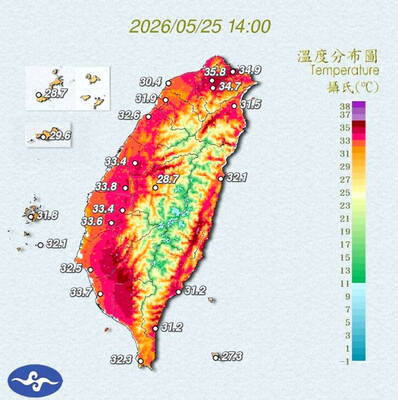
STAY COOL: The HPA recommended that people stay hydrated, use air-conditioning or fans while indoors, wear loose-fitting clothes and walk in the shade while outdoors Employers must implement measures such as installing cooling equipment, and providing drinking water and rest breaks for outdoor workers starting from Monday next week, the Taipei Department of Labor said on Sunday. Employers who fail to comply could face fines of NT$30,000 to NT$300,000 under the Occupational Safety and Health Act (職業安全衛生法), the department said. Businesses in Taipei employing fewer than 100 workers, as well as registered self-employed workers with labor insurance coverage, could receive on-site assessments and guidance from occupational safety consultants to help them apply for central government subsidies to implement or improve heat-protection measures, it said. Under the Ministry of

GLOBALGIVING: ‘ Caving to external pressure is not acceptable for an organization that has cultivated justice reform and human rights for 30 years,’ one NGO said A slew of non-government organizations (NGOs) have withdrawn from the GlobalGiving fundraising platform after it announced it would use “Chinese Taipei” instead of “Taiwan” from next month. The Taiwan Good Rice Association wrote on Facebook on Friday that it was informed on April 28 via a teleconference call of the change, which was made because the platform wanted to operate in China. Taiwan Good Rice is to terminate all cooperative relationships with GlobalGiving in response to the platform’s “unilateral and non-negotiable” decision to remove references to Taiwan, the NGO said. “Taiwan is in the official name of Taiwan Good Rice Association and the

Chinese Nationalist Party (KMT) Chairwoman Cheng Li-wun (鄭麗文) yesterday briefed her party’s Central Standing Committee regarding her scheduled visit to the US between Monday next week and June 16, saying that her purpose would be to persuade the US that the Republic of China (ROC) Constitution was a “one China” constitution that would foster stable and peaceful cross-strait relations. The ROC Constitution is the most important defense for all Taiwanese citizens, as it upholds our democracy and has contributed to our robust economy, which aligns with international and US interests, she said. “We would not be troublemakers and drag the US under,”


 RSS
RSS