


Former Democratic Progressive Party (DPP) chairperson Tsai Ing-wen (蔡英文) yesterday announced the official launch of an English-language opinion and analysis Web site about Taiwan with the aim of sharing perspectives on a wide range of issues.
The Web site, Thinking Taiwan, intends to show diverse perspectives on various issues — beyond political and economic issues that usually dominate international headlines about Taiwan — to an international audience, Tsai said during the site’s launch ceremony.
Tsai said that offering critical and thought-provoking perspectives on the nation is hugely important at a time when foreign news bureaus have either closed or pulled correspondents out of the nation due to a deteriorating media environment or because Taiwan “is no longer an interesting topic.”
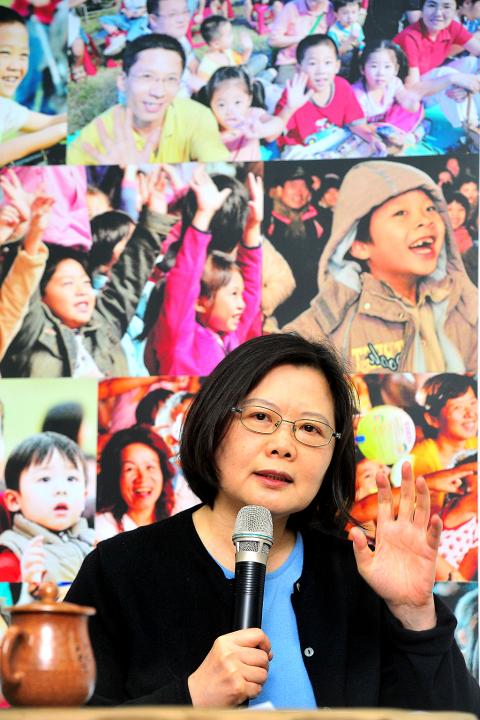
Photo: Chien Jung-fong, Taipei Times
The Web site is to cover politics and defense, topics the international audience takes most interest in, but is also to devote significant attention to society and culture, said the Web site’s editor-in-chief Jean Michael Cole, a former Taipei Times journalist.
Although the site is listed under Tsai’s Thinking Taiwan Foundation, it would try to bring neutral and impartial views and to “strike a balance” with its content so that it would appeal to academics as well as ordinary readers, Cole said.
Currently among the guest writers are Jerome Cohen, a professor of law at New York University School of Law, Mark Stokes, executive director of the US-based think tank Project 2049 Institute, and Stephane Corcuff at the French Centre for Research on Contemporary China (CEFC).
In his introductory column on the Web site, Cohen said that Taiwan has been an underreported topic in US and Western media.
Taiwan’s status would likely soon “become the most dangerous issue dividing the two most important nuclear powers, the US and China,” given that the concerns that have been quietly growing on both sides of the Taiwan Strait about their future relationship was accelerated by the recent Sunflower movement, Cohen wrote.
The Web site is the second opinion and analysis products presented by Tsai’s foundation, following the establishment of the Chinese-language site Thinking Taiwan in August 2012.
More than 1,900 articles penned by more than 600 writers, of whom 80 percent are younger than 40, have been published on the Chinese version of Thinking Taiwan, and 60 percent of its readership came from the 35-and-under age group, foundation executive director Lin Chuan (林全) said.
While Tsai said that the English-language Web site has “nothing to do with elections,” reaching out to an international audience could benefit her campaign by fostering better mutual communication and understanding, if she wins the DPP’s presidential nomination next year.
An article published in the London-based Financial Times during the presidential campaign in 2011, which hinted that Washington had no confidence about Tsai’s ability to manage the cross-strait relationship and about her China policy, dealt a devastating blow to Tsai’s campaign, according to the DPP’s post-election review.
The Web site can be found at thinking-taiwan.com.

Considering that most countries issue more than five denominations of banknotes, the central bank has decided to redesign all five denominations, the bank said as it prepares for the first major overhaul of the banknotes in more than 24 years. Central bank Governor Yang Chin-lung (楊金龍) is expected to report to the Legislative Yuan today on the bank’s operations and the redesign’s progress. The bank in a report sent to the legislature ahead of today’s meeting said it had commissioned a survey on the public’s preferences. Survey results showed that NT$100 and NT$1,000 banknotes are the most commonly used, while NT$200 and NT$2,000

The Centers for Disease Control (CDC) yesterday reported the first case of a new COVID-19 subvariant — BA.3.2 — in a 10-year-old Singaporean girl who had a fever upon arrival in Taiwan and tested positive for the disease. The girl left Taiwan on March 20 and the case did not have a direct impact on the local community, it said. The WHO added the BA.3.2 strain to its list of Variants Under Monitoring in December last year, but this was the first imported case of the COVID-19 variant in Taiwan, CDC Deputy Director-General Lin Ming-cheng (林明誠) said. The girl arrived in Taiwan on

South Korea is planning to revise its controversial electronic arrival card, a step Taiwanese officials said prompted them to hold off on planned retaliatory measures, a South Korean media report said yesterday. A Yonhap News Agency report said that the South Korean Ministry of Foreign Affairs is planning to remove the “previous departure place” and “next destination” fields from its e-arrival card system. The plan, reached after interagency consultations, is under review and aims to simplify entry procedures and align the electronic form with the paper version, a South Korean ministry official said. The fields — which appeared only on the electronic form

The Ministry of Foreign Affairs (MOFA) is suspending retaliation measures against South Korea that were set to take effect tomorrow, after Seoul said it is updating its e-arrival system, MOFA said today. The measures were to be a new round of retaliation after Taiwan on March 1 changed South Korea's designation on government-issued alien resident certificates held by South Korean nationals to "South Korea” from the "Republic of Korea," the country’s official name. The move came after months of protests to Seoul over its listing of Taiwan as "China (Taiwan)" in dropdown menus on its new online immigration entry system. MOFA last week


 RSS
RSS