


Dozens of balloons were released into the sky above the China Medical University Hospital in Greater Taichung yesterday afternoon after a young couple vowed to be true to each other in sickness and in health during their wedding there.
That part of the marriage vows carries great significance to these particular newlyweds, given that the 22-year-old bride, Hsiao Yan (小晏), is a stage-four stomach cancer patient who may have just two months left to live.
The couple chose to get married in their high-school uniforms instead of traditional wedding attire, as the bride and her new husband, Ta Yan (大諺), were both students at New Taipei Municipal Yingge Vocational High School when they started dating a few years ago.
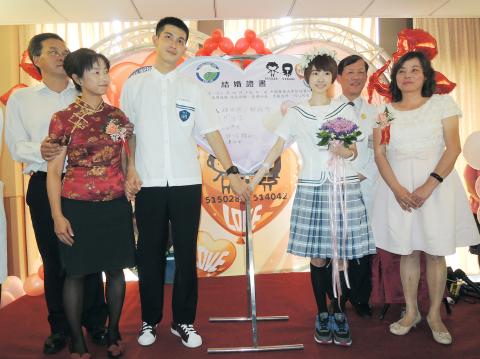
Photo: Tsai Shu-yuan, Taipei Times
Hsiao Yan said she first began experiencing unusual abdominal discomfort and pain early this year.
She tried a variety of medicines to alleviate the increasing discomfort, but none stopped the increasingly severe pains.
She did not go to a doctor until last month, after she started noticing drops of blood when she went to the toilet.
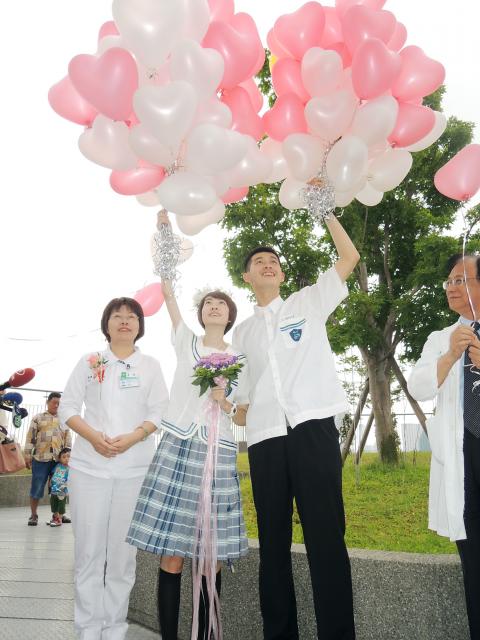
Photo: Tsai Shu-yuan, Taipei Times
By the time Hsiao Yan sought professional medical assistance, the stomach cancer had reached its final stage and spread to her bones, gastrointestinal tract and pelvic area.
She had to have a tube inserted into her abdomen to drain excess fluid and use a catheter after tumors obstructed her urethra.
She also had parts of her large intestine removed.
The procedures have not only caused Hsiao Yan significant pain and distress, but also increased her nausea, she said.
Ta Yan decided to show his determination to stand by her no matter what by proposing to her at an atypical time — while Hsiao Yan was vomiting into a toilet.
“Will you marry me?” Ta Yan said to Hsiao Yan as he recreated his “romantic” proposal at their wedding yesterday.
Hsiao Yan said she was reluctant to say yes at first because she knew that she would be gone soon, and was afraid that their brief time together could negatively affect Ta Yan’s marriage prospects in the future.
“However, Ta Yan was extremely persistent and I had no choice but to accept his proposal,” Hsiao Yan said, with a warm smile on her face.
Ta Yan said their parents were opposed to the idea of the two sweethearts getting married at first, but eventually gave their approval after being moved by his persistence.
“I do not know if Hsiao Yan will ever recover from cancer, but I am willing to take care of her and stand by her for as long as she lives,” Ta Yan said.
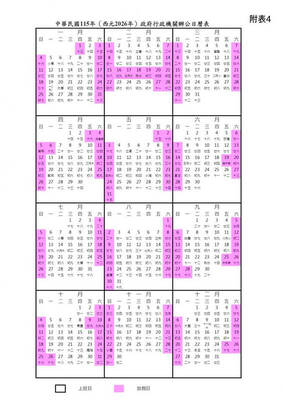
Taiwan is to have nine extended holidays next year, led by a nine-day Lunar New Year break, the Cabinet announced yesterday. The nine-day Lunar New Year holiday next year matches the length of this year’s holiday, which featured six extended holidays. The increase in extended holidays is due to the Act on the Implementation of Commemorative and Festival Holidays (紀念日及節日實施條例), which was passed early last month with support from the opposition Chinese Nationalist Party (KMT) and Taiwan People’s Party. Under the new act, the day before Lunar New Year’s Eve is also a national holiday, and Labor Day would no longer be limited

COMMITMENTS: The company had a relatively low renewable ratio at 56 percent and did not have any goal to achieve 100 percent renewable energy, the report said Pegatron Corp ranked the lowest among five major final assembly suppliers in progressing toward Apple Inc’s commitment to be 100 percent carbon neutral by 2030, a Greenpeace East Asia report said yesterday. While Apple has set the goal of using 100 percent renewable energy across its entire business, supply chain and product lifecycle by 2030, carbon emissions from electronics manufacturing are rising globally due to increased energy consumption, it said. Given that carbon emissions from its supply chain accounted for more than half of its total emissions last year, Greenpeace East Asia evaluated the green transition performance of Apple’s five largest final

Taiwan is to extend its visa-waiver program for Philippine passport holders for another year, starting on Aug. 1, Minister of Foreign Affairs Lin Chia-lung (林佳龍) said on Friday. Lin made the announcement during a reception in Taipei marking the 127th anniversary of Philippine independence and the 50th anniversary of the establishment of the Manila Economic and Cultural Office (MECO) in Taiwan, the Ministry of Foreign Affairs said. The decision reflected Taiwan’s commitment to deepening exchanges with the Philippines, the statement cited Lin as saying, adding that it was a key partner under the New Southbound Policy launched in 2016. Lin also expressed hope
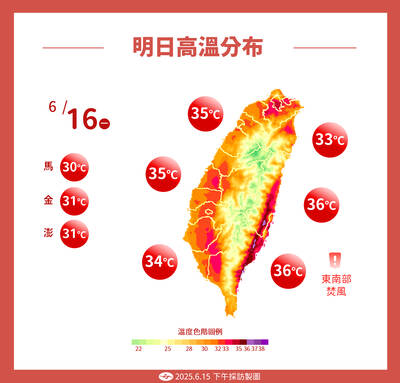
Temperatures in New Taipei City’s Sindian District (新店) climbed past 37°C yesterday, as the Central Weather Administration (CWA) issued heat alerts for 16 municipalities, warning the public of intense heat expected across Taiwan. The hottest location in Taiwan was in Sindian, where the mercury reached 37.5°C at about 2pm, according to CWA data. Taipei’s Shilin District (士林) recorded a temperature of 37.4°C at noon, Taitung County’s Jinfeng Township (金峰) at 12:50 pm logged a temperature of 37.4°C and Miaoli County’s Toufen Township (頭份) reached 36.7°C at 11:40am, the CWA said. The weather agency yesterday issued a yellow level information notice for Taipei, New


 RSS
RSS