


As a student-led protest against the government’s handling of the cross-strait service trade agreement continues, the Ministry of Economic Affairs (MOEA) is planning to hold presentations at universities to explain to students the government’s views on the controversial accord.
Vice Minister of Economic Affairs Woody Duh (杜紫軍) is to head a team assigned to address the pact at schools, with his maiden show scheduled to take place at National Chengchi University today, followed by a second presentation at National Taipei University tomorrow.
During the presentations, Duh will explain what the services trade accord is, its contents and why it was signed, the ministry said.
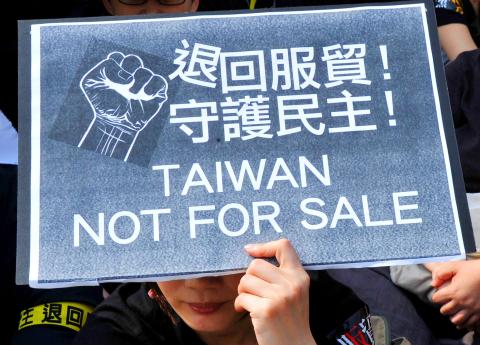
Photo: Mandy cheng, AFP
Duh said he will also detail the signing process, which took place in June last year, and the pact’s legislative review and ratification process.
To avoid possible criticism blasting the presentations as nothing more than government propaganda, he will be open to questions, Duh said, adding that he is ready for any “thorny” questions.
It will be the ministry’s first presentation of the trade pact on campuses since the start of protests against the government’s handling of the accord on March 18 after Chinese Nationalist Party (KMT) lawmakers tried to fast-track it and put it to a full vote on the legislative floor, bypassing the review process.
The protest has since been expanded to an occupation of the Legislative Yuan by student protesters.
Concerned that the agreement, under which the two sides agree to open up to each other’s service sectors, would hurt Taiwan’s businesses and job market, protesters are demanding new legislation that would subject any cross-strait agreement to close monitoring by legislators and that lawmakers refrain from taking any action on the pact until the new law is enacted.
The ministry said that on Aug. 9 last year, it mailed 454 law, economics and finance departments and institutes at universities around the nation, asking if they wanted to have the government’s presentation of the services pact organized on their campuses.
However, most schools, including National Taiwan University and National Tsing Hua University, showed a lack of interest in the proposal, it said.
In other developments, the Formosa Plastics Group (FPG) responded positively to President Ma Ying-jeou’s (馬英九) press conference on Saturday addressing student protesters’ demands over the service trade pact and called for its quick passage through the legislature to help Taiwan gain greater access to the global economic community.
FPG said Ma gave clear explanations to assuage the doubts of the protesters and the public about the pact and cited central bank Governor Perng Fai-nan (彭淮南) as saying that “signing free-trade agreements always involves some give and take.”
If the agreement fails to clear the Legislative Yuan, Taiwan will not be able to conclude its negotiations on the largely completed goods trade agreement, which FPG said would hamper the nation’s efforts to join the proposed Trans Pacific Partnership and the Regional Comprehensive Economic Partnership.
Should this be the case, it will be extremely difficult for Taiwanese manufacturing businesses that are already squeezed by slim profit margins to survive, the group said.
FPG, one of Taiwan’s largest conglomerates with diverse interests, also urged the government to help tide businesses affected by the pact until progress is made.

Considering that most countries issue more than five denominations of banknotes, the central bank has decided to redesign all five denominations, the bank said as it prepares for the first major overhaul of the banknotes in more than 24 years. Central bank Governor Yang Chin-lung (楊金龍) is expected to report to the Legislative Yuan today on the bank’s operations and the redesign’s progress. The bank in a report sent to the legislature ahead of today’s meeting said it had commissioned a survey on the public’s preferences. Survey results showed that NT$100 and NT$1,000 banknotes are the most commonly used, while NT$200 and NT$2,000

The Centers for Disease Control (CDC) yesterday reported the first case of a new COVID-19 subvariant — BA.3.2 — in a 10-year-old Singaporean girl who had a fever upon arrival in Taiwan and tested positive for the disease. The girl left Taiwan on March 20 and the case did not have a direct impact on the local community, it said. The WHO added the BA.3.2 strain to its list of Variants Under Monitoring in December last year, but this was the first imported case of the COVID-19 variant in Taiwan, CDC Deputy Director-General Lin Ming-cheng (林明誠) said. The girl arrived in Taiwan on

South Korea is planning to revise its controversial electronic arrival card, a step Taiwanese officials said prompted them to hold off on planned retaliatory measures, a South Korean media report said yesterday. A Yonhap News Agency report said that the South Korean Ministry of Foreign Affairs is planning to remove the “previous departure place” and “next destination” fields from its e-arrival card system. The plan, reached after interagency consultations, is under review and aims to simplify entry procedures and align the electronic form with the paper version, a South Korean ministry official said. The fields — which appeared only on the electronic form

The Ministry of Foreign Affairs (MOFA) is suspending retaliation measures against South Korea that were set to take effect tomorrow, after Seoul said it is updating its e-arrival system, MOFA said today. The measures were to be a new round of retaliation after Taiwan on March 1 changed South Korea's designation on government-issued alien resident certificates held by South Korean nationals to "South Korea” from the "Republic of Korea," the country’s official name. The move came after months of protests to Seoul over its listing of Taiwan as "China (Taiwan)" in dropdown menus on its new online immigration entry system. MOFA last week


 RSS
RSS