


Selling tatamis used to be a profitable business in Hualien, with about 20 shops specializing in manufacturing the Japanese-style straw mats. That was 50 years ago; today, there is only shop left in the east coast city.
Ho Yi-hua (何益華), the 38-year-old proprietor of the last tatami shop in the city, said sales had declined due to changes in social trends, with fewer people using tatamis, as well as competition from machine-made products.
“Demand has dwindled over the decades, and the market has waned considerably,” he said. “The hand-made craft [of making tatamis] is in decline. Other shops shut down one by one over the years.”
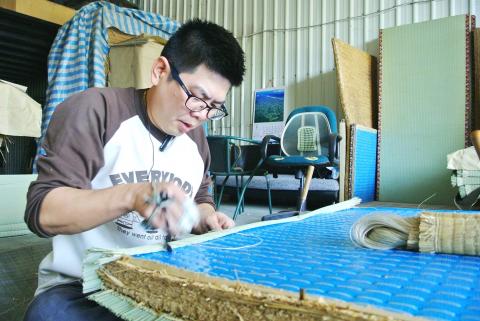
Photo: Wang Chin-yi, Taipei Times
Ho inherited his shop, founded more than 60 years ago, from his parents. However, producing handwoven tatamis is labor-intensive and not very profitable, so few people are willing to learn the trade, he said.
“My wish is to pass on my tatami-making skills to my children. If they do not carry it on, then this traditional craft will die with this generation,” he said.
“During their peak in the 1950s, the tatami shops employed about 20 workers each, turning out thousands of mats each year. This went on until the 1980s,” he said.
At the time a standard-sized tatami — about 2m by 1m — sold for NT$900 to NT$1,000.
“Now they sell for NT$4,000 each. Although the price is better, we now only sell about 400 tatamis each year,” he added.
Most of his orders come from old customers, bed-and-breakfast operators or projects in collaboration with interior decorators, he said.
“When covering the rooms and floors with tatami, the most difficult part is the edges and corners. The dimensions must be measured very precisely, otherwise it will leave small gaps,” he said.
“It can get very exhausting, because we have to deliver the tatamis to people’s homes. It is very tiring to carry a tatami weighing more than 20kg and walk up several flights of stairs,” he said.
Ho said it takes about an hour to make a standard-sized tatami. He uses a traditional bamboo-made ruler and set squares — passed down from his grandparents — to measure the dimensions and cuts the core of rice straws to size using a steel knife, then lays on the bamboo mat material and trims the excess.
“After that, I use a steel needle and thick nylon string to lace and bind them up into a mat. Customers choose the color and design for the fabric used to cover the sides,” he said.
Although business has slumped from its peak decades ago, Ho remains optimistic about prospects for handmade tatamis.
“Machine-made tatamis mostly use foam as the base, which can get hot in the summer as it does not dissipate heat well. After using it for a period, the mat looks flat and shrunken. Our handmade tatamis are warm in winter and cool in summer, and have good air permeability,” he said.
“Moreover, fashion is a cycle: Retro styles will become popular again. Our handmade tatamis are more refined, as we pay more attention to details. This can never be replaced by machine-made products,” Ho added.
“This is a precious traditional craft, handed down in my family for several generations. It will take all my life’s effort to carry on this trade, up to the day when my body can no longer take it. I hope this craft can be preserved and passed on for generations to come, ” Ho said.
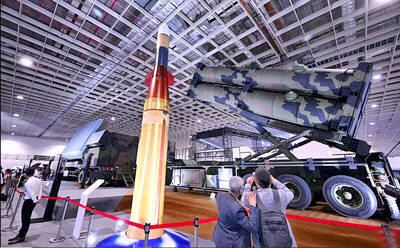
Taiwan is to commence mass production of the Tien Kung (天弓, “Sky Bow”) III, IV and V missiles by the second quarter of this year if the legislature approves the government’s NT$1.25 trillion (US$39.78 billion) special defense budget, an official said yesterday. Commenting on condition of anonymity, a defense official with knowledge of the matter said that the advanced systems are expected to provide crucial capabilities against ballistic and cruise missiles for the proposed “T-Dome,” an advanced, multi-layered air defense network. The Tien Kung III is an air defense missile with a maximum interception altitude of 35km. The Tien Kung IV and V
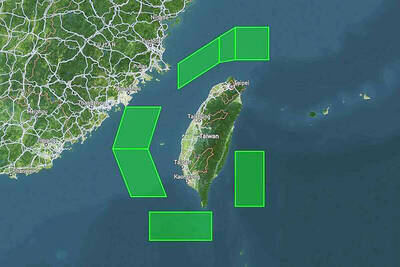
The disruption of 941 flights in and out of Taiwan due to China’s large-scale military exercises was no accident, but rather the result of a “quasi-blockade” used to simulate creating the air and sea routes needed for an amphibious landing, a military expert said. The disruptions occurred on Tuesday and lasted about 10 hours as China conducted live-fire drills in the Taiwan Strait. The Civil Aviation Administration (CAA) said the exercises affected 857 international flights and 84 domestic flights, affecting more than 100,000 travelers. Su Tzu-yun (蘇紫雲), a research fellow at the government-sponsored Institute for National Defense and Security Research, said the air
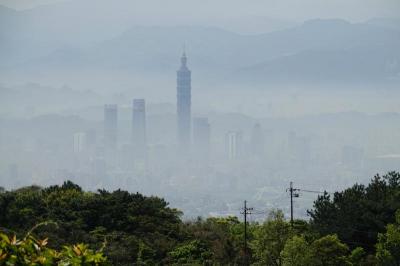
A strong continental cold air mass is to bring pollutants to Taiwan from tomorrow, the Ministry of Environment said today, as it issued an “orange” air quality alert for most of the country. All of Taiwan except for Hualien and Taitung counties is to be under an “orange” air quality alert tomorrow, indicating air quality that is unhealthy for sensitive groups. In China, areas from Shandong to Shanghai have been enveloped in haze since Saturday, the ministry said in a news release. Yesterday, hourly concentrations of PM2.5 in these areas ranged from 65 to 160 micrograms per cubic meter (mg/m³), and pollutants were
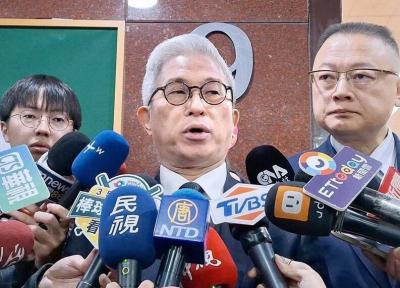
Taiwan’s armed forces have established response protocols for a wide range of sudden contingencies, including the “Wan Chun Plan” to protect the head of state, the Ministry of Defense (MND) said today. After US President Donald Trump on Saturday launched a series of airstrikes in Venezuela and kidnapped Venezuelan President Nicolas Maduro, concerns have been raised as to whether China would launch a similar “decapitation strike” on Taiwan. The armed forces regularly coordinate with relevant agencies and practice drills to ensure preparedness for a wide range of scenarios, Vice Minister of National Defense Hsu Szu-chien (徐斯儉) told reporters before a


 RSS
RSS