


Democratic Progressive Party (DPP) and activists yesterday warned the Chinese Nationalist Party (KMT) against unilaterally pushing the cross-strait service trade agreement through the legislature without lawmakers’ monitoring, saying to do so would break a KMT promise and go against mainstream public opinion.
According to a consensus reached during inter-party negotiations in June last year, the legislature is to review the pact clause-by-clause after the conclusion of 20 public hearings held to solicit opinions from various sectors of industry on the potential impact of the pact.
The last public hearing was held yesterday.
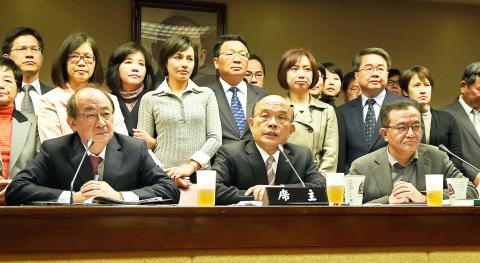
Photo: Wang Min-wei, Taipei Times
However, the KMT has claimed that it could declare the pact effective immediately on the basis of Article 61 of the Act Governing the Legislative Yuan’s Powers (立法院職權行使法).
The article stipulates that any executive order that fails to complete a committee review within three months of the plenary session assigning it to the committee shall be deemed passed and effective immediately.
“The KMT should not act like a thug and a gangster. Nor should it betray its own pledge and go against mainstream public opinion simply to carry out President Ma Ying-jeou’s (馬英九) order,” DPP Chairman Su Tseng-chang (蘇貞昌) said after a meeting of the party’s caucus.
The party would still prefer to see the pact renegotiated, but it wants the legislative review to be conducted according to four principles: reciprocal market opening, fair competition, public livelihood and national security.
DPP caucus whip Ker Chien-ming (柯建銘) saying it would not be legal for the KMT to violate last year’s consensus and the DPP would insist on a line-by-line review.
At a separate press conference, Taiwan Democracy Watch (TDW) said the service trade pact is not an executive order and therefore Article 61 of the Act Governing the Legislative Yuan’s Powers would not apply.
According to the Act Governing Relations between the People of the Taiwan Area and the Mainland Area (臺灣地區與大陸地區人民關係條例), the cross-strait agreement should be reviewed by the legislature, Watch spokesperson Lai Chung-chiang (賴中強) said.
The trade pact should be seen as part of a regional free-trade agreement, and as such, it is customary in all democracies for such agreements to be ratified by the national parliament or legislature Lai said, citing the nation’s trade agreements with Singapore and New Zealand as well as its accession to the WTO in 2001.
The service trade pact would open up 64 of the nation’s service sub-sectors to Chinese investment, including printing and publishing, tourism, restaurants, packaging, delivery services, car rentals, advertising and the hair styling and beauty industry, while 80 Chinese service sectors would be opened to Taiwanese investment.
Meanwhile, the KMT caucus reiterated that it would be in charge of the pact’s review at committee stage, not the DPP.
KMT Legislator Chang Ching-chung (張慶忠), a convener of the Internal Administration Committee, suggested the government go ahead and announce the pact is in effect if his co-convener, DPP Legislator Chen Chi-mai (陳其邁), tries to run the committee’s proceedings.
KMT lawmakers should petition the Executive Yuan to make the announcement, Chang said.
Not all of his colleagues agreed.
KMT Legislator Wu Yu-sheng (吳育昇) said that if the government violates last year’s consensus, Mainland Affairs Council Minister Wang Yu-chi (王郁琦) or Premier Jiang Yi-huah (江宜樺) could face pressure to resign.
The KMT caucus should submit a motion to bring the pact out of the committee without screening and send it directly to a plenary session for a second reading, Wu said.
KMT caucus whip Lin Hung-chih (林鴻池) said the party would ask Legislative Speaker Wang Jin-pyng (王金平) to mediate negotiations over the pack.
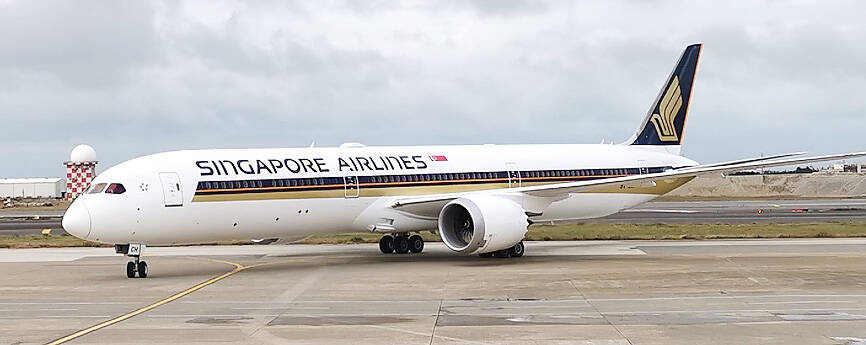
INCREASED CAPACITY: The flights on Mondays, Wednesdays, Fridays and Sundays would leave Singapore in the morning and Taipei in the afternoon Singapore Airlines is adding four supplementary flights to Taipei per week until May to meet increased tourist and business travel demand, the carrier said on Friday. The addition would raise the number of weekly flights it operates to Taipei to 18, Singapore Airlines Taiwan general manager Timothy Ouyang (歐陽漢源) said. The airline has recorded a steady rise in tourist and business travel to and from Taipei, and aims to provide more flexible travel arrangements for passengers, said Ouyang, who assumed the post in July last year. From now until Saturday next week, four additional flights would depart from Singapore on Monday, Wednesday, Friday

Taiwan’s three major international carriers are increasing booking fees, with EVA Airways having already increased the charge to US$28 per flight segment from US$25, while China Airlines (CAL) and Starlux Airlines are set to follow suit. Booking fees are charged by airlines through a global distribution system (GDS) and passed on to passengers. Carriers that apply the fees include CAL, EVA, Starlux and Tigerair Taiwan. A GDS is a computerized network operated by a company that connects airlines with travel agents and ticketing platforms, allowing reservations to be made and processed in real time. Major players include Amadeus, Sabre and Travelport. EVA Air began
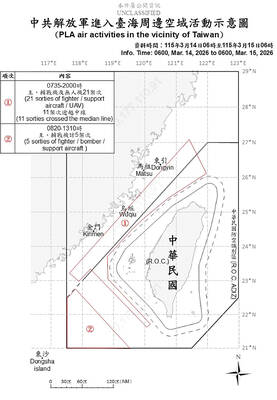
The Ministry of National Defense yesterday reported the return of large-scale Chinese air force activities after their unexplained absence for more than two weeks, which had prompted speculation regarding Beijing’s motives. China usually sends fighter jets, drones and other military aircraft around the nation on a daily basis. Interruptions to such routine are generally caused by bad weather. The Ministry of National Defense said it had detected 26 Chinese military aircraft in the Taiwan Strait over the previous 24 hours. It last reported that many aircraft on Feb. 25, when it spotted 30 aircraft, saying Beijing was carrying out another “joint combat
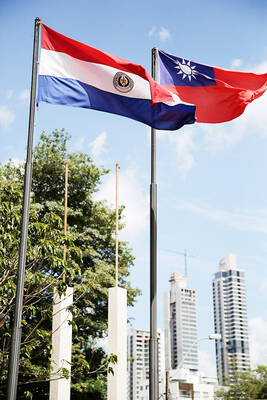
When Paraguayan opposition lawmaker Leidy Galeano returned from an all-expenses-paid tour of six Chinese cities late last year, she was convinced Paraguay risked missing out on major economic gains by sticking with longtime ally Taipei over Beijing — a message that participants on the trip heard repeatedly from Chinese officials. “Everything I saw there, I wanted for my country,” said Galeano, a member of the newly-formed Yo Creo party whose senior figures have spoken favorably about China. This trip and others like it — which people familiar with the visits said were at the invitation of the Chinese consulate in Sao Paulo


 RSS
RSS