


Blue light emissions from electronic products can easily harm children’s eyes and cause cataracts, ophthalmologists warned parents, as an increasing number of children are being taken to hospitals and clinics with eye problems.
Changhua County Show Chwan Healthcare System vice superintendent Lin Hung-yu (林浤裕) said there was a recent case in which a kindergarten-aged child had played on his mother’s cellphone every day for several months. After noticing the child squinting at everything, the parents took him to the clinic.
The child had initially been diagnosed with high myopia, a condition which doctors later ruled out because it is congenital and both parents had mild myopia, Lin said.
After further questioning, the parents revealed that both had been busy at work and often worked from home as well.
“This lifestyle left them little time to spend with their children, and whenever the child started crying for attention, the parents gave him the cellphone to play on, as it usually quietened him down,” Lin said.
The situation had devolved to the situation where the child became addicted to the phone and wanted to play on it even when the parents were not busy, Lin said, adding that the boy usually spent more than half an hour a day on the cellphone.
Due to the lengthy periods the boy spent staring closely at the screen, his ciliary muscles had lost the capability to adjust to things in the distance. He was later diagnosed with pseudomyopia, Lin said.
Lin said that after three months of treatment using a ciliary muscle relaxant, the boy was in the low myopia range.
Myopia, or simple myopia, is a condition in which sight begins to blur when looking at things in the distance, and it can be improved with corrective lenses.
Pseudomyopia is a condition in which spasms of the ciliary muscles cause the person to develop symptoms similar to simple myopia, but which can be treated by relaxing the ciliary muscle through methods such as relaxants.
Lin said more than 30 percent of children who have come to the clinic with eye problems had been playing on their mothers’ cellphones.
He added that if parents did not curb the tendency, the children could go develop high myopia.
Tri-Service General Hospital head of ophthalmology Lu Ta-wen (呂大文) said rates of children with pseudomyopia tended to peak after the winter and summer vacations.
During this period, the children spent more time at home and often spend too much time using electronic devices, Lu said.
“Blue light emitted by electronic products can easily cause cataracts to form and may also harm the macula lutea,” Lu said.
He said that it was best not to let children under the age of six use any electronic products.
“The vision of children who develop myopia tends to deteriorate quickly, and they should not be allowed to use smartphones for more than 40 or 50 minutes without taking a break for at least 10 minutes,” Lu said.
Lu also suggested parents be careful when treating myopia in children, as it may sometimes be pseudomyopia and was not true nearsightedness.
Parents should let an ophthalmologist examine their children before taking them to get glasses, he added.
Lu also suggested frequent outings or spending lots of time outdoors, looking at things far away and trying to relax the ciliary muscles to avoid worsening myopia, adding that vegetables and fruits, which are good for the eyes, should be a regular part of children’s diet.

NATIONAL SECURITY: Authorities are working to confirm the identities of the military personnel involved and investigating possible illegal conduct and regulatory violations Authorities are probing possible national security implications after Kinmen police and immigration officers on Sunday found a Chinese woman allegedly posing as a tourist while engaging in prostitution involving more than 10 military personnel. The woman, surnamed Chen (陳), has since been deported, authorities said, adding that investigators are still working to confirm the identities of those implicated, as the records only listed code names and aliases. The case stemmed from a report received by the Kinmen District Prosecutors’ Office on Friday last week from the Jinhu Precinct of the Kinmen County Police Bureau. On Sunday, police, along with the National Immigration

GLOBALGIVING: ‘ Caving to external pressure is not acceptable for an organization that has cultivated justice reform and human rights for 30 years,’ one NGO said A slew of non-government organizations (NGOs) have withdrawn from the GlobalGiving fundraising platform after it announced it would use “Chinese Taipei” instead of “Taiwan” from next month. The Taiwan Good Rice Association wrote on Facebook on Friday that it was informed on April 28 via a teleconference call of the change, which was made because the platform wanted to operate in China. Taiwan Good Rice is to terminate all cooperative relationships with GlobalGiving in response to the platform’s “unilateral and non-negotiable” decision to remove references to Taiwan, the NGO said. “Taiwan is in the official name of Taiwan Good Rice Association and the

HEAVY WEATHER: Typhoon Jangmi is due to crash straight into the Ryukyus as airlines look to shift flights to larger aircraft or cancel flights to Okinawa entirely Taiwan’s international air carriers announced flight adjustments over the weekend as Typhoon Jangmi is forecast to hit the Ryukyu Islands today and tomorrow. The Central Weather Administration (CWA) upgraded Jangmi from a tropical storm to a typhoon at 8am yesterday, with the eye located 580km south of Naha city. It was moving north at 19kph. Today, China Airlines’ CI-120, CI-121, CI-122 and CI-123 flights between Taoyuan and Naha, Okinawa, have been canceled as well as CI-132 and CI-133 between Kaohsiung and Naha. EVA Air’s BR-112, BR-113, BR-186 and BR-185 flights between Taoyuan and Naha are also canceled. Low-cost carrier Tigerair Taiwan canceled IT-230,
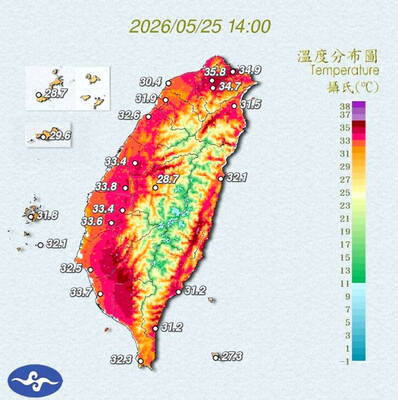
STAY COOL: The HPA recommended that people stay hydrated, use air-conditioning or fans while indoors, wear loose-fitting clothes and walk in the shade while outdoors Employers must implement measures such as installing cooling equipment, and providing drinking water and rest breaks for outdoor workers starting from Monday next week, the Taipei Department of Labor said on Sunday. Employers who fail to comply could face fines of NT$30,000 to NT$300,000 under the Occupational Safety and Health Act (職業安全衛生法), the department said. Businesses in Taipei employing fewer than 100 workers, as well as registered self-employed workers with labor insurance coverage, could receive on-site assessments and guidance from occupational safety consultants to help them apply for central government subsidies to implement or improve heat-protection measures, it said. Under the Ministry of


 RSS
RSS