


The Taipei Astronomical Museum is undertaking a three-year renovation project starting in November in hopes of boosting its dwindling popularity.
The project is estimated to cost about NT$580 million (US$19 million) and is to be carried out in two stages, according to the museum, which expects the makeover to help increase annual visitor numbers from about 600,000 now to more than 1 million.
The first phase, set to begin in November, would see the addition of a new exhibit called “Space City” to the Cosmic Adventure Section on the fourth floor. When completed, visitors will be able to enjoy magnificent views of outer space — created through film, lighting and special effects — while traveling along a 200m track on an indoor train. The facility is set to reopen in October next year.
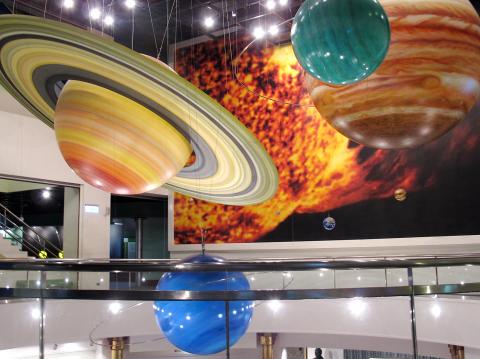
Photo: Hsieh Chia-chun, Taipei Times
The second phase of renovation is scheduled to start next year and wrap up in December 2017, during which the first three floors of the museum will be closed to the public.
Three more exhibits — Discovery of Extraterrestrial Life, Astronomical Research in Taiwan and Children’s Section — are to be added to the current nine permanent ones.
“The museum has never undergone a major renovation since it was opened to the public in 1997. Although we have endeavored to share the latest astronomy news on the museum’s Web site and routinely update the information on its exhibition display boards, we have received many complaints about its outdated facilities,” museum curator Chen An-li (陳岸立) said.
However, the cost of renovating the museum has drawn a mixed response among Taipei City councilors.
Democratic Progressive Party (DPP) Taipei City Councilor Yen Sheng-kuan (顏聖冠) said that compared with the renovation costs for the 50,000m2 Taipei Children’s Recreation Center (NT$2 billion) and the 15,000m2 Taipei Zoo’s Tropical Rainforest House (NT$380 million), it was unreasonable for the science museum to spend NT$580 million on a 4,500m2 area.
“To attract visitors, the museum needs to do more than just upgrade its hardware. It should also enhance its knowledge in astronomy and beef up its promotional efforts,” Yen said.
In response, Chen said the average renovation cost per square meter for science museums overseas was between NT$100,000 and NT$150,000, but the Taipei museum would only be spending about NT$80,000 per square meter.
Chinese Nationalist Party (KMT) Taipei City Councilor Lee Chin-yuan (李慶元) backed the museum, saying it was in desperate need of a makeover if it did not want to continue losing visitors because of its outdated exhibits.
KMT Taipei City Councilor Wang Cheng-de (王正德) said it was good that the museum decided to “make modifications to the suit while wearing it,” referring to how parts of the museum would remain open to the public during the renovation period.

Considering that most countries issue more than five denominations of banknotes, the central bank has decided to redesign all five denominations, the bank said as it prepares for the first major overhaul of the banknotes in more than 24 years. Central bank Governor Yang Chin-lung (楊金龍) is expected to report to the Legislative Yuan today on the bank’s operations and the redesign’s progress. The bank in a report sent to the legislature ahead of today’s meeting said it had commissioned a survey on the public’s preferences. Survey results showed that NT$100 and NT$1,000 banknotes are the most commonly used, while NT$200 and NT$2,000

The Centers for Disease Control (CDC) yesterday reported the first case of a new COVID-19 subvariant — BA.3.2 — in a 10-year-old Singaporean girl who had a fever upon arrival in Taiwan and tested positive for the disease. The girl left Taiwan on March 20 and the case did not have a direct impact on the local community, it said. The WHO added the BA.3.2 strain to its list of Variants Under Monitoring in December last year, but this was the first imported case of the COVID-19 variant in Taiwan, CDC Deputy Director-General Lin Ming-cheng (林明誠) said. The girl arrived in Taiwan on

South Korea is planning to revise its controversial electronic arrival card, a step Taiwanese officials said prompted them to hold off on planned retaliatory measures, a South Korean media report said yesterday. A Yonhap News Agency report said that the South Korean Ministry of Foreign Affairs is planning to remove the “previous departure place” and “next destination” fields from its e-arrival card system. The plan, reached after interagency consultations, is under review and aims to simplify entry procedures and align the electronic form with the paper version, a South Korean ministry official said. The fields — which appeared only on the electronic form

The Ministry of Foreign Affairs (MOFA) is suspending retaliation measures against South Korea that were set to take effect tomorrow, after Seoul said it is updating its e-arrival system, MOFA said today. The measures were to be a new round of retaliation after Taiwan on March 1 changed South Korea's designation on government-issued alien resident certificates held by South Korean nationals to "South Korea” from the "Republic of Korea," the country’s official name. The move came after months of protests to Seoul over its listing of Taiwan as "China (Taiwan)" in dropdown menus on its new online immigration entry system. MOFA last week


 RSS
RSS