


Few of the thousands of devotees who enthusiastically joined the annual procession for the patron deity of Taipei’s Qingshan Temple (青山宮) last year knew that without the hard work of a few members of the Qingshan Association the festival might have been canceled.
On Nov. 19, three days before the start of the four-day-long festival, a fire broke out in the 159-year-old temple in Wanhua District (萬華), damaging its lobby and burning 12 statues of deities.
Thanks to association members who braved the fire to save equipment essential for the procession, it not only went on as planned, but featured a yellow rubber duck.
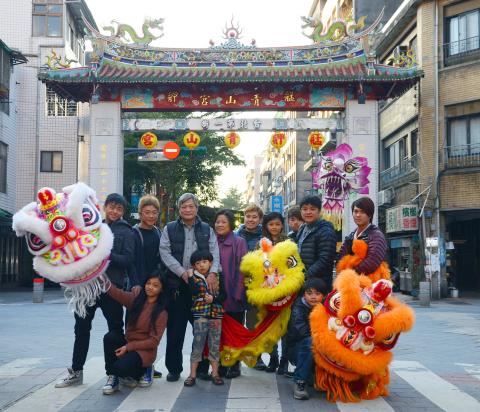
Photo: Chu Hsiao-hai, Taipei Times
The temple, dedicated to the Lord of Green Mountains (青山王) — also known as Ling An Tsun Wang (靈安尊王) — was designated as a grade-three national historic monument in 1985.
“It was heart-wrenching to see the doppelganger statue of Ling An Tsun Wang burned down like that. It was a shared childhood memory for my brother and me,” association chief executive officer Wang Ching-ling (王慶齡) said.
Wang Ching-ling and his elder brother Wang Ching-chung (王慶鐘) are key members of the association, which is officially named the Taipei Qingshan Culture Promotion and Development Association.
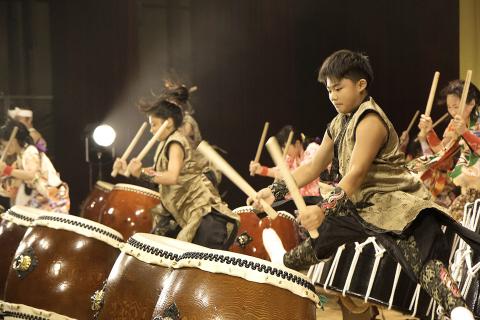
Photo courtesy of the Taipei Qingshan Culture Promotion and Development Association
The group works to ensure the temple’s traditions are passed down to future generations.
The Wang brothers said they learned their lion dancing skills from their grandfather, Wang Tou-chi (王斗吉), who was the temple’s vice chairman when he founded the Qingshan Temple Lion Dance Troupe in 1978.
Wang Tou-chi decided to incorporate a lion dance into the traditional procession after he became friends with the founder of the Liang Kuang Lion Dance Troupe, Lee Hui-hsiu (李輝岫).
Lee, who left China in 1949, had founded his company in 1966.
The Qingshan Temple Lion Dance Troupe attracted scores of youngsters who wanted to master the traditional dance, including the Wang brothers.
“Even when we were little, [grandfather’s efforts to promote lion dancing] made us very proud,” Wang Ching-chung said.
The temple troupe became an indispensable part of many religious festivals, prompting Wang Tou-chi to set up another dance troupe, the Taipei Ching Ho Kuang Lion Dance Troupe, to cope with the increasing number of invitations for them to perform for companies and businesses.
“Because my grandfather had always wanted to pass down his legacy to the next generation, he chose the first word in our first names, ching, as well as ho (和), which means peaceful coexistence, as the name for the new troupe,” Wang Ching-chung said.
The Wang brothers not only became the backbone of the Qingshan Temple Lion Dance Troupe, but also helped bring the Ching Ho troupe to a global audience by leading it on tours of China, Japan, the Philippines and South Korea.
Wang Ching-chung is well-versed in different styles of lion dance, ranging from the “Foshan” (佛山) style, which is said to be the oldest form, to the more contemporary “Hoshan” (鶴山) style.
However, his younger brother is more interested in traditional drumming and has helped transform the style of drum performances at religious parades from one-man shows to group performances.
Wang Ching-ling said he became acquainted with Japanese taiko drummer Ryo Shiobara after Ryo borrowed a few drums from the Ching Ho Kuang for a performance in Taiwan in 2004.
At first, the two men only exchanged opinions on music and on the cultural differences between Japan and Taiwan, but Wang Ching-ling later decided to become an apprentice to Ryo. He wanted to incorporate taiko elements into traditional lion dances.
His efforts led to the Ching Ho Kuang becoming the only overseas troupe to participate in the Japan National Lion Dance Carnival in 2011.
The two brothers’ children are following in their fathers’ footsteps. They were admitted into the elementary school of the National Taiwan College of Performing Arts last year.
The Wang brothers founded the Monga Cultural Committee in 2005 with an aim of turning the annual procession into a larger-scale cultural event.
“Monga” was the former name for Wanhua.
Although a lack of funds forced them to halt the festival shortly afterwards, they were able to start over again in 2011, when they changed the committee’s name to the Qingshan Association.
However, some people — mostly newer residents of Wanhua — have been reluctant to join the religious procession because of their unfamiliarity with the tradition, the Wang brothers said.
“We are hoping that the association can serve as a promotional platform though which we can spread the spirit of the temple culture to schools and communities, and turn the annual event into the most celebrated festival in the area,” they said.
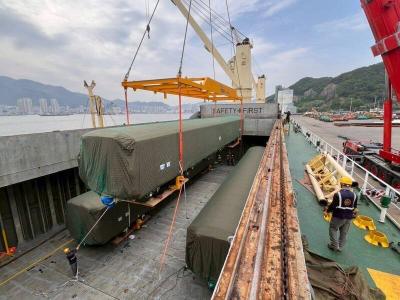
The first of 10 new high-capacity trains purchased from South Korea’s Hyundai Rotem arrived at the Port of Taipei yesterday to meet the demands of an expanding metro network, Taipei Rapid Transit Corp (TRTC) said yesterday. The train completed a three-day, 1,200km voyage from the Port of Masan in South Korea, the company said. Costing NT$590 million (US$18.79 million) each, the new six-carriage trains feature a redesigned interior based on "human-centric" transportation concepts, TRTC said. The design utilizes continuous longitudinal seating to widen the aisles and optimize passenger flow, while also upgrading passenger information displays and driving control systems for a more comfortable
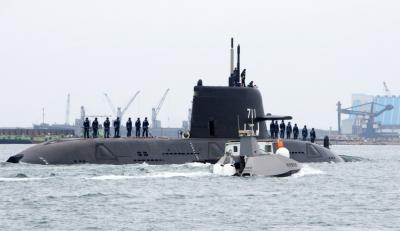
Taiwan's first indigenous defense submarine, the SS-711 Hai Kun (海鯤, or Narwhal), departed for its 13th sea trial at 7am today, marking its seventh submerged test, with delivery to the navy scheduled for July. The outing also marked its first sea deployment since President William Lai (賴清德) boarded the submarine for an inspection on March 19, drawing a crowd of military enthusiasts who gathered to show support. The submarine this morning departed port accompanied by CSBC Corp’s Endeavor Manta (奮進魔鬼魚號) uncrewed surface vessel and a navy M109 assault boat. Amid public interest in key milestones such as torpedo-launching operations and overnight submerged trials,
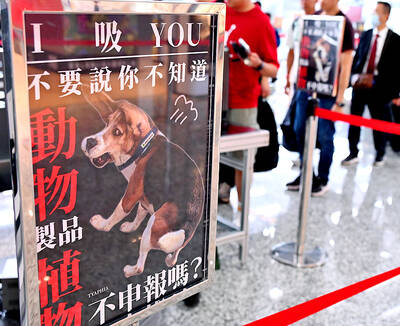
Quarantine awareness posters at Taiwan Taoyuan International Airport have gone viral for their use of wordplay. Issued by the airport branch of the Animal and Plant Health Inspection Agency, the posters feature sniffer dogs making a range of facial expressions, paired with advisory messages built around homophones. “We update the messages for holidays and campaign needs, periodically refreshing materials to attract people’s attention,” quarantine officials said. “The aim is to use the dogs’ appeal to draw focus to quarantine regulations.” A Japanese traveler visiting Taiwan has posted a photo on X of a poster showing a quarantine dog with a
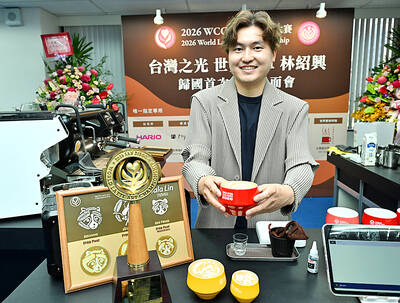
Taiwan’s coffee community has launched a “one-person-one-e-mail” campaign, calling for people to send a protest-e-mail to the World Coffee Championships (WCC) urging it to redesignate Taiwanese competitors as from “Taiwan,” rather than “Chinese Taipei.” The call followed sudden action last week after the WCC changed all references to Taiwanese competitors from “Taiwan” to “Chinese Taipei,” including recent World Latte Art champion Bala (林紹興), who won the World Latte Art Championship in San Diego earlier this month. When Bala received the trophy, he was referred to as representing Taiwan, as well as in the announcement on the WCC’s Web site, until it


 RSS
RSS