

Former minister of transportation and communications Kuo Yao-chi (郭瑤琪), who was sentenced to eight years in prison on corruption charges on Thursday, said yesterday that she would resort to all possible legal proceedings to fight the conviction.
“I have never received bribes... A reputation is not earned in one or two days. I have spent my entire career as a public servant building a good reputation. All my associates know I am not someone who can be bribed,” Kuo told a press conference in Taipei.
Kuo was accused of receiving a bribe of US$20,000 in 2006, when the Democratic Progressive Party (DPP) was in office.
The Supreme Court upheld the conviction handed down by the Taiwan High Court in March, which found Kuo guilty of accepting a bribe related to using her position as transportation minister to grant favors to the Nan Ren Hu Group, a service industry conglomerate, even though she had been found not guilty in first and second trials in 2009 and 2010 respectively.
Kuo and her lawyer, Wellington Koo (顧立雄), both claimed the conviction was flawed because of insufficient evidence and inconsistent testimony from Lee Tsung-hsien (李宗賢), son of Nan Ren Hu chairman Lee Ching-po (李清波). They said they would sue Lee Tsung-hsien for perjury and request a retrial and an extraordinary appeal.
Lee Tsung-hsien testified that he had been asked by his father to deliver the cash, but he gave inconsistent information about the numbers, color and material of the tea gift boxes that contained the US$20,000 and were allegedly delivered to Kuo, at first saying that the cash was placed in two iron tea boxes.
He revoked his deposition after Kuo submitted a red tea box, which prosecutors failed to find in a raid of her house, and subsequently said that there was only one cardboard tea box.
The Ministry of Justice’s Investigation Bureau later canceled Lee Tsung-hsien’s original testimony, Koo said.
“In other words, Kuo’s conviction was upheld with inconsistent testimony and without any substantial evidence because no cash was never found — not in the tea box nor in any of Kuo’s or her family’s bank accounts,” Koo said. “I’m wondering if the judicial system applies a different set of standard for DPP politicians and government officials who served under the DPP administration.”
Huang Di-ying (黃帝穎), a lawyer who supports Kuo, also said there was a political factor to the ruling, citing the case of former Executive Yuan secretary-general Lin Yi-shih (林益世) of the Chinese Nationalist Party (KMT).
Lin was involved in a case with alleged bribes of up to NT$63 million (US$2.1 million), but his corruption charges were dropped despite prosecutors seizing cash and obtaining an audio recording which could have proved his guilt, Huang said.
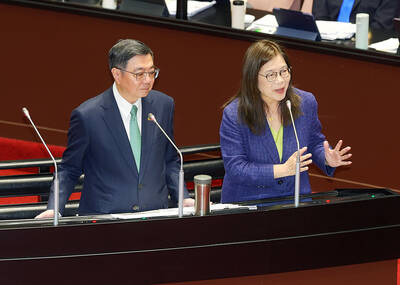
The donation of offshore patrol vessel Kinmen to the Philippines includes provisions that protect Taiwanese fishers and facilitate security cooperation across the First Island Chain, officials said yesterday. The comment was made during the Cabinet’s comprehensive administrative report at the legislature after Chinese Nationalist Party (KMT) Legislator Hsu Yu-chen (許宇甄) expressed concerns about the decision to give a ship to a country whose coast guard had in 2013 fired on a Taiwanese trawler and killed its captain without provocation. The Cabinet should lay out the safeguards that have been established to prevent the Philippine government from using the Kinmen to harass, expel
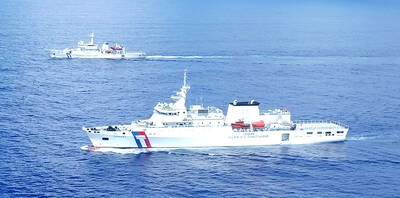
‘FRIENDSHIP FLEET’: A CGA official is scheduled to meet with the president of the Pacific nation, while one of the ships is to host a banquet and National Day event Two Coast Guard Administration (CGA) patrol vessels have docked at Malakal Harbor in Palau as part of an expedition exercise and diplomatic visit, during which a senior official is expected to meet with Palauan President Surangel Whipps Jr, the agency said yesterday. The two vessels, the 4,000-tonne-class Chiayi and the 1,000-tonne-class Penghu, set sail for Palau from Taiwan last week and arrived on Tuesday at Malakal Harbor, the CGA’s Fleet Branch said in a statement. The journey marks the second time the CGA has dispatched a “friendship fleet” to another country, after it sent its first-ever goodwill fleet, comprising the Hualien and
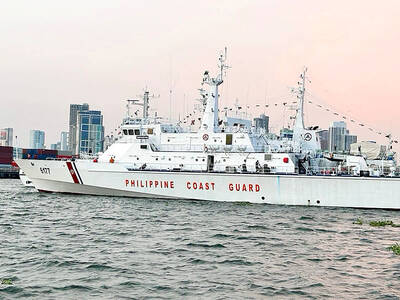
A patrol vessel donated by the Coast Guard Administration (CGA) to the Philippines was commissioned into the Philippine Coast Guard (PCG) on Friday, a Philippine non-governmental organization said. The CGA on Sept. 16 confirmed media reports that Taiwan had donated a retired 500-tonne patrol vessel to the Philippines. The Manila-based We Protect Our Seas (WPS) foundation, which served as an intermediary in the transfer, said that the vessel was formerly the CGA’s 500-tonne petrol vessel Kinmen (CG123). The WPS, in a statement issued on Friday, said the vessel, renamed as the BRP Sarangani, had been commissioned into the PCG the
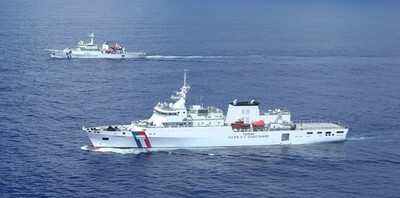
The Coast Guard Administration (CGA) today said that two of its patrol vessels have docked at Palau's Malakal Harbor as part of an expedition exercise and diplomatic visit, during which a senior official is expected to meet with the Palauan president. The two vessels, the 4,000-tonne-class Chiayi (嘉義) and the 1,000-tonne-class Penghu (澎湖), set sail for Palau from Taiwan last week and arrived at Malakal Harbor yesterday, the CGA's Fleet Branch said in a statement. The journey marked the second time the CGA has dispatched a "Friendship Fleet" to another country, after it sent its first-ever goodwill fleet, comprising the Hualien (花蓮)


 RSS
RSS