


While China insisted that it was not involved in the Gambia’s decision to cut diplomatic ties with Taiwan, lawmakers yesterday demanded that the government review President Ma Ying-jeou’s (馬英九) policy of “flexible diplomacy” and take precautions to prevent a domino effect in the wake of the incident.
Gambian President Yahya Jammeh announced on Thursday that diplomatic relations with Taiwan would be severed with immediate effective.
Chinese Ministry of Foreign Affairs spokesman Hong Lei (洪磊) said in response to media queries, said that Beijing was caught unaware by the move and that China was not in contact with the Gambia.
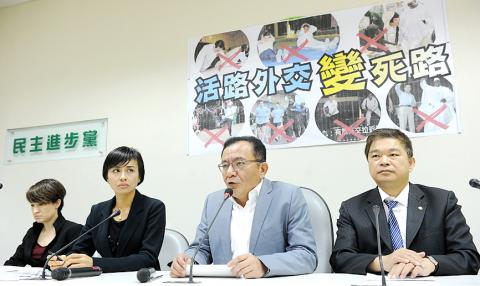
Photo: Liu Hsin-de, Taipei Times
In Taipei, politicians across party lines cast doubt on the effectiveness of Ma’s policy of “flexible diplomacy” that underpinned the nation’s “diplomatic truce” with China.
The Democratic Progressive Party (DPP) issued a three-point statement saying that the incident demonstrated the failure of Ma’s policy of “flexible diplomacy” and that the government must immediately engage in crisis management to prevent a domino effect.
The DPP demanded that the government explain in detail why the Gambia cut the ties and that officials in charge of national security and diplomatic affairs resign.
The party also asked Ma to shift his policy away from managing cross-strait relations as a priority to focusing on foreign policy and issues of international and regional concerns.
Meanwhile, government officials, Presidential Office Secretary-General Timothy Yang (楊進添), Premier Jiang Yi-huah (江宜樺) and Deputy Vice Foreign Minister Simon Ko (柯森耀), all said that the incident could be attributed more to Jammeh’s “personal characteristics” than either China or Ma’s policy.
Jammeh did not give any reason as to why it has also withdrawn from the Commonwealth after 48 years and that the UK was also in the dark, they said.
DPP Legislator Tsai Huang-liang (蔡煌瑯) asked the government to be vigilant about relationships with El Salvador, Honduras, Paraguay and the Dominican Republic, saying that all are in danger.
The government should terminate aid projects, which are being implemented in the Gambia, DPP Legislator Hsueh Ling (薛凌) said.
According to DPP Legislator Liu Chao-Hao (劉櫂豪), the aid projects for the Gambia in next year’s government budget were valued at NT$400 million (US$13.5 million).
Jiang did not take the advice, saying that the government would only end the projects — including in the areas of medicine and construction and agriculture — if it fails to retain relations with the Gambia.
Should the government fail to retain ties, about 200 Gambian students studying in Taiwan under scholarship schemes run by the government will not face immediate deportation to the Gambia, Jiang said.
Chinese Nationalist Party (KMT) Legislator Lin Yu-fang (林郁方), an outspoken supporter of “flexible diplomacy,” said the government has to get to the bottom of the situation of whether China broke the tacit agreement that underpinned the policy of “flexible diplomacy.”

Considering that most countries issue more than five denominations of banknotes, the central bank has decided to redesign all five denominations, the bank said as it prepares for the first major overhaul of the banknotes in more than 24 years. Central bank Governor Yang Chin-lung (楊金龍) is expected to report to the Legislative Yuan today on the bank’s operations and the redesign’s progress. The bank in a report sent to the legislature ahead of today’s meeting said it had commissioned a survey on the public’s preferences. Survey results showed that NT$100 and NT$1,000 banknotes are the most commonly used, while NT$200 and NT$2,000

The Centers for Disease Control (CDC) yesterday reported the first case of a new COVID-19 subvariant — BA.3.2 — in a 10-year-old Singaporean girl who had a fever upon arrival in Taiwan and tested positive for the disease. The girl left Taiwan on March 20 and the case did not have a direct impact on the local community, it said. The WHO added the BA.3.2 strain to its list of Variants Under Monitoring in December last year, but this was the first imported case of the COVID-19 variant in Taiwan, CDC Deputy Director-General Lin Ming-cheng (林明誠) said. The girl arrived in Taiwan on

South Korea is planning to revise its controversial electronic arrival card, a step Taiwanese officials said prompted them to hold off on planned retaliatory measures, a South Korean media report said yesterday. A Yonhap News Agency report said that the South Korean Ministry of Foreign Affairs is planning to remove the “previous departure place” and “next destination” fields from its e-arrival card system. The plan, reached after interagency consultations, is under review and aims to simplify entry procedures and align the electronic form with the paper version, a South Korean ministry official said. The fields — which appeared only on the electronic form

The Ministry of Foreign Affairs (MOFA) is suspending retaliation measures against South Korea that were set to take effect tomorrow, after Seoul said it is updating its e-arrival system, MOFA said today. The measures were to be a new round of retaliation after Taiwan on March 1 changed South Korea's designation on government-issued alien resident certificates held by South Korean nationals to "South Korea” from the "Republic of Korea," the country’s official name. The move came after months of protests to Seoul over its listing of Taiwan as "China (Taiwan)" in dropdown menus on its new online immigration entry system. MOFA last week


 RSS
RSS