


A 23-year-old Taiwanese on a working holiday in Australia received burns to the lower half of his body at a meat-processing factory after he fell in into boiling water on Wednesday, the Ministry of Foreign Affairs said yesterday.
His life is not in danger and the ministry arranged for his parents to arrive in Australia yesterday morning to take care of him, ministry spokesperson Anna Kao (高安) said.
The Chinese-language Apple Daily first reported the story yesterday, saying friends of the man, surnamed Hsiao (蕭), provided it with details of the incident because they were angry at the way the factory and Hsiao’s employment agency treated him.
According to the Apple Daily, Hsiao, who works in the slaughter department of T&R Pastoral, a meat-processing factory in South Australia, was ordered to wash hanging hooks alone in the boiler room at 6pm on Wednesday when he slipped into a bath of boiling water in a 1.8m deep cauldron.
Hsiao was flown by helicopter to a hospital in Adelaide, the capital city of South Australia, 78km from the factory, for emergency treatment as he was severely burned over a large area of the lower half of his body. T&R Pastoral has billed Hsiao A$50,000 (US$47,168) for the transportation cost, Apple Daily reported.
A person with a Chinese-invested employment agency named by Hsiao’s friends as “Little Chou” quickly turned them down when they sought his help and told them that the fee was regarded as out-of-pocket expenses, it reported.
According to the Apple Daily report, most of the young Taiwanese hired by T&R Pastoral were black-market working holidaymakers, defined as those who receive payments in cash rather than through direct deposits into a bank account associated with a tax number as required by the Australian Taxation Office.
There have been cases of Taiwanese working holidaymakers taking black-market jobs even though they know the pay is not as good and they will not be enrolled in an insurance program because the job market in Australia for people on working-holiday visas is very competitive.
According to data compiled by the Australian Department of Immigration and Citizenship, Canberra issued 35,000 working holiday visas to Taiwanese between July last year and June this year, a year-on-year growth of 59 percent, making Taiwan the second-largest source of working holidaymakers in Australia, behind the UK.
In a press release later yesterday, the ministry said that the Taipei Economic and Cultural Office in Australia has encouraged Taiwanese living near the Adelaide hospital to visit Hsiao and that the office will continue to assist him and his family.

STAY AWAY: An official said people should avoid disturbing snakes, as most do not actively attack humans, but would react defensively if threatened Taitung County authorities yesterday urged the public to stay vigilant and avoid disturbing snakes in the wild, following five reported snakebite cases in the county so far this year. Taitung County Fire Department secretary Lin Chien-cheng (林建誠) said two of the cases were in Donghe Township (東河) and involved the Taiwan habus, one person was bit by a Chinese pit viper near the South Link Railway and the remaining two were caused by unidentified snakes. He advised residents near fields to be cautious of snakes hiding in shady indoor areas, especially when entering or leaving their homes at night. In case of a
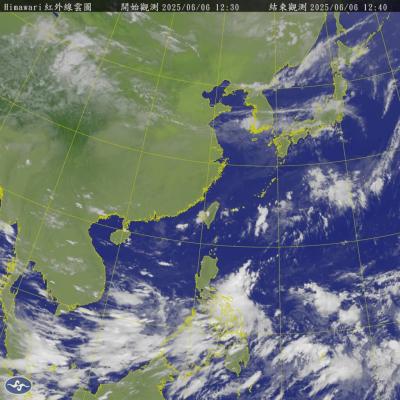
A tropical disturbance off the southeastern coast of the Philippines might become the first typhoon of the western Pacific typhoon season, the Central Weather Administration (CWA) said. The system lacks a visible center and how it would develop is only likely to become clear on Sunday or Monday, the CWA said, adding that it was not yet possible to forecast the potential typhoon's effect on Taiwan. The American Meteorological Society defines a tropical disturbance as a system made up of showers and thunderstorms that lasts for at least 24 hours and does not have closed wind circulation.

ENERGY RESILIENCE: Although Alaska is open for investments, Taiwan is sourcing its gas from the Middle East, and the sea routes carry risks, Ho Cheng-hui said US government officials’ high-profile reception of a Taiwanese representative at the Alaska Sustainable Energy Conference indicated the emergence of an Indo-Pacific energy resilience alliance, an academic said. Presidential Office Secretary-General Pan Men-an (潘孟安) attended the conference in Alaska on Thursday last week at the invitation of the US government. Pan visited oil and gas facilities with senior US officials, including US Secretary of the Interior Doug Burgum, US Secretary of Energy Chris Wright, Alaska Governor Mike Dunleavy and US Senator Daniel Sullivan. Pan attending the conference on behalf of President William Lai (賴清德) shows a significant elevation in diplomatic representation,

Credit departments of farmers’ and fishers’ associations blocked a total of more than NT$180 million (US$6.01 million) from being lost to scams last year, National Police Agency (NPA) data showed. The Agricultural Finance Agency (AFA) said last week that staff of farmers’ and fishers’ associations’ credit departments are required to implement fraud prevention measures when they serve clients at the counter. They would ask clients about personal financial management activities whenever they suspect there might be a fraud situation, and would immediately report the incident to local authorities, which would send police officers to the site to help, it said. NPA data showed


 RSS
RSS