


The National Palace Museum and two Japanese national museums signed agreements in Taipei on Wednesday to lend their collections on a reciprocal basis for exhibitions in each other’s country.
The agreements pave the way for National Palace Museum’s treasures to be exhibited elsewhere in Asia for the first time.
The museum has feared that China would lay claim to the museums’ antiquities when exhibited in countries without anti-seizure laws, making it reluctant to send its pieces outside the country.
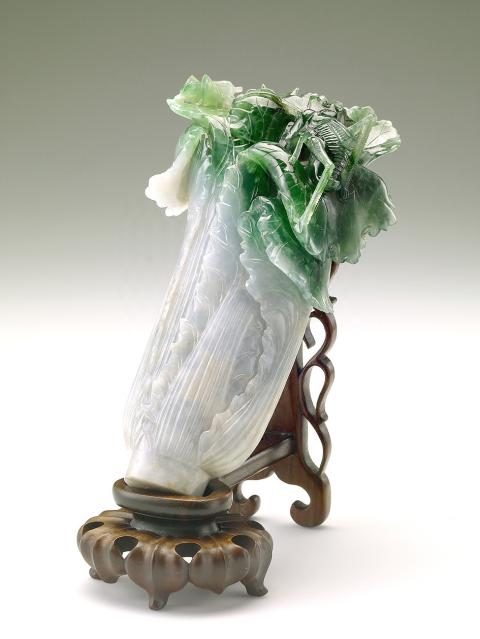
Photo courtesy of the National Palace Museum, Taipei
A total of 231 sets of precious works from the National Palace Museum are to be exhibited at the Tokyo National Museum from June 24 to Sept. 15 next year and at the Kyushu National Museum from Oct. 7 to Nov. 30 next year, the National Palace Museum said.
Among the items to be exhibited are the popular Jadeite Cabbage with Insects (翠玉白菜), which will be on display for two weeks at the Tokyo museum, and the Meat-shaped Stone (肉形石), to be shown for two weeks at the Kyushu museum. It will be the first time either has been exhibited abroad.
The Complete Library of the Four Treasuries, a collection of major literary works produced in China over successive dynasties, and a calligraphy hand-scroll from the Song Dynasty (960-1279) featuring Chinese writer Su Shih’s (蘇軾) poetry will also be loaned, as well as other ancient books, calligraphies, paintings and embroideries, and ceramic, bronze and jade objects.
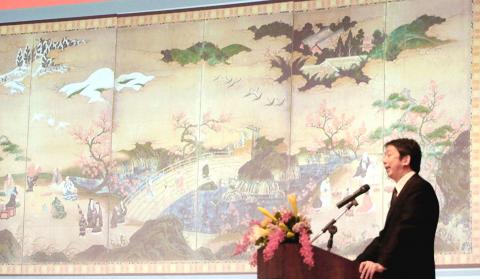
Photo: CNA
In return, the two Japanese museums will provide a total of 150 pieces for a three-month exhibition at the National Palace Museum’s Chiayi County branch starting in October 2016.
Among them are The Great Wave off Kanagawa, which is part of the Thirty-six Views of Mount Fuji, a series of famous woodblock prints by Katsushika Hokusai, and a 12th century painting of Kujaku Myoo, the peacock goddess. The painting is a national treasure of Japan and has never been exhibited overseas.
The agreements were signed by National Palace Museum Director Feng Ming-chu (馮明珠), Tokyo National Museum executive director Masami Zeniya and Kyushu National Museum director Karoku Miwa.
“The three museums have organized the exhibitions in the spirit of reciprocity, and to move and satisfy museum visitors in both countries,” Fung said.
The Tokyo National Museum has hosted more than 100 large exhibitions showcasing collections from various countries over the past 50 years, but it has never been able to organize an exhibition by the National Palace Museum, which holds many exquisite Chinese cultural artifacts, Zeniya said.
He called Japan’s reciprocal exhibition in Taiwan “unprecedented” and expressed the hope that the two sides can deepen ties as a result of the exhibitions.
Japan passed a law in 2011 that renders foreign-loaned cultural objects immune from seizure, allowing Taiwan’s treasures to be exhibited in the country without fear of losing them to China.
Despite boasting one of the world’s largest collections of Chinese artifacts and artworks — reputed to number more than 690,000 items — the National Palace Museum has only made four large overseas loans since it was established in 1965.
They were to the US in 1996, France in 1998, Germany in 2003 and Austria in 2008 — but only after those countries passed laws to prevent seizure of the treasures by Beijing.

FUKUOKA SITUATION: Japanese media reported that the pathogen is expected to be identified by the summer, while the CDC downplayed the idea that it was hMPV A “mysterious cold-like illness” reported in Japan’s Fukuoka Prefecture does not seem to be a new disease, but Japanese authorities have been asked about the situation, the Centers for Disease Control (CDC) said yesterday. The Fukuoka Prefectural Medical Association on Wednesday told a news conference that a “mystery cold” that has become a hot topic on social media is “highly likely to be caused by some kind of viral infection,” Japan’s KBC News reported. “Many people are experiencing symptoms starting with a sore throat, followed by a runny nose, phlegm and a severe cough,” KBC News reported, citing association officials. Health authorities are

Nvidia Corp CEO Jensen Huang (黃仁勳) arrived in Taiwan yesterday ahead of upcoming AI and technology events, saying he plans to meet with clients and Taiwan Semiconductor Manufacturing Co Chairman C.C. Wei (魏哲家) during his visit. After landing at Taipei Songshan Airport, Huang posed for photos with fans and handed out Yakult drinks to reporters and supporters waiting at the scene, saying he has “a lot to do” during the trip. Asked about reports that Nvidia’s planned headquarters site in Taipei’s Beitou Shilin Technology Park could break ground on May 27, Huang said that if the company holds an event, he would

Carrefour Taiwan is to begin using a new name from the start of July, but it cannot divulge the name until then, the chairman of the supermarket chain's parent company said today. President Chain Store Co chairman Lo Chih-hsien (羅智先) was asked by reporters after a shareholders' meeting to confirm whether the company has settled on a new name for the supermarket brand. In March, the government-registered name of two Carrefour Taiwan branches was quietly changed to "Le Chia Kang" (樂家康) in Chinese, raising speculation that has been selected as the name. Lo said that because of local regulations and contractual obligations, the
The Philippines would likely be involved in any conflict over Taiwan due to its proximity to the democracy claimed by China, President Ferdinand Marcos Jr said, reiterating a stance that risks angering Beijing. “In the Philippines, we do not have a choice because Taiwan is so close to the Philippines and we have almost 200,000 Filipino nationals living and working in Taiwan,” Marcos said in an interview with Japanese media in Manila on Monday. The Philippine leader’s comments come ahead of a state visit to Japan next week, where he is to meet with Japanese Prime Minister Sanae Takaichi to discuss security


 RSS
RSS