


The tragic crash of a Sunrise Airlines BK117 helicopter transporting supplies and Central Weather Bureau (CWB) personnel to the bureau’s Yushan Observation Station on Wednesday that killed all three people on board has thrown the spotlight on the hazardous working conditions employees face at the station.
The helicopter crashed 500m east of the Yushan station, which is 3,850m above sea level on the North Peak of Yushan (玉山), also known as Jade Mountain, killing pilot Chang Kuo-kang (張國綱), co-pilot Lin Yi-chi (林益淇) and bureau worker Chen Wen-chung (陳文忠).
“Working at weather stations in mountainous areas necessitates tolerance of the pain of being alone and away from your family for a long time,” CWB Forecast Center director Cheng Ming-dean (鄭明典) said.
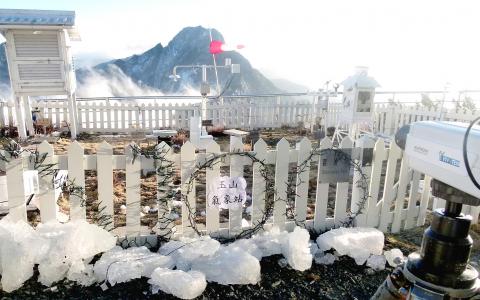
Photo: Hsieh Chieh-yu, Taipei Times
It also requires physical strength and mental stamina, as workers have to stay at the stations for at least two consecutive months during winter, Cheng said, adding that the bureau often gives the head table at year-end banquets to these employees as a gesture of gratitude for the difficult work that they do.
Yushan weather station is the highest-altitude weather observation station in Northeast Asia and the temperature between day and night often varies significantly, station employees said, adding that the temperature averages about 15?C in summer and could drop as low as minus-12?C in winter.
They said they would not have been able to make it through the days when there were not even electricity and water supplies, if they had not trained their minds to “see suffering as taking vitamin supplements.”
Aside from inclement weather, the Yushan station relies on the outside world for daily necessities. Getting supplies to the station used to be a difficult task in the past, when the bureau had to hire Aboriginal workers to carry the supplies to the station from Yushan’s Tataka visitor center at an altitude of 2,600m.
“The route takes experienced hikers at least four hours to complete and amateurs may need twice as much time,” the employees said, adding that although the task is now being carried out by helicopters, it remains challenging.
“What we look forward to most at the station is the arrival of the helicopters, because it means we are getting new supplies and are going home,” they said. “However, the choppers often experience violent shakes as they hit turbulence.”
Adding to their hardship, the bureau’s decision to assign only three staff members to the Yushan station — a meteorological observer and two janitors — has left the facility constantly understaffed.
In addition to working 15 hours a day, from 5am to 8pm, the employees are also in charge of plumbing and electrical repairs and clearing snow. They are allowed to return home only after 15 consecutive days of work.
However, going home is no less painstaking than the job itself, as they have to first trek to the Tataka visitor center before they can drive down the mountain, so if they are feeling unwell or the weather is bad, they may end up spending their days off on the mountain.
Hsieh Hsin-tien (謝新添), who has worked at the station as a meteorological observer for two decades, said when the 921 Earthquake struck the nation in 1999, the tremor caused the mountain to shake so severely that it made a “deafening roar.”
“Since I had nowhere to hide, I figured I might as well organize the seismic data collected at the station and send it to the bureau for analysis,” Hsieh said.
However, the long work hours and high job demands do not translate into a remarkably high salary.
Sources said that Chen, a senior janitor at the station, was paid a monthly salary of about NT$50,000 (US$1,665) along with regional additional pay of NT$14,420, which is no better than what other civil servants working in remote areas receive.
Additional reporting by Tsai Tsung-hsun

Considering that most countries issue more than five denominations of banknotes, the central bank has decided to redesign all five denominations, the bank said as it prepares for the first major overhaul of the banknotes in more than 24 years. Central bank Governor Yang Chin-lung (楊金龍) is expected to report to the Legislative Yuan today on the bank’s operations and the redesign’s progress. The bank in a report sent to the legislature ahead of today’s meeting said it had commissioned a survey on the public’s preferences. Survey results showed that NT$100 and NT$1,000 banknotes are the most commonly used, while NT$200 and NT$2,000

The Centers for Disease Control (CDC) yesterday reported the first case of a new COVID-19 subvariant — BA.3.2 — in a 10-year-old Singaporean girl who had a fever upon arrival in Taiwan and tested positive for the disease. The girl left Taiwan on March 20 and the case did not have a direct impact on the local community, it said. The WHO added the BA.3.2 strain to its list of Variants Under Monitoring in December last year, but this was the first imported case of the COVID-19 variant in Taiwan, CDC Deputy Director-General Lin Ming-cheng (林明誠) said. The girl arrived in Taiwan on

South Korea is planning to revise its controversial electronic arrival card, a step Taiwanese officials said prompted them to hold off on planned retaliatory measures, a South Korean media report said yesterday. A Yonhap News Agency report said that the South Korean Ministry of Foreign Affairs is planning to remove the “previous departure place” and “next destination” fields from its e-arrival card system. The plan, reached after interagency consultations, is under review and aims to simplify entry procedures and align the electronic form with the paper version, a South Korean ministry official said. The fields — which appeared only on the electronic form

The Ministry of Foreign Affairs (MOFA) is suspending retaliation measures against South Korea that were set to take effect tomorrow, after Seoul said it is updating its e-arrival system, MOFA said today. The measures were to be a new round of retaliation after Taiwan on March 1 changed South Korea's designation on government-issued alien resident certificates held by South Korean nationals to "South Korea” from the "Republic of Korea," the country’s official name. The move came after months of protests to Seoul over its listing of Taiwan as "China (Taiwan)" in dropdown menus on its new online immigration entry system. MOFA last week


 RSS
RSS