


A male student at a university in southern Taiwan has taken his school’s gender equality committee to court for infringing on his intellectual property rights by ordering him to hand over a non-frontal nude photograph that he took of his female schoolmate after he posted it on Facebook without her consent.
The male student, surnamed Lee (李), said the girl in the photo was an exchange student at his school who asked him to take clothed and nude pictures of her while they were on a trip to Kenting about six months ago.
The pair got into an altercation in March after Lee posted some of the pictures — including the non-frontal nude one showing the woman standing on a beach — on his Facebook page and tagged her without her permission.
The woman was infuriated after seeing the photographs and demanded that Lee take them off Facebook immediately. However, he agreed only to remove the tags, saying he had the intellectual property rights to the images because he took them.
After several failed attempts to persuade Lee to delete the photos, the woman in April pressed charges against him for damaging her reputation.
Although the images had reportedly already been removed by the networking site’s supervisors due to an anonymous report, the woman still lodged a complaint with the school committee over the matter.
Following a two-month investigation, the committee in June ruled that Lee’s actions had subjected the female student to personal humiliation and emotional distress, and constituted sexual harassment and a violation of her physical autonomy.
The ruling also said that even if Lee had the rights to the photographs, this did not warrant him encroaching on the woman’s personality rights, which protect her from any unauthorized use of her name and image, as well as invasion of privacy.
The committee ordered that Lee be given a demerit, attend an eight-hour gender equality course, hand over the photographs, apologize to the woman and sign an affidavit waiving his ownership rights to the images.
Lee appealed the ruling, but was unsuccessful. He then agreed to an unconditional settlement of the lawsuit filed against him by the woman when the case was being reviewed at the Kaohsiung District Prosecutors’ Office earlier last month.
However, Lee still contends that he had the property rights to the photographs, which he said were not obscene because they showed neither the woman’s face nor her private parts.
“Being the photographer of these images entitles me to publicize them, making the committee’s order that I hand over the pictures and sign an affidavit waiving my property rights to the photographs an infringement of my right to own property,” Lee said.
He also argued that as it dealt with property rights and personality rights, the case should have been handled by the Intellectual Property Court rather than by the committee.
Commenting on the case, prosecutor-turned-lawyer Cheng Yi-chun (鄭伊鈞) said Lee’s conduct might not be considered sexual harassment as he did not have physical contact with or engage in verbal harassment of the woman.
“Nevertheless, agreeing to pose for nude photographs does not implicitly mean consent to their publication has been given. The woman should demand compensation from Lee at a civil court for infringing on her right of publicity,” Cheng said.
Another lawyer, who spoke on condition of anonymity, said that although the nude photos did not show the woman’s face, posting them along with information identifying her encroached on her privacy and personality rights.
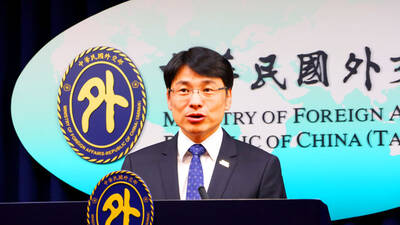
ENDORSING TAIWAN: Honduran presidential candidate Nasry Afura said that Honduras was ‘100 times better off’ when it was allied with Taipei The Ministry of Foreign Affairs yesterday said it would explore the possibility of restoring diplomatic relations with Honduras based on the principle of maintaining national interests and dignity. The ministry made the remarks in response to reporters’ questions regarding an article titled: “Will Taiwan Regain a Diplomatic Ally?” published in The Diplomat on Saturday. The article said Honduras’ presidential election in November could offer Taiwan the chance to regain an ally, as multiple candidates have promoted re-establishing diplomatic relations with Taiwan. Honduras severed diplomatic ties with Taiwan in March 2023 in favor of Beijing, but since switching its diplomatic recognition,
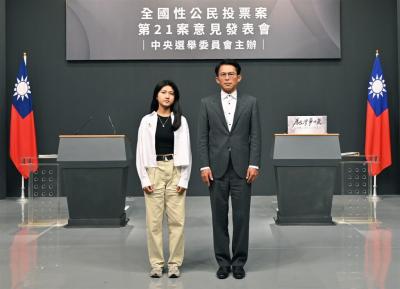
A fourth public debate was held today about restarting the recently decommissioned Ma-anshan Nuclear Power Plant, ahead of a referendum on the controversial issue to be held in less than two weeks. A referendum on Aug. 23 is to ask voters if they agree that “the Ma-anshan Nuclear Power Plant should continue operations upon approval by the competent authority and confirmation that there are no safety concerns.” Anyone over 18 years of age can vote in the referendum. The vote comes just three months after its final reactor shut down, officially making Taiwan nuclear-free. Taiwan People’s Party Chairman Huang Kuo-chang (黃國昌) represented

Scoot announced yesterday that starting in October, it would increase flights between Taipei and Japan’s Narita airport and Hokkaido, and between Singapore and Taipei. The low-cost airline, a subsidiary of Singapore Airlines, also said it would launch flights to Chiang Rai in Thailand, Okinawa and Tokyo’s Haneda airport between December and March next year. Flights between Singapore and Chiang Rai would begin on Jan. 1, with five flights per week operated by an Embraer E190-E2 aircraft, Scoot said. Flights between Singapore and Okinawa would begin on Dec. 15, with three flights per week operated by Airbus A320 aircraft, the airline said. Services between Singapore
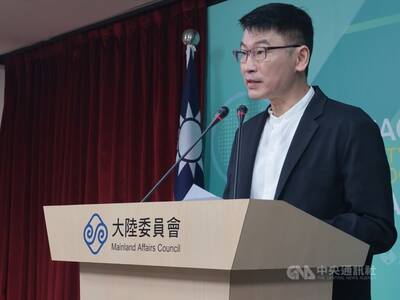
The Mainland Affairs Council (MAC) yesterday announced a ban on all current and former government officials from traveling to China to attend a military parade on Sept. 3, which Beijing is to hold to mark the 80th anniversary of the end of the Second Sino-Japanese War. "This year marks the 80th anniversary of the end of World War II and the Republic of China’s victory in the War of Resistance [Against Japan]," MAC Deputy Minister and spokesperson Liang Wen-chieh (梁文傑) told a regular news briefing in Taipei. To prevent Beijing from using the Sept. 3 military parade and related events for "united


 RSS
RSS