


The Taiwanese contender for the International Olympic Committee’s (IOC) presidency is a frontrunner in the six-man race, according to unfinished online polls.
A survey by sports Web site aroundtherings.com shows that Wu Ching-kuo (吳經國), 66, has garnered 43.76 percent of the votes cast in the popularity rating so far, leading the second-highest hopeful, Ukraine’s Sergey Bubka, 49, by 14.24 percentage points.
The poll, which has no deadline, does not specify total votes.
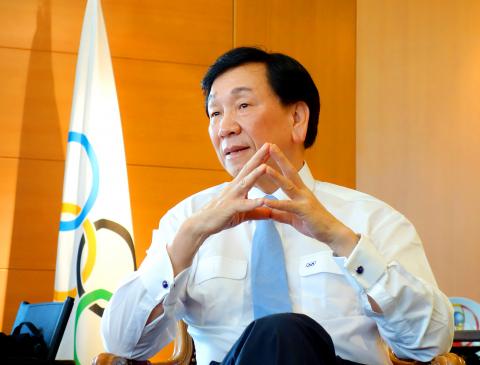
Photo: CNA
Wu’s popularity could be due to his experience in sports circles — he has served for more than 25 years on the IOC and has headed the International Boxing Association for the past seven years.
Rounding out the list are Germany’s Thomas Bach (8.15 percent), Puerto Rico’s Richard Carrion (7.88 percent), Singapore’s Ng Ser-miang (5.99 percent) and Denis Oswald of Switzerland (4.75 percent).
Another survey by Web site insidethegames.biz shows a similar picture, with Wu having garnered 549 votes as of 6pm yesterday, nearly 28 percent of the total 1,992 cast.
Bubka, who won an Olympic gold medal in the pole vault in Seoul in 1988, topped that list with 923 votes, or 46.3 percent, followed by Wu and then 60-year-old Carrion, who had 350 votes, or 17.6 percent.
Oswald, Bach and Ng rounded out the list in that order with fewer than 100 votes each. The poll will close on Friday next week.
Votes can be cast and opinions voiced on the Around the Rings Web site and on the Inside the Games Web site.
An election will be held during an IOC session next month in Buenos Aires to replace Jacques Rogge of Belgium, who finishes his 12 years of service this year.
The session will not only select the new leader of the world’s most influential sports body, but will also decide on the host city for the 2020 Olympic Games, as well as choosing an extra sport to be added to the Olympic program.

Considering that most countries issue more than five denominations of banknotes, the central bank has decided to redesign all five denominations, the bank said as it prepares for the first major overhaul of the banknotes in more than 24 years. Central bank Governor Yang Chin-lung (楊金龍) is expected to report to the Legislative Yuan today on the bank’s operations and the redesign’s progress. The bank in a report sent to the legislature ahead of today’s meeting said it had commissioned a survey on the public’s preferences. Survey results showed that NT$100 and NT$1,000 banknotes are the most commonly used, while NT$200 and NT$2,000

The Centers for Disease Control (CDC) yesterday reported the first case of a new COVID-19 subvariant — BA.3.2 — in a 10-year-old Singaporean girl who had a fever upon arrival in Taiwan and tested positive for the disease. The girl left Taiwan on March 20 and the case did not have a direct impact on the local community, it said. The WHO added the BA.3.2 strain to its list of Variants Under Monitoring in December last year, but this was the first imported case of the COVID-19 variant in Taiwan, CDC Deputy Director-General Lin Ming-cheng (林明誠) said. The girl arrived in Taiwan on

South Korea is planning to revise its controversial electronic arrival card, a step Taiwanese officials said prompted them to hold off on planned retaliatory measures, a South Korean media report said yesterday. A Yonhap News Agency report said that the South Korean Ministry of Foreign Affairs is planning to remove the “previous departure place” and “next destination” fields from its e-arrival card system. The plan, reached after interagency consultations, is under review and aims to simplify entry procedures and align the electronic form with the paper version, a South Korean ministry official said. The fields — which appeared only on the electronic form

The Ministry of Foreign Affairs (MOFA) is suspending retaliation measures against South Korea that were set to take effect tomorrow, after Seoul said it is updating its e-arrival system, MOFA said today. The measures were to be a new round of retaliation after Taiwan on March 1 changed South Korea's designation on government-issued alien resident certificates held by South Korean nationals to "South Korea” from the "Republic of Korea," the country’s official name. The move came after months of protests to Seoul over its listing of Taiwan as "China (Taiwan)" in dropdown menus on its new online immigration entry system. MOFA last week


 RSS
RSS