


With Taiwan oppressed under authoritarian rule in the 1970s, the literary efforts of then-National Taiwan University medical student Lin Heng-zhe (林衡哲) made one of the first cracks in the closed society of the time by introducing the thoughts of Western philosophers to the nation.
However, this impressive breakthrough — and Lin’s subsequent creation of a series of books that have introduced more than 500 Western classics to Taiwanese over the past four decades — was all due to a teenage crush.
While in his first year as a medical student at the university, Lin said he met a student from the Taipei First Girls’ High School at a bookstore and then again at a concert.
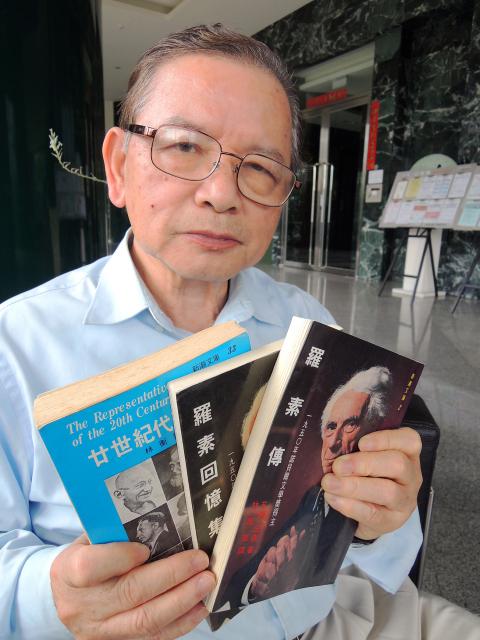
Photo: Hsieh Wen-hua, Taipei Times
“She was beautiful. Dressed in a pure-white gown, she looked like an angel on earth,” Lin said, adding that he was inspired to emulate Dante Alighieri and write something to show her his love.
Dante compiled The New Life, a collection of love poetry written over a period of about 10 years, to pay tribute to Beatrice Portinari, his lifelong love, in 1295.
Lin decided to write a music critique to get his love’s attention because she adored music.
Over four years, Lin wrote more than 70,000 words of musical critiques before he learned that his crush had someone else in her life.
Devastated, Lin said that at first, he thought his romantic rival had to at least be better-looking, but eventually found that the other man was “as short as me,” adding that he “felt she had chosen the wrong man.”
At the time, he was reading the works of Chinese philosopher and essayist Hu Shih (胡適) and had come across a famous epigram by Hu that said: “Instead of misleading students in class, it would be a greater contribution to translate a world classic.”
Lin said he laid aside his personal feelings, quit all his tutoring sessions and dedicated an entire summer to translating Wisdom: Conversations with the Elder Wise Men of Our Day (當代人物智慧訪問錄) by James Nelson. Once finished, he gave the manuscript to Wen Hsing Publishing, which printed it.
Encouraged by his initial success, he then translated Bertrand Russell’s Portraits From Memory And Other Essays and once again approached Wen Hsing to publish it, but the company’s owner, Hsiao Meng-neng (蕭孟能), told Lin it was best to find another publisher because Wen Hsing was being monitored by the then-Chinese Nationalist Party (KMT) regime.
Lin said he eventually managed to persuade Chang Ching-chi (張清吉), the owner of Chih Wen Publishing, to print a series of books titled Modern Library (新潮文庫), under which he published the Russell translation and others.
The series picked up where Lin left off and over the past 40 years has brought works on literature, philosophy, music, cinema and art by intellectual greats such as Freud, Sartre, Tolstoy, Schweitzer, Kierkegaard, Homer, Plato and Maupassant to Taiwanese readers.
Using the money he earned through his translations, Lin left for the US, but has always kept his home in his mind, even after he was blacklisted by the KMT government for publishing books that had been banned in Taiwan in the US.
Lin said that as a child, he had grown up thinking of China as his ancestral home and place of origin, but after reading The Fig Tree (無花果) by Wu Cho-liu (吳濁流), he started to understand Taiwan and the 228 Incident.
The Incident refers to a brutal crackdown by the then-KMT regime that began on Feb. 27, 1947, against tens of thousands of people — many of them members of the intellectual elite — which ushered in the White Terror Era.
“It was then that I began to become conscious of my Taiwanese heritage,” Lin said, adding that this led him to publish books about the Incident in the US, which got him on the government black list.
Lin said that being blacklisted meant he was unable to see his father one last time before he passed away, adding that his father had told him not to risk coming back.
“Seeing your picture is the same as seeing you,” Lin remembered his father telling him.
Lin has also translated many autobiographies and said that of these, the only one that made him cry was that of Yoichi Hatta.
Hatta was a Japanese hydraulic engineer who designed the Chianan Canal (嘉南大圳) and Wushantou Reservoir (烏山頭水庫) in Taiwan during Japanese rule. Lin said he had been very moved by the devotion of Hatta’s wife, who drowned herself in the reservoir after her husband passed away.
Lin said he wished that Oscar-winning Taiwanese director Ang Lee (李安) would make a movie about the Hattas’ story.
Just as he managed to introduce bits of the West into Taiwan, Lin has also sought to bring elements of Taiwanese culture to the US.
To this end, Lin founded the Taiwan Library in southern California, where he holds a Taiwanese Culture night each year to introduce Taiwanese musicians to US citizens, as well as to attendees from other nations.
The 74-year-old Lin smiled when thinking about the impetus that started him off on his path and said that love had always been a great motivator across the ages.
Thinking about the girl he had pined for all those years ago, Lin said she had ultimately been better off marrying a man who was able to give her all his love, since “I can only give half my heart to another because I have already given the other half to preserving and promoting Taiwanese culture.”

Considering that most countries issue more than five denominations of banknotes, the central bank has decided to redesign all five denominations, the bank said as it prepares for the first major overhaul of the banknotes in more than 24 years. Central bank Governor Yang Chin-lung (楊金龍) is expected to report to the Legislative Yuan today on the bank’s operations and the redesign’s progress. The bank in a report sent to the legislature ahead of today’s meeting said it had commissioned a survey on the public’s preferences. Survey results showed that NT$100 and NT$1,000 banknotes are the most commonly used, while NT$200 and NT$2,000

The Centers for Disease Control (CDC) yesterday reported the first case of a new COVID-19 subvariant — BA.3.2 — in a 10-year-old Singaporean girl who had a fever upon arrival in Taiwan and tested positive for the disease. The girl left Taiwan on March 20 and the case did not have a direct impact on the local community, it said. The WHO added the BA.3.2 strain to its list of Variants Under Monitoring in December last year, but this was the first imported case of the COVID-19 variant in Taiwan, CDC Deputy Director-General Lin Ming-cheng (林明誠) said. The girl arrived in Taiwan on

South Korea is planning to revise its controversial electronic arrival card, a step Taiwanese officials said prompted them to hold off on planned retaliatory measures, a South Korean media report said yesterday. A Yonhap News Agency report said that the South Korean Ministry of Foreign Affairs is planning to remove the “previous departure place” and “next destination” fields from its e-arrival card system. The plan, reached after interagency consultations, is under review and aims to simplify entry procedures and align the electronic form with the paper version, a South Korean ministry official said. The fields — which appeared only on the electronic form

The Ministry of Foreign Affairs (MOFA) is suspending retaliation measures against South Korea that were set to take effect tomorrow, after Seoul said it is updating its e-arrival system, MOFA said today. The measures were to be a new round of retaliation after Taiwan on March 1 changed South Korea's designation on government-issued alien resident certificates held by South Korean nationals to "South Korea” from the "Republic of Korea," the country’s official name. The move came after months of protests to Seoul over its listing of Taiwan as "China (Taiwan)" in dropdown menus on its new online immigration entry system. MOFA last week


 RSS
RSS