


Three people were injured in a mountainous region of Greater Taichung on Monday, when a hiking team was attacked by swarms of ferocious hornets. It was the latest in a spate of hornet attacks across the nation.
The hornet assault took place at the Wuwowei Mountain (烏我尾山) hiking trail in the Guguan (谷關) region. Two of the victims suffered serious injuries and received medical treatment at a hospital in Dongshih (東勢), and one was later transferred to a hospital in Greater Tainan.
Stings by Asian giant hornets, the world’s largest hornet species, cause painful localized swelling and can be fatal to some individuals due to allergic reaction to its venom, which contains a type of neurotoxin.
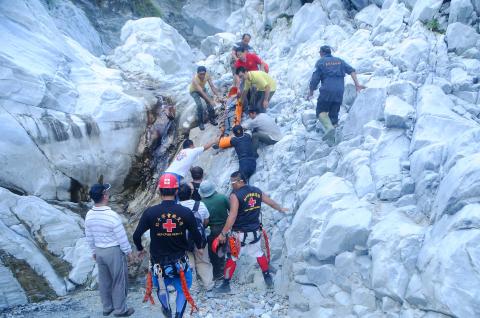
Photo: Yu Tai-lang, Taipei Times
In Taiwan and China, they are called “tiger head bees” (虎頭蜂), due to the bright orange-brown stripes on their heads and bodies.
Amid the surge of hornet attacks in many areas, health authorities are warning people to stay away from hornets’ nests and to wear long sleeves and long trousers when in mountainous areas.
“If you come across hornets, do not agitate them and do not attempt to swat them. One should cover one’s head and hands with clothing and retreat quickly from the area. Seek medical treatment right away for hornet stings,” the warning says.
In Monday’s incident, a woman in her late 40s surnamed Kuo (郭) was stung more than 50 times.
While attempting to run away from the hornets, she fell and suffered a head wound.
Another victim was a man in his 50s surnamed Chu (朱), who was stung about 20 times on his arms.
One member of the hiking group from Greater Tainan said they saw “thick swarms of hornets flying toward us. It was a scary scene, we were all very frightened.”
“The hornets surrounded us and were circling above our heads. Their furious, loud buzzing filled the air. It felt like we were besieged by fleets of aircraft on a bombing raid,” another member said.
“The only thing we could do was run away, and we kept on running,” he added, estimating the swarms comprised several thousand hornets.
After running for some distance, with the aggressive hornets still in pursuit, most of the hikers got down on the ground and covered themselves with jackets and clothing. The group was trapped for nearly three hours, before the hornets gradually retreated, allowing them to return to the trail entrance, where their bus was parked.
On Thursday last week, 65 students and academics from Taipei on a geological field trip in Hualien County were attacked by hornet swarms. The group was examining rocks on a river bed in Taroko National Park when they were attacked.
While running to escape, a teaching assistant surnamed Lee (李) slipped on rocks and broke a leg. He had to be carried out on a stretcher and transported to a hospital in Hualien. Twenty-nine people were stung and treated at the hospital.
On Friday last week, a family of four was attacked by hornets while they were picking vegetables on a riverbank in Yilan County’s Datong Township (大同). The father lost consciousness and went into shock, but doctors at a hospital in Yilan’s Luodong City (羅東) said he had recovered.
Earlier this month, scores of people were injured by hornets in northern Taiwan in three separate incidents over one weekend.
On July 6, 13 people from two families were attacked in a mountainous area of Yilan County, while 12 people were attacked at a mountain park in Taoyuan County. The next day, 13 people were stung in New Taipei City’s (新北市) Neidong Recreation Area.
On June 29, 11 members of a family were attacked by a hornet swarm in Wutai Township (霧台), Pingtung County. Three adults suffered serious injuries.

NATIONAL SECURITY: Authorities are working to confirm the identities of the military personnel involved and investigating possible illegal conduct and regulatory violations Authorities are probing possible national security implications after Kinmen police and immigration officers on Sunday found a Chinese woman allegedly posing as a tourist while engaging in prostitution involving more than 10 military personnel. The woman, surnamed Chen (陳), has since been deported, authorities said, adding that investigators are still working to confirm the identities of those implicated, as the records only listed code names and aliases. The case stemmed from a report received by the Kinmen District Prosecutors’ Office on Friday last week from the Jinhu Precinct of the Kinmen County Police Bureau. On Sunday, police, along with the National Immigration

GLOBALGIVING: ‘ Caving to external pressure is not acceptable for an organization that has cultivated justice reform and human rights for 30 years,’ one NGO said A slew of non-government organizations (NGOs) have withdrawn from the GlobalGiving fundraising platform after it announced it would use “Chinese Taipei” instead of “Taiwan” from next month. The Taiwan Good Rice Association wrote on Facebook on Friday that it was informed on April 28 via a teleconference call of the change, which was made because the platform wanted to operate in China. Taiwan Good Rice is to terminate all cooperative relationships with GlobalGiving in response to the platform’s “unilateral and non-negotiable” decision to remove references to Taiwan, the NGO said. “Taiwan is in the official name of Taiwan Good Rice Association and the

HEAVY WEATHER: Typhoon Jangmi is due to crash straight into the Ryukyus as airlines look to shift flights to larger aircraft or cancel flights to Okinawa entirely Taiwan’s international air carriers announced flight adjustments over the weekend as Typhoon Jangmi is forecast to hit the Ryukyu Islands today and tomorrow. The Central Weather Administration (CWA) upgraded Jangmi from a tropical storm to a typhoon at 8am yesterday, with the eye located 580km south of Naha city. It was moving north at 19kph. Today, China Airlines’ CI-120, CI-121, CI-122 and CI-123 flights between Taoyuan and Naha, Okinawa, have been canceled as well as CI-132 and CI-133 between Kaohsiung and Naha. EVA Air’s BR-112, BR-113, BR-186 and BR-185 flights between Taoyuan and Naha are also canceled. Low-cost carrier Tigerair Taiwan canceled IT-230,

Chinese Nationalist Party (KMT) Chairwoman Cheng Li-wun (鄭麗文) yesterday briefed her party’s Central Standing Committee regarding her scheduled visit to the US between Monday next week and June 16, saying that her purpose would be to persuade the US that the Republic of China (ROC) Constitution was a “one China” constitution that would foster stable and peaceful cross-strait relations. The ROC Constitution is the most important defense for all Taiwanese citizens, as it upholds our democracy and has contributed to our robust economy, which aligns with international and US interests, she said. “We would not be troublemakers and drag the US under,”


 RSS
RSS