


If Taiwan were to declare independence and enact a new constitution, the People’s Republic of China (PRC) would have a share of responsibility for the outcome, because of its refusal to recognize the existence of the Republic of China (ROC), former premier Frank Hsieh (謝長廷) said yesterday.
Hsieh, who has been advocating a cross-strait approach based on the ROC Constitution, elaborated on what he called the “two constitutions, different interpretations (憲法各表)” formula in a speech on the role of the Constitution in the nation’s democratization at a forum.
Hsieh said Taiwan and China are like two connected wheels, while the ROC Constitution is where a gear tooth can engage a tooth on the other gear so the two wheels can rotate smoothly.
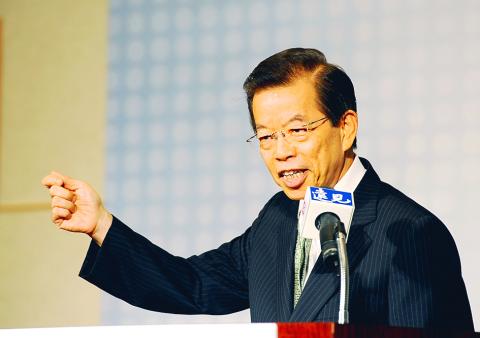
Photo: Lo Pei-der, Taipei Times
Hsieh said he has a different view from people who are calling for a new constitution, either because they feel no connection with the current constitution because it represents China, or because they see it as unfit for Taiwan and hampering its normalization as a nation.
However, “ideals can only be realized under the situation we are in because we do not live in a vacuum,” Hsieh said.
The 2005 constitutional amendment, which set an extremely high threshold for constitutional revisions — approval from three-quarters of lawmakers and at least 50 percent of the whole electorate — has made it nearly impossible to pass any other amendment to the Constitution, he said.
Hsieh said the ROC Constitution “has inherent flaws,” but it serves as a common basis for a consensus to be reached within a politically divided society.
The ROC Constitution is the only common ground shared by the ruling and opposition parties in Taiwan to formulate policies toward China that are acceptable to all the parties and thus to maintain peace and stability in cross-strait relations, he said.
Although the “two constitutions, different interpretations” — a revision from his previous initiative called “a constitutional one China (憲法一中)” — has drawn some criticism from fellow Democratic Progressive Party (DPP) members, Hsieh said the DPP should accept the ROC Constitution.
Office holders in the previous DPP administration all took an oath to observe the Constitution, while DPP lawmakers have sought interpretations from the Council of Grand Justices on various issues based on the Constitution, he said.
“How can you seek a constitutional interpretation if you do not recognize the Constitution?” he asked.
“It’s okay for an ordinary individual not to consider the Constitution valid, but not for politicians who have taken a constitutional oath,” Hsieh said.
Hsieh said he replaced his “constitutional one China” initiative after Beijing took the term “one China” to signify that he agrees that there is “one China.”
Beijing has done the same thing with the Chinese Nationalist Party’s (KMT) “one China with different interpretations (一中各表)” initiative, taking it to mean that the “one China” principle is acceptable to both Taiwan and China, he said.
Hsieh added that China has found the “two constitutions, different interpretations” formula, which was first proposed when he met with then-Taiwan Affairs Office Minister Wang Yi (王毅) in Beijing in October last year, “tolerable.”
If Beijing could not stand it, “I would not have been able to visit China again,” he said, referring to his trip to Hong Kong for a forum on cross-strait relations last month, followed by a visit to Shenzhen.

LOUD AND PROUD Taiwan might have taken a drubbing against Australia and Japan, but you might not know it from the enthusiasm and numbers of the fans Taiwan might not be expected to win the World Baseball Classic (WBC) but their fans are making their presence felt in Tokyo, with tens of thousands decked out in the team’s blue, blowing horns and singing songs. Taiwanese fans have packed out the Tokyo Dome for all three of their games so far and even threatened to drown out home team supporters when their team played Japan on Friday. They blew trumpets, chanted for their favorite players and had their own cheerleading squad who dance on a stage during the game. The team struggled to match that exuberance on the field, with

UPDATED TEST: The new rules aim to assess drivers’ awareness of risky behaviors and how they respond under certain circumstances, the Highway Bureau said Driver’s license applicants who fail to yield to pedestrians at intersections or to check blind spots, or omit pointing-and-calling procedures would fail the driving test, the Highway Bureau said yesterday. The change is set to be implemented at the end of the month, and is part of the bureau’s reform of the driving portion of the test, which has been criticized for failing to assess whether drivers can operate vehicles safely. Sedan drivers would be tested regarding yielding to pedestrians and turning their heads to check blind spots, while drivers of large vehicles would be tested on their familiarity with pointing-and-calling

A Taiwanese man apologized on Friday after saying in a social media post that he worked with Australia to provide scouting reports on Taiwan’s team, enabling Australia’s victory in this year’s World Baseball Classic (WBC), saying it was a joke and that he did not hold any position with foreign teams or Taiwan’s sports training center. Chen Po-hao (陳柏豪) drew the rage of many Taiwan baseball fans when he posted online on Thursday night, claiming credit for Australia’s 3-0 win over Taiwan in the opening game for Pool C, saying he worked as a physical therapist with the national team and
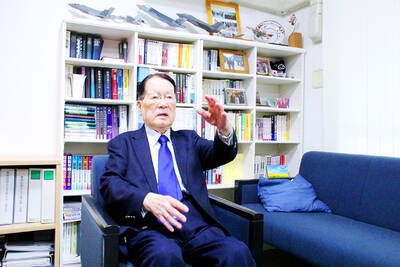
Whether Japan would help defend Taiwan in case of a cross-strait conflict would depend on the US and the extent to which Japan would be allowed to act under the US-Japan Security Treaty, former Japanese minister of defense Satoshi Morimoto said. As China has not given up on the idea of invading Taiwan by force, to what extent Japan could support US military action would hinge on Washington’s intention and its negotiation with Tokyo, Morimoto said in an interview with the Liberty Times (sister paper of the Taipei Times) yesterday. There has to be sufficient mutual recognition of how Japan could provide


 RSS
RSS